
Expanded Metal Mesh for Filtration and Industrial Applications
Expanded metal mesh is made by slitting and stretching sheet metal into an interconnected open pattern. Conventional slit-and-stretch expansion forms the openings without punching out separate blanks. Its strands and bonds form a continuous structure that allows fluids, air and light to pass through while providing support or protection.
Filtalloy manufactures expanded metal mesh in carbon steel, galvanized steel, stainless steel, aluminum and other metals. We supply raised and flattened mesh as rolls, finished sheets and custom components for filtration, filter support structures, architectural panels and industrial equipment.
Expanded Metal Construction and Mesh Forms
- Continuous strands and bonds provide a one-piece support structure.
- Material, pitch, strand width and thickness can be selected to suit the component.
- Open patterns provide flow paths through filter support layers and protective covers.
- Mesh can be cut, formed and welded into cylindrical supports, panels and other components.
- Raised and flattened surfaces offer different profiles for integration and handling.
- Rolls and finished sheets are available, with custom dimensions and surface finishes.
- Expanded metal can be an economical alternative to perforated metal where its pattern and component design meet the application requirements.
Raised / standard expanded metal: strands and bonds retain their formed profile. The overall mesh thickness differs from the local strand thickness.
Flattened expanded metal: the expanded mesh is passed through flattening rolls to give a flatter surface and lower overall profile.
Diamond, square, round and hexagonal opening patterns are available according to the required design and manufacturing method. Mesh form and opening pattern are specified separately.
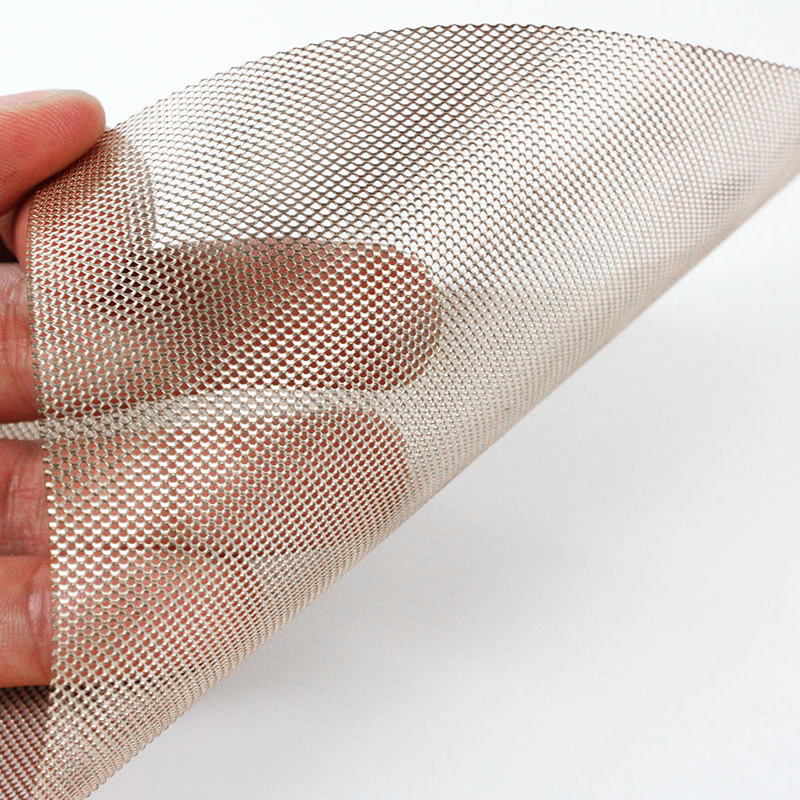
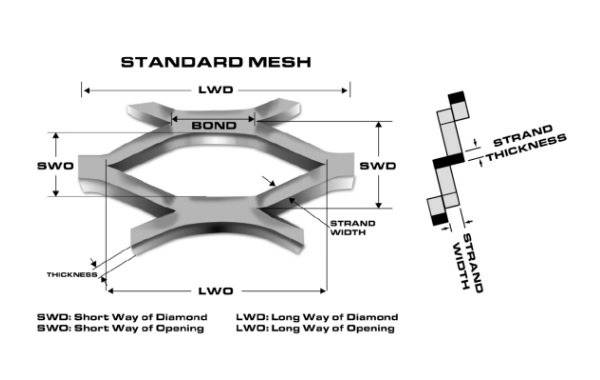
MEM-1: Standard / Raised Expanded Metal Mesh
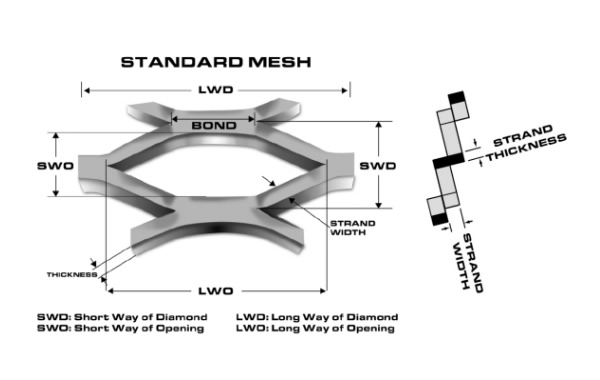
MEM-2: Flattened Expanded Metal Mesh
Expanded Metal Mesh Materials and Specifications
Common supply ranges are listed below. Thickness refers to the original sheet before expansion. The ranges are selected in combination; their minimum and maximum values cannot be combined arbitrarily.
| Material | Sheet thickness | Common maximum finished width |
|---|---|---|
| Carbon steel / galvanized steel | 0.4–8.0 mm | Up to 2000 mm for suitable roll specifications |
| Stainless steel 304 / 316 | 0.5–6.0 mm | 1500 mm; selected thick-sheet, large-pattern products up to 1800 mm, mainly as sheets |
| Aluminum alloy | 0.4–5.0 mm | 1800 mm |
For thin carbon-steel filter support mesh with 0.4–1.5 mm original sheet thickness, the established production width is up to 1500 mm. Final width and delivery form depend on the material, pattern and thickness.
Other available materials include stainless steel 310 and 430, titanium, nickel, brass and copper. Their thickness and dimensional options are confirmed for each specification.
| Parameter | Common range / size | Selection notes |
|---|---|---|
| SWD — short-way pitch | 2–60 mm | Filter supports: commonly 2–10 mm; platform / walkway patterns: commonly 10–60 mm |
| LWD — long-way pitch | 4–120 mm | Many of our regular diamond patterns use approximately 2:1 LWD-to-SWD proportions; other proportions can be customized |
| Strand width | 0.8–12 mm | Support mesh / light guards: commonly 0.8–3 mm; platform / heavier structural patterns: commonly 3–12 mm |
| Finished sheet sizes | 1000 × 2000 mm; 1220 × 2440 mm | These are finished mesh dimensions; other sizes can be customized |
| Roll length | 30 m standard; 10, 20 or 50 m options | Other lengths, short rolls and cut lengths are available by order; suitability for roll delivery depends on the mesh specification |
Pitch versus clear opening: SWD and LWD describe the short- and long-way pattern pitch, measured between corresponding bond centers. SWO and LWO describe the clear opening dimensions. Specify the measurement convention on your drawing.
Three thickness measurements: original sheet thickness, local finished strand thickness and overall mesh thickness are distinct specification terms. Forming and flattening can affect the finished dimensions; confirm the required measurement and tolerance for the selected mesh.
Open area: expressed as a percentage and confirmed for the selected pattern and strand dimensions. Pattern pitch alone does not establish clear opening, open area or filtration performance.
Cutting, Forming and Surface Treatments
We supply rolls, flat sheets, cut-to-size pieces and formed components. Services include punching, laser cutting, forming and welding for filter supports and other specified parts.
Available finishes include pre-galvanized steel, hot-dip galvanized steel, PVC / powder coating, epoxy coating, PTFE spray coating and anodizing for aluminum. Finishes are selected for the material and application. Silver, black, white and custom colors are available as applicable to the chosen finish.
Coating can change the final clear opening and component dimensions. Specify the required finished dimensions and any surfaces that must remain uncoated.
Expanded Metal Mesh Applications
Choose the material and mesh geometry according to the environment, required support, clear opening, flow conditions and component design. Our expanded metal mesh serves the following applications:
- Filtration and fluid handling: air and liquid filter support layers, strainers and protective components.
- Filter element support structures: formed support cylinders, cages, filter housings and protective covers.
- Architecture and façades: cladding, curtain-wall panels, screens and decorative infill.
- Civil engineering: mesh panels and fabricated components for project-specific structures.
- Industrial safety and machinery: equipment guards, protective enclosures, barriers, speaker grilles and internal appliance separators.
- Energy, petrochemicals, power plants and offshore equipment: filter supports, guards and specified access-platform components.
- Transportation and automotive: filter support and equipment protection components.
- Mining, aggregates and recycling: screens, protective panels and handling-equipment components.
- Agriculture: screens, guards and agricultural equipment components.
Other component applications include metal shielding and radiant panels. Specialized flame-arrestor components require application-specific testing and validation.
Walkway and load-bearing designs require confirmation of span, supports, load and installation details. Corrosive service requires material and finish selection for the actual medium. Pressure drop and filtration efficiency depend on the complete filter design and operating conditions.
Inspection and Material Certificates
- Material grade verification.
- Pattern pitch, strand width and thickness, and clear opening checks.
- Finished sheet / roll dimensions and cutting tolerances.
- Mesh defects: broken strands, cracks, irregular openings and deformation.
- Appearance: oxidation, oil contamination, burrs and the specified surface finish.
Mill test certificates (MTCs) and spectrometric composition testing are available. Customer-specified third-party testing, including SGS, can be arranged on request; cost and lead time are agreed separately. Pressure-drop and filtration-efficiency tests are carried out according to order requirements.
Expanded Metal Mesh FAQ
What is the difference between raised and flattened expanded metal?
Raised mesh retains the formed strand-and-bond profile. Flattened mesh is rolled after expansion to produce a flatter surface and lower overall profile. Specify the required form and finished thickness for your component.
Are SWD and LWD the same as clear opening dimensions?
No. SWD and LWD describe pattern pitch; SWO and LWO describe the clear openings. Provide either pair with its measurement convention, together with strand width and thickness, or send a dimensioned drawing.
What expanded metal materials and thicknesses do you supply?
Common original sheet thickness ranges are 0.4–8.0 mm for carbon or galvanized steel, 0.5–6.0 mm for stainless steel 304 / 316, and 0.4–5.0 mm for aluminum alloy. Other available metals include stainless steel 310 / 430, titanium, nickel, brass and copper, with dimensions confirmed by specification.
Can expanded metal mesh be supplied in custom sheets, rolls and formed parts?
Yes. Common finished sheet sizes are 1000 × 2000 mm and 1220 × 2440 mm. The usual roll length is 30 m, with 10, 20 and 50 m options. Other sizes and lengths, cut pieces and fabricated components are available subject to the material and mesh configuration.
Can expanded metal be used as a filter support or walkway?
It can be specified for filter support structures and selected platform or walkway designs. Filter supports require review of the filter assembly and flow conditions; walkway designs require confirmation of load, span, supports and installation. Mesh pitch is not a guaranteed filtration rating.
What inspection and material documents are available?
Routine checks cover material grade, pattern pitch, strand dimensions, clear opening, finished size and cutting tolerances, defects and appearance. MTCs and spectrometric composition testing are available. Third-party testing can be arranged on request, with cost and lead time agreed separately. Pressure-drop and filtration-efficiency tests are specified by order.
Discuss Your Expanded Metal Requirements
Custom project: share the application, medium, temperature, flow conditions and required support or protection so we can discuss the material and mesh configuration.
Manufacture to drawing: provide the material grade, original sheet thickness, SWD × LWD or SWO × LWO, strand width, raised or flattened form, pattern direction, finished dimensions, tolerances, surface treatment and quantity. For formed parts, include seams, interfaces and assembly details.
Existing sample: provide a sample or clear photographs and known dimensions for specification review.
Tell us whether you need rolls, finished sheets, cut pieces or fabricated components, together with any inspection and certificate requirements.
Related Products
Products
Discuss Your Project
Share your drawing, dimensions and application requirements with our team.