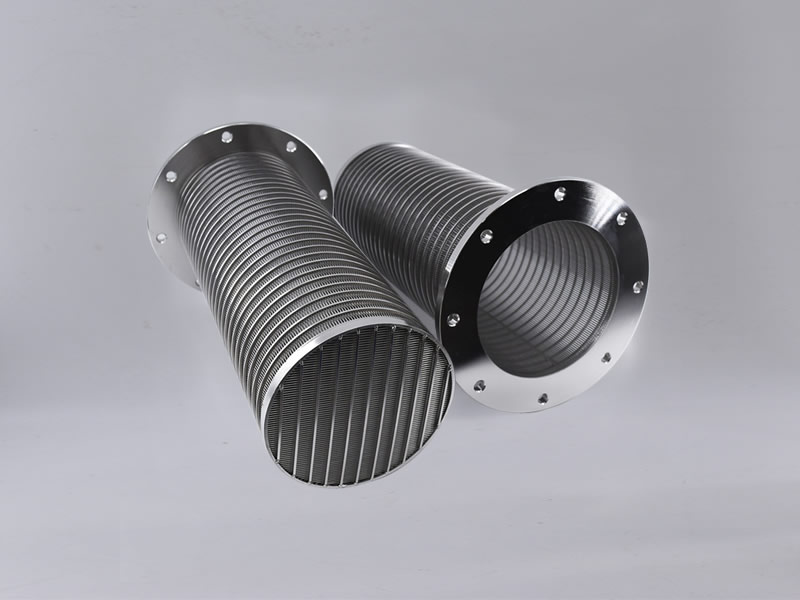
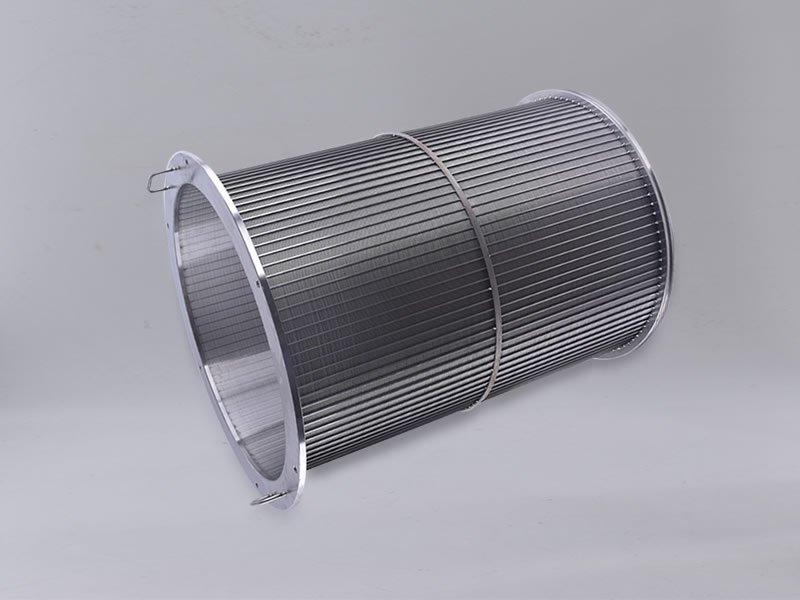
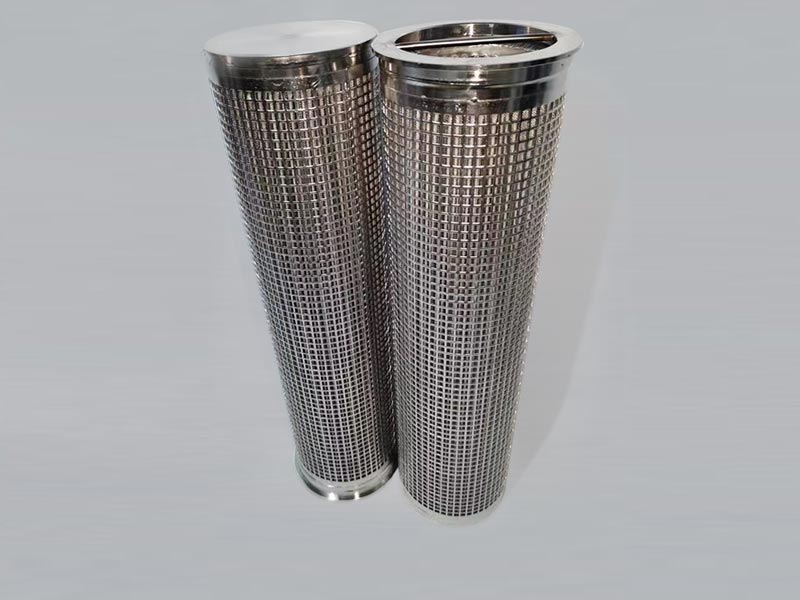
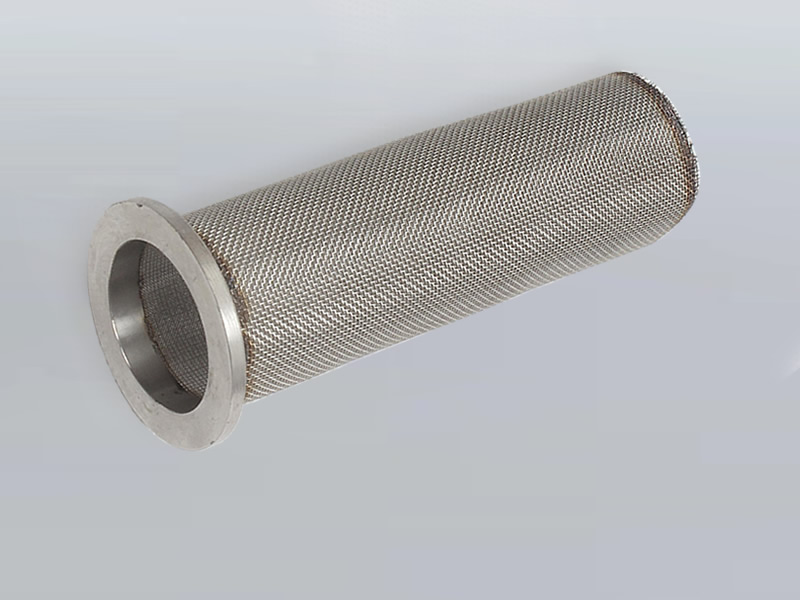
Wedge wire screens, also called profile wire or slotted wire screens, use V-shaped surface wires welded to support rods for filtration, solid–liquid separation and media retention. Filtalloy manufactures stainless steel and special-alloy screens in flat, curved, cylindrical and custom shapes.
Screen geometry, slot opening, material and support arrangement are selected for the application. Polyurethane screening panels are also available for dewatering and sizing, with a separate slot range from metal wedge wire.
Metal Wedge Wire Screen Slot Openings
Minimum manufacturable slot opening: 20 μm (0.02 mm) for metal V-profile wire screens, subject to the selected construction.
Common metal screen slot range: 0.05–3 mm. Coarse screening and wastewater bar screens can use openings above 5 mm, depending on the design.
Slot opening is not an absolute filtration rating. A 20 μm opening does not establish 100% retention of 20 μm particles or an ISO 16889 beta ratio.
Slots widen from the working screen surface toward the back, helping reduce particle wedging. Surface-wire orientation must match the required flow direction.
Open area, flow resistance and clogging behaviour depend on slot size, wire profile, supports, fluid properties and solids loading.
Polyurethane Screening Panels
Polyurethane panels are supplied for dewatering and screening, with common slot openings of 0.25–3 mm. The 20 μm minimum quoted for metal wedge wire does not apply to polyurethane panels.
Stainless Steel and Special-Alloy Materials
Available materials include 304, 304L, 316, 316L, 321 and 904L stainless steel; duplex 2205 (S32205) and super duplex 2507 (S32750); Hastelloy alloys such as C-276; Monel 400 and K500; titanium Grade 2; bronze and copper–nickel alloys. Select the material for the actual medium, temperature, corrosion and wear conditions.
Custom Geometry, Flow Direction and Supports
Inside-to-outside and outside-to-inside flow designs are available. Surface-wire and support-rod orientation, profile selection and rod spacing are determined by the drawing and service conditions. Round, semicircular, sector-shaped, flat and curved screens can be manufactured to requirements.
Options include reinforcing rings, flanges, threaded ends, plain ends, coupling connections and split assemblies with bolted joints. Self-supporting constructions are available; additional reinforcement and support spacing are engineered for higher differential pressure, external pressure or mechanical load. Pressure capacity is confirmed for each structure and application rather than quoted as one universal rating.
Wedge Wire Profiles and Support Rod Specifications
Specification of Support Rod
Item
Width
Height
mm
mm
S22
2
2.28
S25
2
3
S35
3
5
S53
5
3
D45
3.8
5.6
D56
5
6.5
10×3
3
10
11×5
5
11
15×3
3
15
25×3
3
25
50×3
3
50
Specification of V Wire Profiles
Type
Item
Width
Height
Angle
mm
mm
°
Round
R0.8
0.8
0.8
Round
R1
1
1
Round
R2
2
2
V
4V
0.45
1.2
6
V
5V
0.5
1.25
6
V
6V
0.6
1.2
13
V
10V
0.75
1.425
10
V
11V
0.75
1.8
8
V
12V
1
2
10
V
12VL
1
2
-
V
15V
1.2
2.5
10
V
18V
1.5
2.5
12.5
V
18VP
1.5
2.8
13
V
22V
1.8
3.7
10
V
28V
2.2
4.5
10
V
28VP
2.2
4.7
10
V
28VT
2.28
3.55
13
V
34V
2.8
5.5
10
V
42V
3.4
6.8
10
V
50V
3.4
7.5
10
V
50VP
3.4
7.5
12
V
58V
5
6
20
VWF-1 Lauter tun screens for brewing, with optional fixing holes.
VWF-2 Coarse bar screen for wastewater screening.
VWF-3 Polyurethane panel for dewatering and screening; shown with 1.0 mm slots.
VWF-4 Sieve bend screen for pulp, coal and mineral processing.
VWF-5 Centrifuge baskets for dewatering coal, fertilizer, salt and chemical products.
VWF-6 Special-alloy wedge wire screens for seawater filtration.
VWF-7 Split screw press screen for sludge and process dewatering.
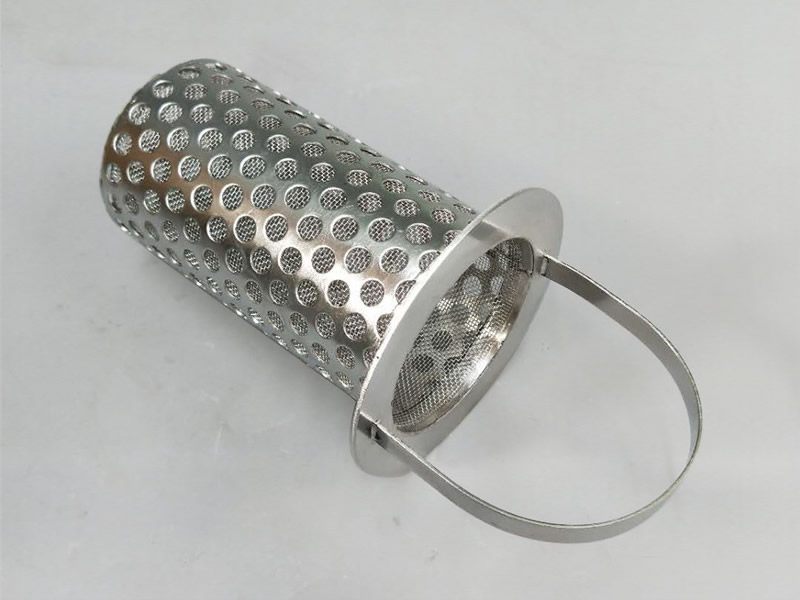
VWF-8 Wedge wire basket for use in a compatible self-cleaning filter assembly.
VWF-9 Wedge wire element for a compatible automatic cleaning strainer.
VWF-10 Stainless steel screw press screen for manure dewatering.
VWF-11 Resin trap screens for ion exchange systems.
VWF-12 Header lateral distributor for sand, carbon and ion exchange media.
VWF-13 Stainless steel wedge wire filter nozzle for water treatment.
VWF-14 Stainless steel well screens; load capacity is confirmed for the project.
VWF-15 Wedge wire screen elements with 250 μm (0.25 mm) slots.
Cleaning Wedge Wire Screens
Depending on the assembly, cleaning options include reverse-flow backwashing, water jet cleaning, compressed-air reverse cleaning and gentle brushing. Set water or air pressure to avoid damage to the surface wires, welds and supports. Avoid scraping the screening face with a hard steel-wire brush.
Automatic cleaning requires a compatible filter housing and cleaning mechanism. A screen element alone does not provide automatic cleaning. Confirm cleaning-fluid and method compatibility separately for polyurethane panels. Isolate and depressurize equipment before removing a screen.
Manufacturing Inspection
Slot-opening spot checks with suitable gauges, including feeler or plug gauges where applicable.
Surface-wire and support-rod profile dimensions and angles.
Overall diameters, length and flange-hole spacing.
Roundness and straightness of cylindrical screens.
Resistance-weld quality, including checks for missed, incomplete or detached welds.
Material-grade verification against mill certificates covering chemical composition and mechanical properties.
Tolerances and inspection methods are agreed in the drawing or order for the selected slot range, profile and structure. Metal-screen inspection requirements are not automatically applied to polyurethane panels.
Wedge Wire Screen FAQ
What is a wedge wire screen?
It is a slotted screen made by welding profiled surface wires to support rods. It can be formed into panels, cylinders, baskets and other custom geometries.
Does a 20 μm slot mean an absolute 20 μm filter rating?
No. Slot opening is a geometric specification. Particle retention depends on particle shape, orientation and service conditions; it does not establish a beta-ratio rating.
Can the same minimum slot be supplied in polyurethane?
No. Our common polyurethane panel slot range is 0.25–3 mm. The 20 μm minimum applies to selected metal V-profile wire constructions.
Can you supply either flow direction?
Yes. We configure the screen surface and supports for inside-to-outside or outside-to-inside flow and the intended cleaning direction.
How is pressure capacity specified?
It is checked for the individual geometry, material, wire and support arrangement, reinforcement and loads. Please provide differential pressure, external pressure, temperature and the drawing.
Is the screen self-cleaning?
A compatible system can backwash or mechanically clean the screen. Automatic cleaning depends on the equipment and cleaning mechanism.
Discuss Your Wedge Wire Screen Requirements
Custom development
Provide the medium, solids or retained media, required slot opening, flow, temperature, differential pressure, external pressure or mechanical loads, flow direction and installation space.
Made to drawing
Send drawings with screen shape, diameters, length, slot tolerances, wire profiles, support spacing, connections, materials and inspection requirements.
Made from a sample
Send an existing screen for dimensional and structural assessment when drawings are unavailable. Include application details and photos of the mating equipment.