
Custom Perforated Tubes for Filter Support and Protection
Filtalloy manufactures custom perforated metal tubes and pipes primarily as inner or outer support and protective structures for finer filtration media. They can support woven mesh, sintered mesh, sintered metal fiber felt or a suitably designed membrane assembly. A bare perforated tube can also serve as a coarse screen or pipeline strainer; its holes do not establish a fine filtration rating.
We perforate or cut the flat sheet first, then roll and weld it into the required shape. Straight-seam and spiral-welded constructions are both available. Material, wall thickness, openings, seam design and reinforcement are selected for the finished structure and duty.
Straight-seam and spiral-welded perforated tubes
Both manufacturing routes are available to the agreed drawing. Neither seam type carries a universal pressure or strength rating.

PEFT-1: Perforated tubes – straight seam welded

PEFT-2: Perforated tube — spiral welded
Support construction and operating limits
- Inner support cores and outer protective sleeves for finer filter media.
- Hole shape, pitch and arrangement selected for flow paths and support needs.
- Woven mesh, sintered mesh and sintered metal fiber felt combinations available.
- Custom ends, connections, reinforcement and access features.
- Cleanable and reusable structures where the material and assembly permit.
Allowable differential pressure, external pressure and temperature depend on the complete construction, material, openings, welds, supports and installation. Provide system pressure, normal and maximum differential pressure, pressure direction, temperature, flow and mounting details for confirmation. Low pressure loss, high backwash efficiency or a fixed service life are not universal properties.
Perforated tube dimensions and specifications
- Outside diameter: 10–1000 mm; larger custom diameters can be discussed.
- Common wall thickness: 1–3 mm; heavier walls can be customized.
- Length: normally up to 6 m for packaging and transport. Longer lengths can be discussed; 6 m is not a manufacturing limit.
- Hole diameter: 4–20 mm, with larger openings available on request. Smaller holes and slots are reviewed against material, wall thickness, tooling or laser-cutting requirements.
- Hole patterns: round, square, slotted, hexagonal and custom patterns.
- Solid areas: end margins, seam strips and other unperforated regions specified on the drawing.
- Flow: outside-to-inside or inside-to-outside, designed for the assembly and cleaning direction.
Materials and surface treatment
- Stainless steel 304, 316, 316L and 321
- Mild carbon steel and galvanized steel
- Aluminum
- Brass, copper and phosphor bronze
- Titanium
- High-alloy options, including Inconel, Hastelloy and Monel families, subject to exact grade and availability
Specify the exact grade and required material documentation. Degreasing, brush polishing and electropolishing are available as appropriate to the substrate and order. Corrosion compatibility is confirmed against the medium, concentration, temperature and duty.
Combined media, shapes and end connections
Ordinary woven mesh, sintered mesh and sintered metal fiber felt can be combined with the perforated support. The filtering medium and its agreed specification determine the filtration target; the support tube alone does not establish retention efficiency.
Round, square, hexagonal and custom cross-sections are available. End caps, internal or external threads, flanges, rubber ends, reinforcing rings and hinged access-door structures can be supplied to the drawing. Select sealing materials and connection details for the operating conditions.

PEFT-3: Square hole perforated pipe

PEFT-4: Scale hole perforated tube
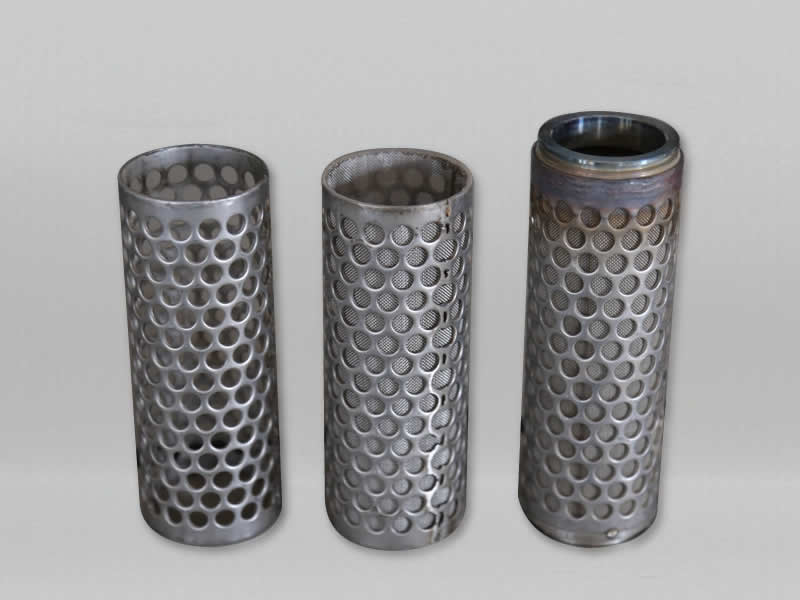
PEFT-5: Perforated tubes with an inner filtration mesh layer

PEFT-6: Available in round, square, hex, and other shapes

PEFT-7: Perforated tubes with female threaded ends

PEFT-8: Perforated tubes with rubber ends

PEFT-9: Perforated tubes with an hinged open door

PEFT-10: Perforated tubes with outer Support Ring
Effective open area of perforated tubes
Distinguish the open area of the perforated pattern from the effective open area of the complete tube. Solid seam strips, end margins and other non-perforated areas reduce the available opening area. The pattern percentage alone does not establish flow capacity or structural strength.
Use our perforated tube effective open area calculator within its stated scope, then confirm the drawing and operating requirements. See perforated sheets and plates for flat-sheet hole patterns.
Application media and industries
Typical duties include water treatment, oil and gas, chemical processing, hydraulic and lubrication systems, dust collection, food and beverage processing, mining and desalination. In fine-filter assemblies, the perforated tube acts primarily as a support or guard.
- Liquids: industrial clean water, wastewater and groundwater; lubricating, hydraulic and fuel oils; chemical process liquids; food and beverage streams where material and contact requirements are confirmed.
- Corrosive liquids: acid or alkaline solutions, seawater and brine require confirmation of composition, concentration, temperature and exact alloy. A high-alloy designation alone does not establish compatibility.
- Gases: compressed air, fuel gas, flue gas, process synthesis gas, dust-laden airflow and ventilation exhaust, subject to the complete assembly’s material, temperature and pressure requirements.
- Solid–fluid duties: support components in oil and gas well sand-control assemblies, and ventilation or drying of granular materials. Actual separation performance depends on the complete screen or filter construction.
Cleaning, reuse and replacement
Choose cleaning according to contamination and the complete assembly. A method suitable for the bare support may damage fine media, membranes, seals or end components.
- Reverse-flow flushing or backwashing: for compatible structures; online operation requires an appropriate housing, valves and flow arrangement.
- Water-jet cleaning: for removed parts, using controlled pressure suitable for the tube and any attached medium.
- Compressed-air reverse purging: for suitable gas-duty assemblies with loose dust or particles.
- Compatible solvent or detergent soaking and a soft brush: for oily contamination. Avoid hard steel brushes that can damage edges or attached media.
- Ultrasonic cleaning: where suitable, using an agreed short, low-power procedure for small or precision parts.
- Chemical cleaning: for scale or deposits, with the reagent and procedure matched to the exact alloy, welds, seals and filter media.
- Controlled thermal cleaning: for polymer-contaminated all-metal assemblies only when the material and procedure permit. Membranes, rubber and other non-metal components need separate assessment.
Suitable perforated tubes can be repeatedly cleaned and reused after inspection. Replace parts with severe corrosion, cracked welds, extensive hole-edge deformation or loss of their support function. Cleaning does not restore a damaged structure.
Manufacturing inspection
- Dimensions: outside and inside diameters, individual length, end dimensions and flange or connection geometry against the drawing.
- Roundness: out-of-round condition checked for cylindrical parts to support fit and avoid local interference.
- Straightness: tube bow checked, with particular attention to long parts and installation clearance.
- Hole pattern: opening size, pitch and arrangement checked against the drawing using suitable gauges or calipers.
- Welds: straight or spiral seams and end welds visually checked for weak or missed welds, weld projections and cracks.
- Burrs: holes, inside and outside surfaces, cut ends and weld areas inspected. One-side or both-side deburring can be specified to protect adjacent media.
- Materials: grade checked against material documentation, including MTC requirements agreed for the order.
Penetrant testing (PT) and positive material identification (PMI) are optional checks by agreement, with any additional cost confirmed. They are not standard mandatory tests on every part. Inspection methods, sampling and tolerances are specified per order.
Custom manufacture and replacement
Design for a new application
Share the filter medium, process conditions, installation space and support requirements. We review the perforated structure, material, seam, reinforcement and connections before agreeing the drawing and checks.
Manufacture to drawing
Send your dimensions, hole pattern, material, weld and end details, tolerances and operating requirements. We manufacture to the agreed drawing and specification.
Recreate from a sample
An existing part can help establish geometry, holes, seams and fittings. Uncertain material or original performance requirements must be confirmed; a used sample alone may not establish them.
Perforated tube FAQ
Is a perforated tube a precision filter?
Its main role is support and protection. A bare tube can perform coarse screening; finer filtration comes from the specified filter medium in the assembly.
Do you offer straight-seam and spiral-welded tubes?
Yes. Both are made by perforating or cutting flat sheet, then rolling and welding it. Construction is specified on the drawing.
Is 6 m the maximum manufacturing length?
No. Lengths normally up to 6 m facilitate packaging and transport. Longer lengths can be discussed.
Can you add fine mesh and custom end fittings?
Yes. Woven mesh, sintered mesh and sintered metal fiber felt combinations, threads, flanges, end caps, rubber ends and other illustrated features are available to specification.
Can the tube be backwashed?
Compatible constructions can use reverse-flow cleaning. Confirm the complete assembly, flow direction, housing and attached media before selecting the procedure.
What differential pressure can it withstand?
Capacity is confirmed for the exact structure and application. Provide the pressure direction, differential pressure, temperature, material, geometry and installation supports.
Inquiry for Our Product
Please provide:
- Drawing or existing sample; quantity
- Outside and inside diameters, length and wall thickness
- Material grade and surface requirements
- Hole shape, size, pitch, arrangement, solid margins and seam strip
- Weld construction, supports, end fittings, seals and mounting details
- Each filter-medium layer and its specification, if applicable
- Medium, flow, normal and peak temperature
- System pressure, normal and maximum differential pressure, and pressure direction
- Cleaning method, tolerances and required inspection
Related Products

Products
Contact Our Engineers
Complete our interactive form to receive a custom quote based on your needs.