
Custom Demister Pads for Gas–Liquid Separation
Filtalloy manufactures custom demister pads for removing entrained liquid droplets from gas streams. Layered knitted mesh is formed into round, ring-shaped, rectangular or custom units, with support grids and segmented construction as specified.
We primarily manufacture to customer drawings and operating specifications. For new projects or replacement mesh mist eliminators, we can offer construction and manufacturing suggestions for customer review; the final design and selection remain with the customer.
This page covers vessel and tower mist-elimination pads, focusing on liquid-droplet capture, coalescence, drainage and installation. It is distinct from knitted mesh roll stock, compact die-formed components and framed panel filters.
Custom wire mesh demister construction
- Metal, plastic and stainless-steel/PP mesh combinations.
- Mesh type, wire or filament size and packing density to specification.
- Complete units or numbered segments for manhole access and handling.
- Support grids, frames and fixing accessories supplied to drawing.
- Pad thickness, diameter, inner opening and segment dimensions to drawing.
- Vertical or horizontal gas-flow installations manufactured to the agreed design.
Operating temperature, corrosion compatibility, flow capacity, allowable differential pressure and support requirements are confirmed for the complete assembly. High gas velocity, resistance to fouling and low pressure loss are not universal guarantees.
Demister pad applications and media
Applications include droplet coalescence, oil and emulsion mist separation, distillation and absorption columns, gas and air scrubbers, stripping, rectification, crystallization, evaporation and drying equipment where entrained liquid must be removed.
Industries include refining, petrochemicals, natural gas, power generation, flue-gas treatment, pharmaceuticals, food and beverage, metallurgy, fine chemicals and desalination. In water-related services, the function remains removal of droplets from a gas stream.
Gas-side media may include process gas, natural gas, air, flue gas and synthesis gas. Entrained liquids may include aqueous solutions, oils/emulsions, amine solutions, acids, alkalis and organic solvents. PP or PTFE structures can be supplied for corrosive gas-liquid duties after compatibility review of the complete assembly.

Metal and plastic demister pad materials
- Stainless steel: 304, 316, 316L, 309, 310/310S and 321, with exact grade specified.
- High alloys: Hastelloy, Monel and Inconel families, with grade confirmed.
- Other metals: titanium, nickel, copper, brass, tinned copper, aluminum, galvanized steel and plain steel.
- Plastics: PP, PE, HDPE and PTFE.
- Combination: stainless-steel and PP mesh.
Mesh, support grids, frames and fasteners must each suit the medium, concentration, temperature and cleaning conditions. Material names alone do not establish the corrosion or temperature suitability of the complete unit.
Demister pad specifications and installation
- Published wire diameters: 0.19, 0.20, 0.23, 0.25, 0.28 and 0.30 mm; other wire/filament specifications to customer requirements.
- Metal mesh packing density: 80–432 kg/m³; specify the required style and target density.
- Structure: complete units or segments sized for manhole access and transport.
- Published grid members: flat bar 25 × 3 mm and round bar Ø6 mm; other sizes to drawing.
- Dimensions: pad thickness, outside/inside dimensions, segment geometry and assembly clearances to drawing.
- Accessories: support grids, frames and fixing components can be supplied.
Confirm gas-flow direction, drainage path, effective flow area, vessel supports and installation access. Segments must fit together and seat correctly to limit bypass. Grid arrangement and support strength follow the agreed installation design.
The existing style table below is retained. Its entries are not a universal porosity or surface-area range for all materials. Other manufacturers’ style references aid identification only; they do not establish performance equivalence or automatic interchangeability. Confirm a replacement against the drawing, construction and operating requirements.
| Demister Pad Styles | |||||||||||
| Style | Density | Free Volume % | Surface Area m2/m3 | Demister Pads of Other Companies | |||||||
| Metex | York | Vico-Tex | Koch | Knitmesh | Uop | Becoil | Becoil | ||||
| H | 80 | 99.0 | 158 | Hi-Thruput | 931 | 160 | 511 | 4536 | B | 7CA | 954 |
| L | 120 | 98.5 | 210 | 422 | |||||||
| N | 144 | 98.2 | 280 | Nu-Standard | 431 | 280 | 911 | 9030 | A | 4CA | |
| SN | 128 | 98.4 | 460 | 326 | 415 | 706 | |||||
| SL | 193 | 97.5 | 375 | Xltra-Dense | 421 | 380 | 1211 | 9033 | C | 4BA | 890 |
| SM | 300 | 96.2 | 575 | ||||||||
| SH | 390 | 95 | 750 | ||||||||
| T | 220 | 97.2 | 905 | ||||||||
| R | 432 | 94.5 | 1780 | Muti-stand | 333 | 800 | |||||
| W | 220 | 97.2 | 428 | Wound | |||||||
| GS | 160 | 96.7 | 5000 | 371 | |||||||
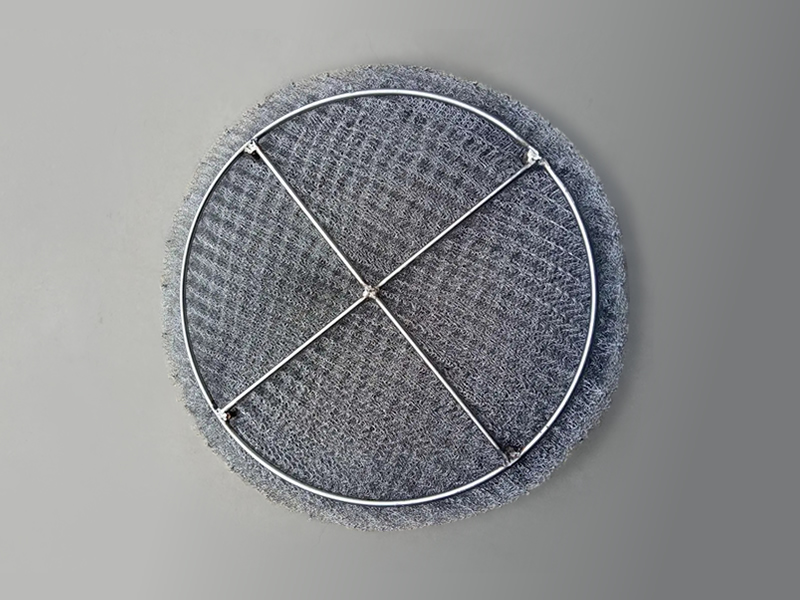
DMP-1: Single demister pad with round bar grating
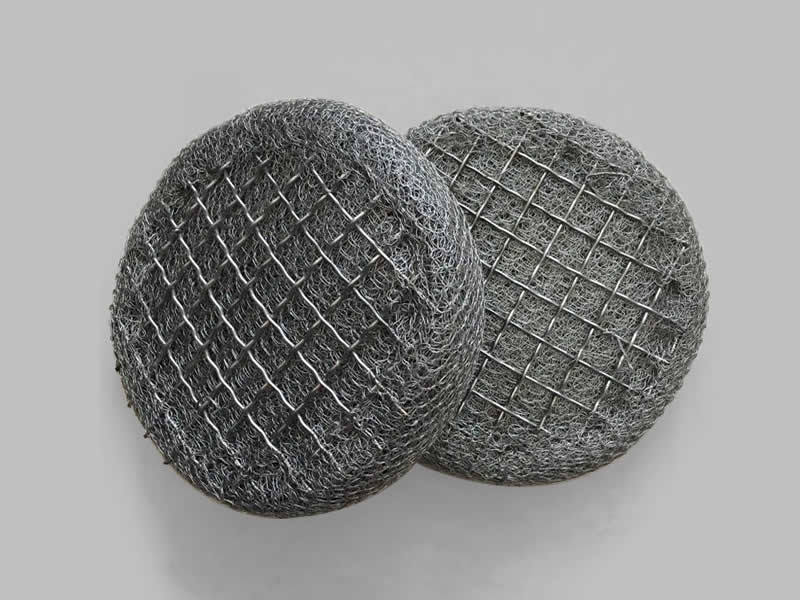
DMP-2: Demister pads with top & bottom support mesh

DMP-3: Round demister pad in multi-segments
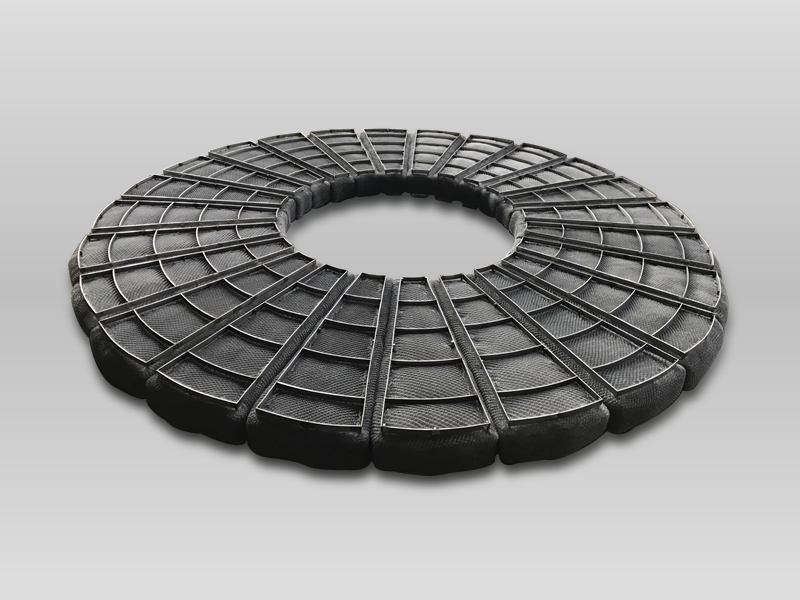
DMP-4: Ring demister pad in multi-segments
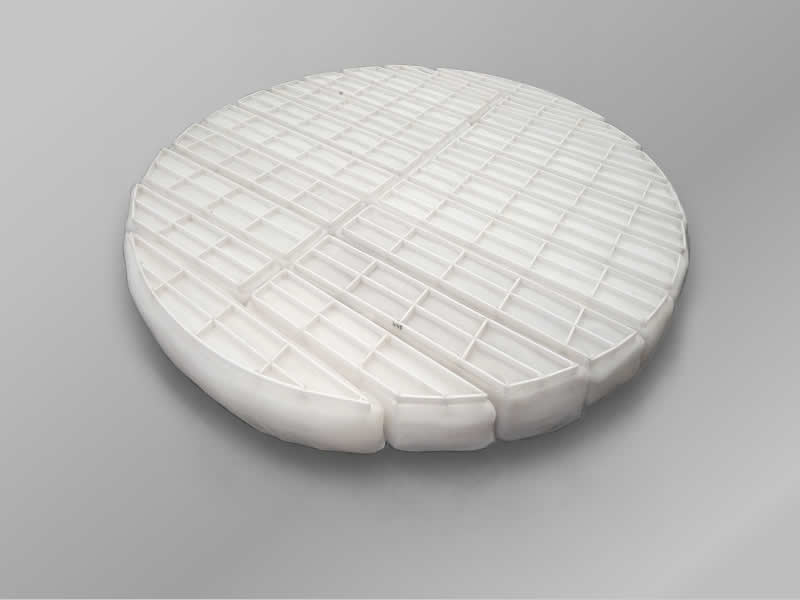
DMP-5: PP demister pads with flat PP grating

DMP-6: PP demister pads with flat SS grating
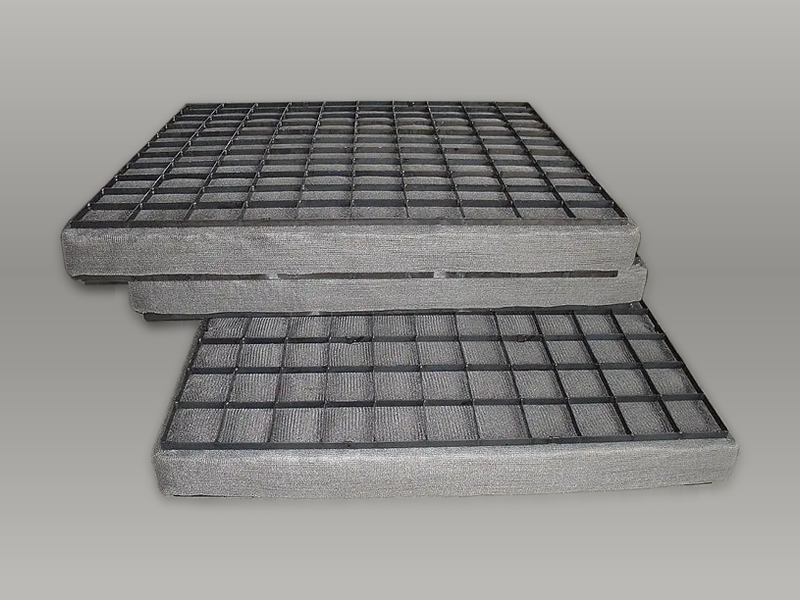
DMP-7: Rectangular demister pads with grating
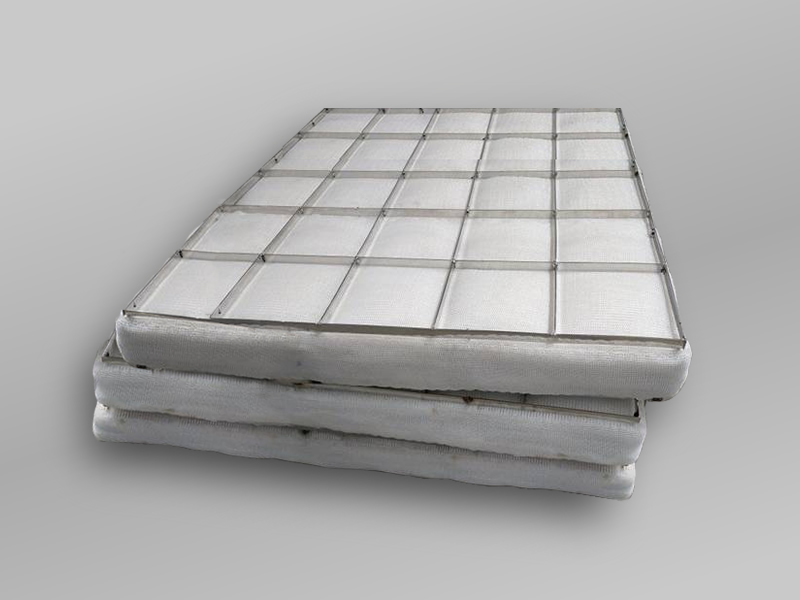
DMP-8: Rectangular PP demister pads with grating
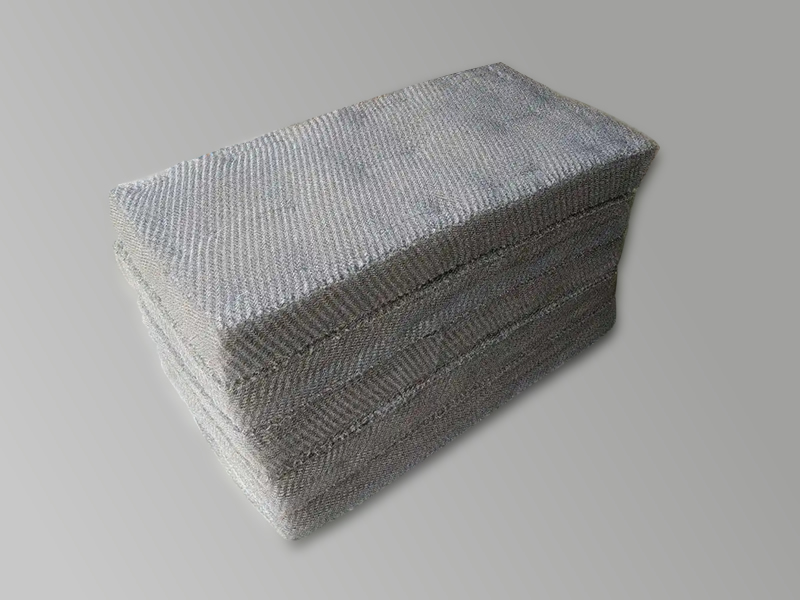
DMP-9: Metal demister Pads without grating
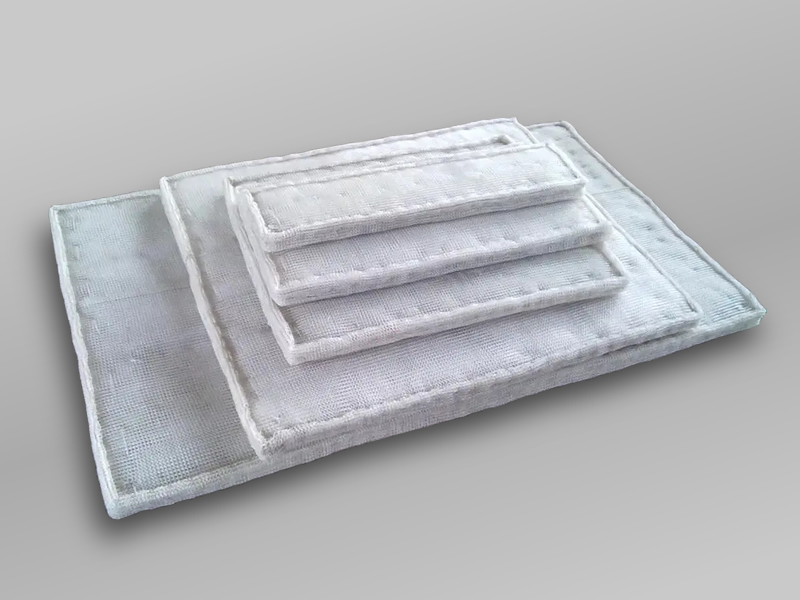
DMP-10: PP demister pads without grating
Demister Pad Design, Maintenance and Ordering
How a knitted mesh mist eliminator works
Entrained droplets deviate from the gas path through inertia, contact the wire or filament surfaces and coalesce into larger drops. Collected liquid drains through the pad along the designed drainage path under gravity.
At low gas velocity, inertial capture of some droplets can be insufficient. Excessive gas or liquid loading can hinder drainage and cause flooding or re-entrainment. These are related but distinct effects. Operate within the gas/liquid loading and velocity window confirmed for the installation; being below a flooding limit alone does not guarantee separation efficiency.
Separation efficiency and pressure drop
Separation efficiency is a design estimate or project target, not a routine individually measured factory value. Wire size, mesh density, pad thickness, droplet-size distribution, gas/liquid properties, liquid load, velocity and installation all affect the result. Density alone is not a selection rule.
Agree the target droplet size, size-specific collection efficiency, flow range and allowable operating pressure drop for each project. This page does not publish a universal minimum droplet size, removal percentage or wet pressure-drop guarantee. Dry and wet pressure losses must be distinguished; structural differential-pressure capacity also requires separate confirmation.
Cleaning and replacement
Choose a cleaning method for the contaminant and every component material. Follow vessel isolation, access and handling procedures before removing segments through the manhole.
- Water or compatible process-liquid rinsing: controlled low-pressure washing along a suitable drainage direction.
- Chemical cleaning: select the agent, concentration, temperature and contact time for the deposit and complete assembly.
- Steam cleaning: only after confirming the temperature suitability of mesh, grids, fixings and combination materials.
- Soaking and gentle local cleaning: compatible soaking, a soft brush or controlled compressed air where suitable; avoid hard wire brushing and flows that distort the mesh.
PP and PTFE have different compatibility limits. Do not assume either a cleaning chemical or steam procedure is suitable from the plastic name alone.
When to stop reuse and replace
- Collapsed, crushed or permanently deformed mesh.
- Severe wire thinning, corrosion damage or failed welds.
- Broken support grids, detached joints or insecure fixing.
- Persistent abnormal pressure drop, carryover or drainage after compatible cleaning and inspection.
- Loss of structural integrity after prolonged thermal or corrosive service.
Investigate operating and installation causes as well as pad condition. Cleaning does not restore damaged mesh geometry or broken supports. Reuse depends on inspection; unlimited service life is not promised.
Manufacturing inspection
- Dimensions: outside/inside dimensions, pad thickness, segment sizes, mating clearances and assembled flatness.
- Mass and packing density: each mesh section weighed and density calculated from the agreed mesh volume; support-grid and frame mass accounted for separately.
- Wire and mesh construction: wire/filament dimensions, specified flat or corrugated structure and single-wire or multi-wire construction checked.
- Grids and joints: member dimensions, welds or plastic joints, missing connections and segment engagement checked.
- Segment assembly: identification, mating seams and fit to the specified support arrangement checked; large units divided to the agreed access dimensions.
- Materials: metal grade and MTC requirements verified; plastics checked against resin grade and supplier material documents.
These are manufacturing and conformity checks. They are not individual separation-efficiency, flooding or wet pressure-drop tests. Any additional performance verification requires an agreed method and acceptance criteria.
Custom demister pads and replacement units
New project
Send the operating conditions and vessel layout. We can discuss manufacturable mesh, support and segment options for customer review. Final process design and selection are confirmed by the customer.
Manufacture to drawing
Provide the approved mesh style, density, material, pad thickness, segment drawing, supports, fixing details and inspection requirements.
Replace an existing demister pad
Send the nameplate, existing style, drawings, photos or sample. Used parts may be deformed or fouled. Confirm recovered dimensions and construction before production; a brand/style cross-reference alone does not guarantee equivalent performance.
Demister pad FAQ
Is separation efficiency tested on every pad?
No. Published project efficiency is a design estimate or agreed target. Factory checks focus on the specified construction, dimensions, mass/density, materials and assembly.
Does higher mesh density always improve separation?
No. Density must be considered with wire size, thickness, gas/liquid loading and drainage. A denser pad is not automatically the correct choice.
Can you supply segmented mesh mist eliminators?
Yes. Round, ring-shaped and rectangular pads can be supplied as segments to drawing, with grids, frames and fixing accessories where specified.
Can a pad be used with horizontal gas flow?
Yes. We manufacture to the agreed flow direction, support arrangement and drainage design. Confirm orientation before ordering.
Can plastic demister pads be steam-cleaned?
Only where the complete assembly and cleaning temperature have been confirmed suitable. PP, PE, HDPE and PTFE must not be treated as interchangeable materials.
How does this differ from other knitted mesh products?
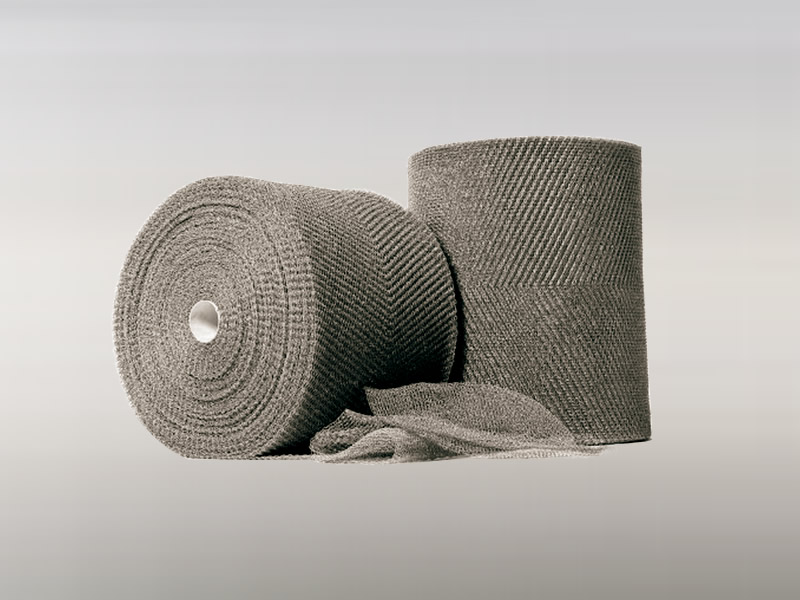
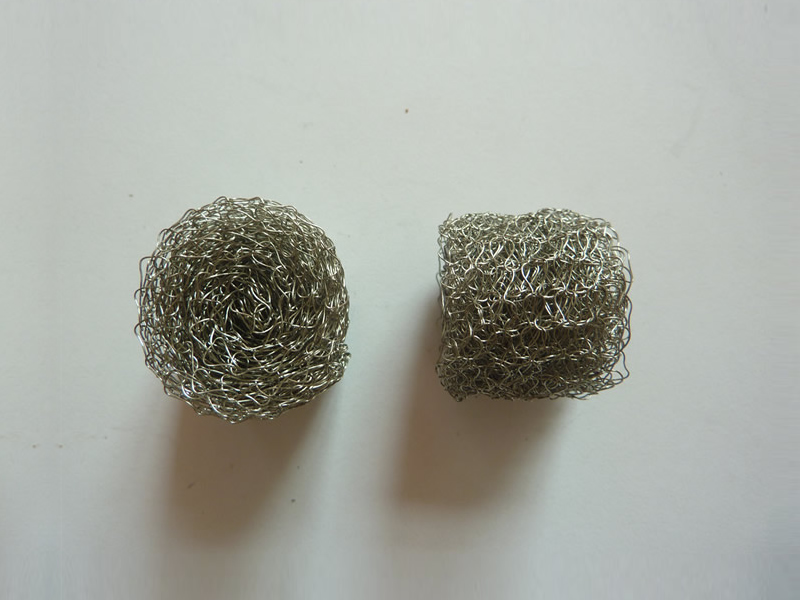
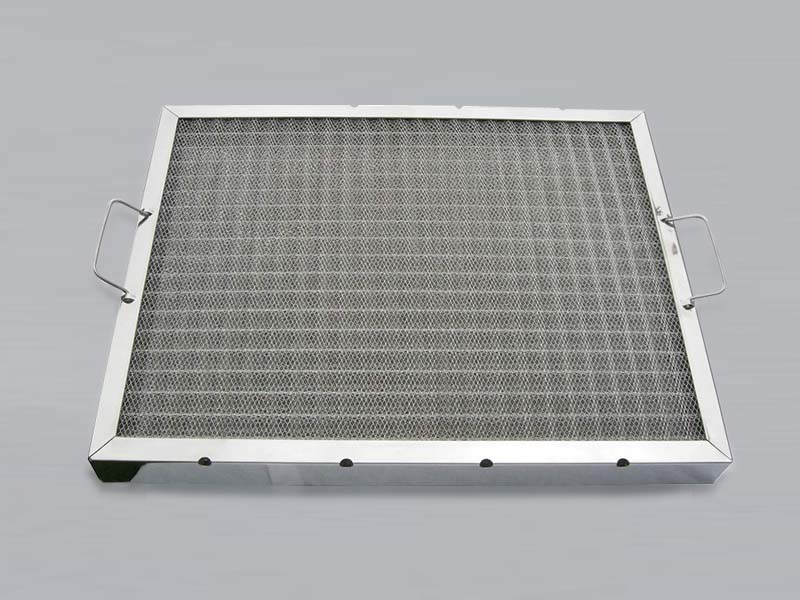
This page covers layered vessel/tower pads for liquid-droplet separation. See knitted mesh rolls for base material, compressed knitted filters for die-formed parts and knitted panel filters for framed panels.
Information for a demister pad inquiry
- Flow: minimum, normal and maximum gas flow; identify actual or standard m³/h and the reference conditions.
- Operating conditions: temperature and pressure at the pad.
- Gas/liquid properties: gas density and viscosity; liquid density, surface tension, composition and corrosion conditions.
- Liquid loading: entrained liquid quantity with units and reference basis.
- Separation target: droplet-size distribution where available, target sizes and required collection efficiency/test basis.
- Pressure loss: allowable operating pressure drop and any structural differential-pressure requirement.
- Vessel and pad: vessel inside diameter, effective flow area, pad thickness and available installation height.
- Access: manhole dimensions, segment handling and transport limits.
- Installation: gas direction, drainage, support beams/seats, grid and fixing drawings.
- Service: fouling, scaling, cleaning requirements and replacement history.
- Replacement references: current style/nameplate, drawings, photographs or sample.
- Order: quantity, material documents, tolerances and inspection/acceptance requirements.
Related Products
Products
Contact Our Engineers
Send your drawing, operating conditions or replacement details to discuss a custom demister pad.