
Custom Compressed Knitted Wire Mesh Filters
Filtalloy manufactures compressed knitted wire mesh filters and porous formed components to drawings or samples. Knitted mesh is cut, folded, wound or layered, then pressed in a die into rings, tubes, cylinders, pads and custom shapes.
This page focuses on finished compressed elements for coarse filtration and specified particle or droplet interception. The interlocking-wire structure provides interconnected flow paths, but no universal micron rating or retention efficiency applies. Define the medium, flow, particle or droplet target, pressure-loss limit and test conditions for the finished part.
Wire size, alloy, loop construction, density, flow-path length and forming all affect behavior. We develop samples for evaluation rather than infer filtration performance from density alone. Different densities, zoned structures and multi-material combinations are available to specification.
Custom compressed filter construction
- Die-formed shapes to agreed dimensions and tolerances.
- Single-wire or multi-wire base mesh, with each feed wire specified.
- Round-wire or flat-wire structures.
- Custom density, zoned construction and material combinations.
- Sample development and agreed mechanical or flow checks.
Corrosion compatibility, temperature suitability, allowable differential pressure and mechanical response are confirmed for the exact part and duty. No universal high-efficiency, high-temperature or tight-tolerance guarantee applies.
Materials and finished-part specifications
- Stainless steel: 304, 316, 316L, 309, 310S and 321.
- High alloys: Monel, Hastelloy and Inconel, exact grade confirmed.
- Other metals: titanium, nickel, copper, brass, tinned copper, aluminum, galvanized steel and plain steel.
- Round-wire diameter: 1 mm; specify each feed wire in the order drawing.
- Flat-wire width and thickness: to drawing.
- Shapes: rings, tubes, cylinders, square pads, conical rings and custom forms.
- Finished dimensions, mass and bulk density: per project.
- Different densities, zoned structures, multi-material and graphite-composite parts: to specification.
Roll dimensions and areal weight must not be substituted for finished compressed-part dimensions and bulk density.
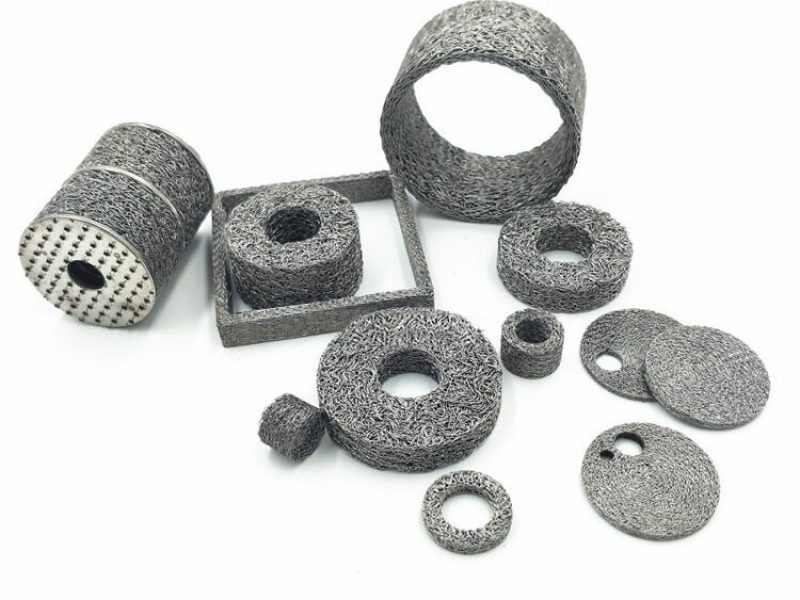
Compressed knitted mesh applications
Filtration is the primary focus. Other functions below are project-specific component uses, not performance claims for every compressed part. Dedicated tower mist-elimination and framed-panel filtration are covered on their separate product pages.
| Function | Component uses and requirements |
|---|---|
| Filtration and separation | Engine breathers, crankcase ventilation, specified particle/droplet interception and exhaust components. Airbag filter parts are manufactured to defined customer specifications; mesh alone does not establish system safety performance. |
| Noise, vibration and thermal assemblies | Exhaust noise-control, damping and shock-support parts, and components in thermal-isolation assemblies. Performance depends on the complete installation. |
| Support and sealing assemblies | Elastic compensation and cushioning for catalytic-converter or DPF assemblies. Bare knitted mesh is not a gas-tight seal; support and bypass control depend on the complete design. |
| Electrical and electrochemical assemblies | Specified conductive parts for EMI/RFI, fuel-cell, electrolysis and chlor-alkali assemblies. Mesh alone does not establish shielding effectiveness, electrode behavior or system performance. |
| Safety-related projects | Flame-arresting or explosion-related components require defined requirements and validated assemblies. Ordinary compressed mesh carries no flame-arresting or explosion-protection claim. |
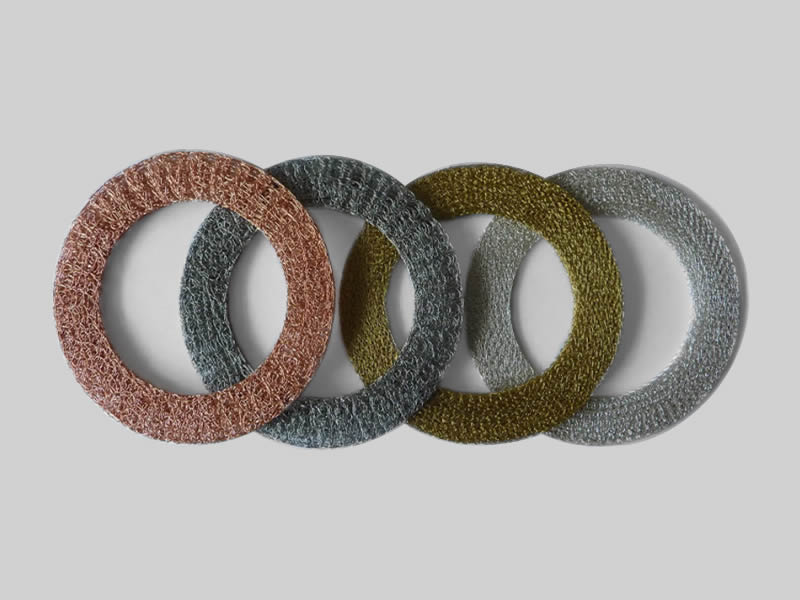
CKM-1: Compressed knitted mesh in different materials
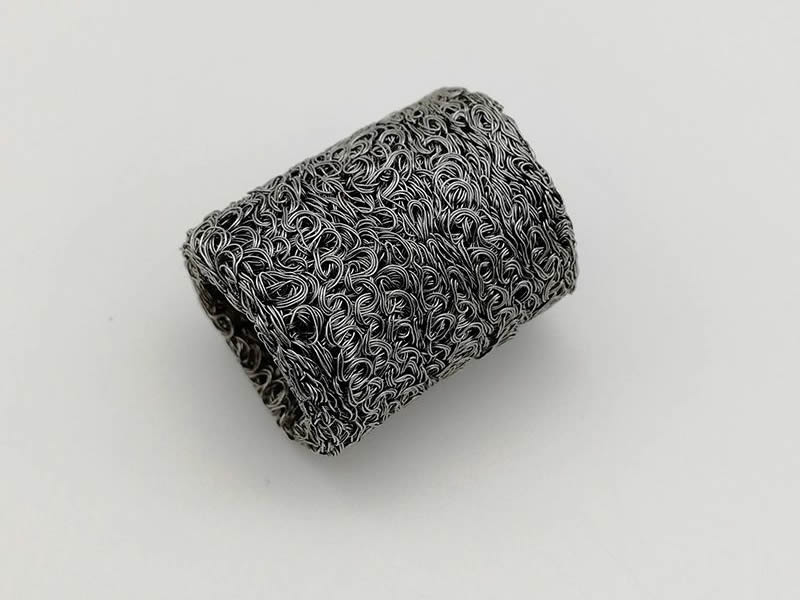
CKM-2: Compressed knitted filter in a tubular shape
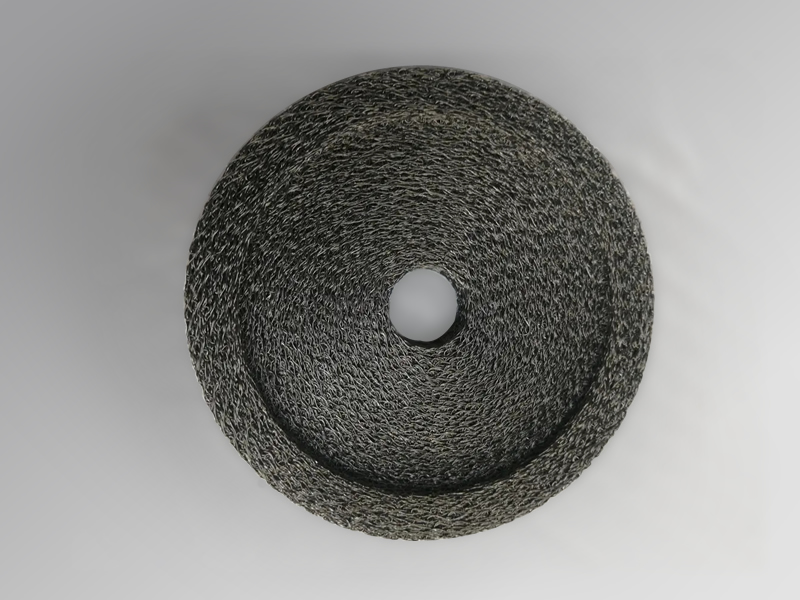
CKM-3: Compressed knitted filter in special round shape
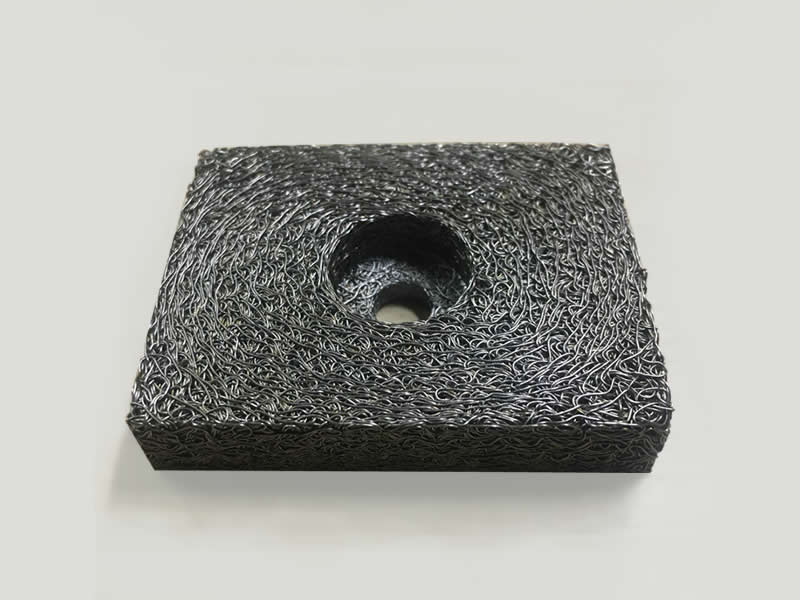
CKM-4: Knitted mesh filter made based on client’s request
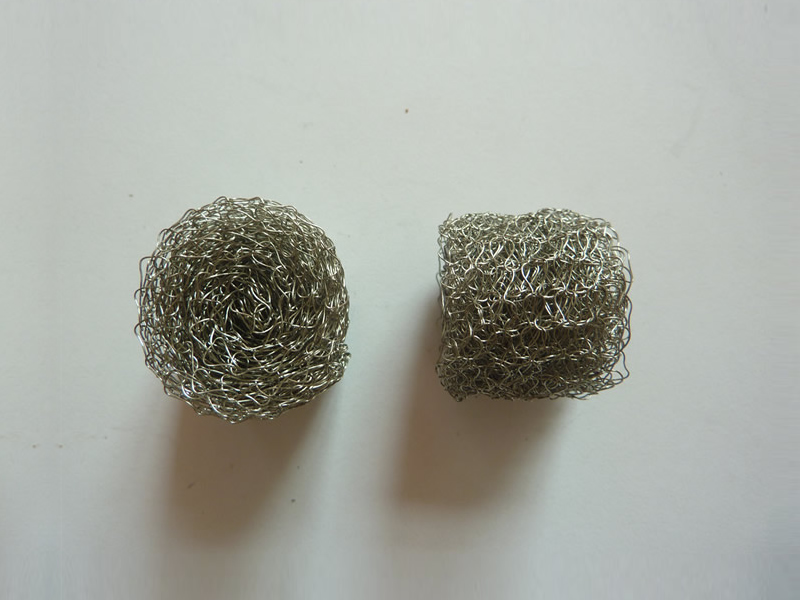
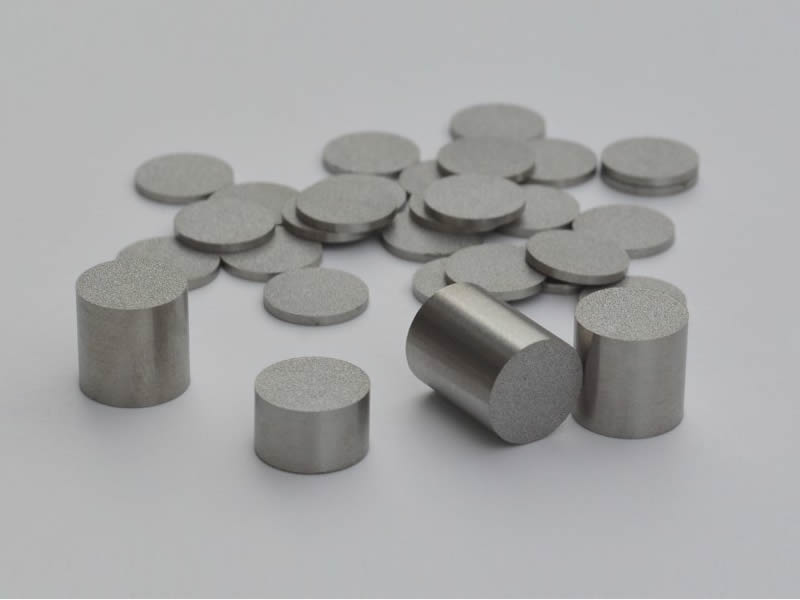
CKM-5: Compressed knitted filter in cylinder shape
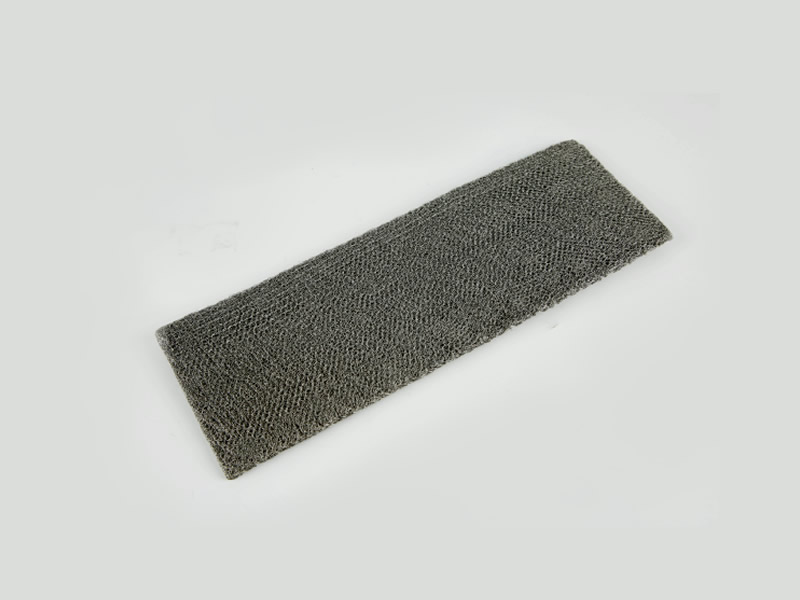
CKM-6: Flat square compressed knitted mesh component — application confirmed per project
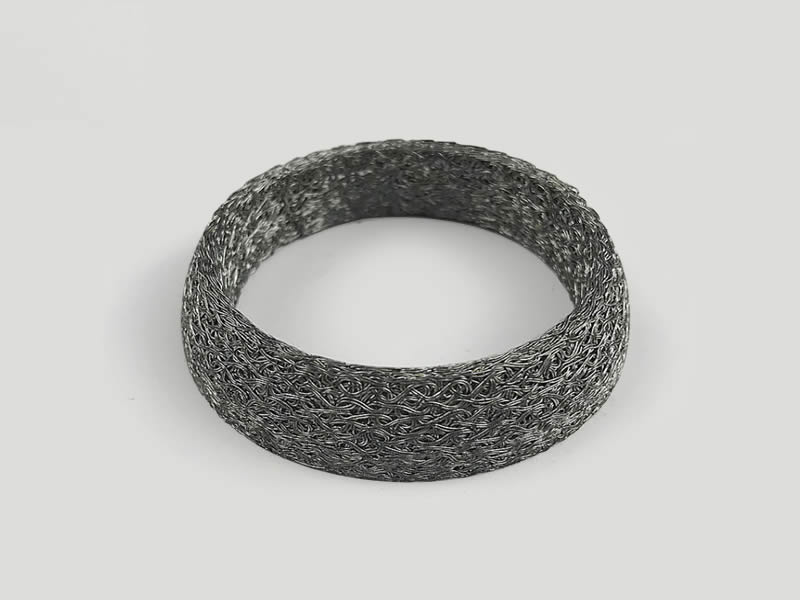
CKM-7: Compressed knitted filter in conical ring shape
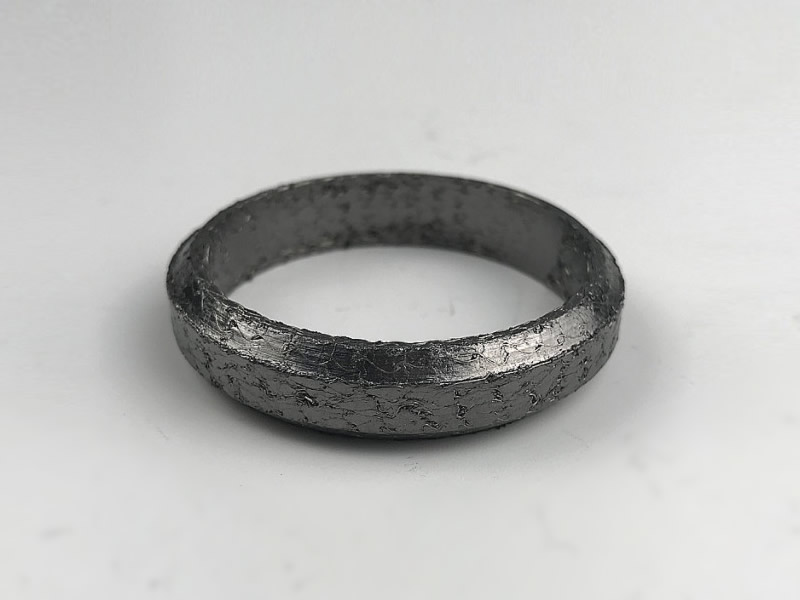
CKM-8: Compressed knitted filter combined with graphite
Technical Guide and Ordering
Mass, bulk density and porosity
Finished-part mass and bulk density are actual production-control parameters. Bulk density is calculated from measured mass and agreed finished geometric volume. Define the free or loaded measurement state and account for central holes and shaped features.
For a suitable single-material part, porosity can be calculated using bulk density and the material solid density. Mixed-metal and graphite-composite parts require their composition and density basis to be established separately. Density and calculated porosity do not alone establish pressure loss, filtration efficiency or mechanical performance. Demister-pad density ranges are not used as specifications for these compressed parts.
Operating conditions and optional tests
- Temperature assessment: based on exact grade, medium, environment and component condition. Routine furnace validation is not included.
- Flow-pressure-loss testing: sample parts can be tested at agreed flow and medium conditions on a factory air or water bench. This is not proof of allowable differential pressure, collapse resistance or burst pressure.
- Compression and recovery: a test machine records load at an agreed compressed height, followed by unloading and recovery/permanent-set measurements. Compressing to 70% of free height means a 30% height reduction; specify the intended convention.
- Fatigue: cyclic compression is not routine inspection. Cycles, loading, temperature and acceptance criteria can be agreed for a custom or outsourced test.
Specify normal and peak temperature, system pressure, flow-pressure loss, allowable differential pressure, compression travel, load, recovery and fatigue requirements separately. Methods and acceptance values follow the agreed drawing, OEM specification or test plan.
Cleaning and replacement
Select cleaning for the complete part, contaminant and function. Avoid hard brushing or aggressive flows that distort loops or affect recovery.
- Compatible solvent or detergent soaking to loosen oily residues, followed by gentle removal of deposits.
- Controlled reverse airflow or water flushing where the part, installation and flow direction permit.
- Low-pressure compressed air for loose dust.
- Short, low-power ultrasonic cleaning where suitable for the component.
- Controlled thermal cleaning only for compatible all-metal parts and an agreed procedure; inspect dimensions, structure and recovery afterward.
Graphite-composite components are not cleaned by burning or ultrasonic methods; agree a separate procedure. Reusable filter parts must be inspected after cleaning. Recovery-dependent support or sealing components may need scheduled replacement after thermal exposure and service; unlimited reuse is not promised.
Manufacturing inspection
- Dimensions: formed outside/inside diameters, height, chamfers, cuts and critical drawing tolerances.
- Mass and density: individual weighing and bulk-density calculation using the agreed volume.
- Materials: order grade and MTC requirements checked; PMI available by agreement for appropriate metal parts.
- Wire and structural defects: visible broken wires, missing material, detached loops and incomplete edges checked.
- Surface: sharp projections, scale and oil residues checked; food or electronics cleanliness requirements agreed separately.
- Compression: first articles and tooling changes checked for specified load and unloaded recovery/permanent set; production sampled to an agreed plan.
Pressure-loss and fatigue checks are sampled or ordered separately, not described as 100% inspection. Conditions, loads, sampling and acceptance values are agreed per order.
Custom filters and replacement components
New filtration duty
Provide medium, particle or droplet target, flow, temperature, pressure conditions, installation space and cleaning requirements. We review material, base mesh, formed geometry and density, then agree samples and verification.
Manufacture to drawing
Send dimensions and tolerances, material, wire construction, mass/density, zones, compression requirements and test criteria.
Recreate from a sample
A sample helps recover geometry, mass and construction. A used part may have permanent deformation or deposits; uncertain original density, material and performance must be confirmed before reproduction.
Compressed knitted wire mesh FAQ
Does compressed mesh have a universal micron rating?
No. Define the target and test conditions for the finished element. Density alone does not establish filtration efficiency.
Can you make different densities or zones?
Yes. Density, zoned construction and multi-material combinations can be specified with drawing and acceptance requirements.
Does a pressure-loss test establish pressure resistance?
No. It measures flow resistance under test conditions. Allowable differential pressure and structural capacity need separate confirmation.
Can the part be cleaned and reused?
It depends on contamination, material and function. Inspect after compatible cleaning; graphite-composite parts and recovery-dependent components require separate treatment and replacement criteria.
Do you test fatigue on every part?
No. Fatigue is a custom or outsourced test by agreement. Compression checks follow first-article, tooling-change and production-sampling requirements.
How is this different from a demister pad or panel filter?
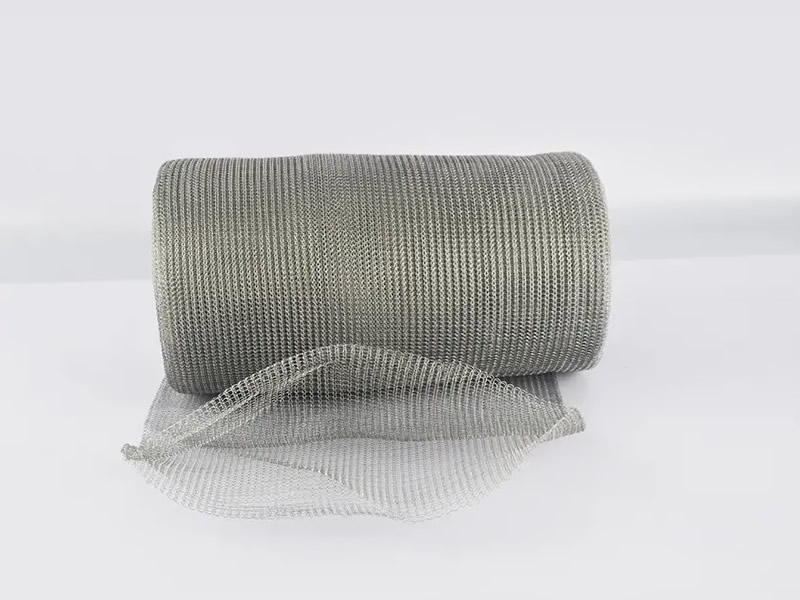
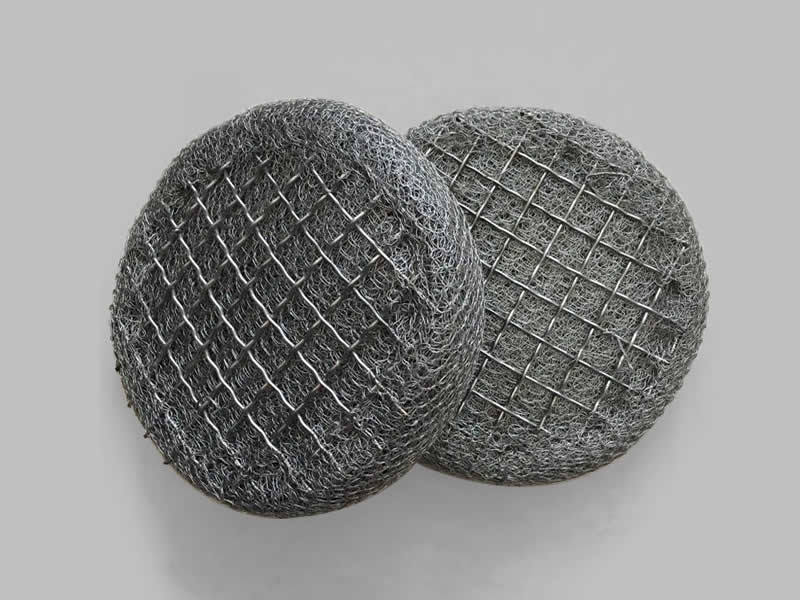
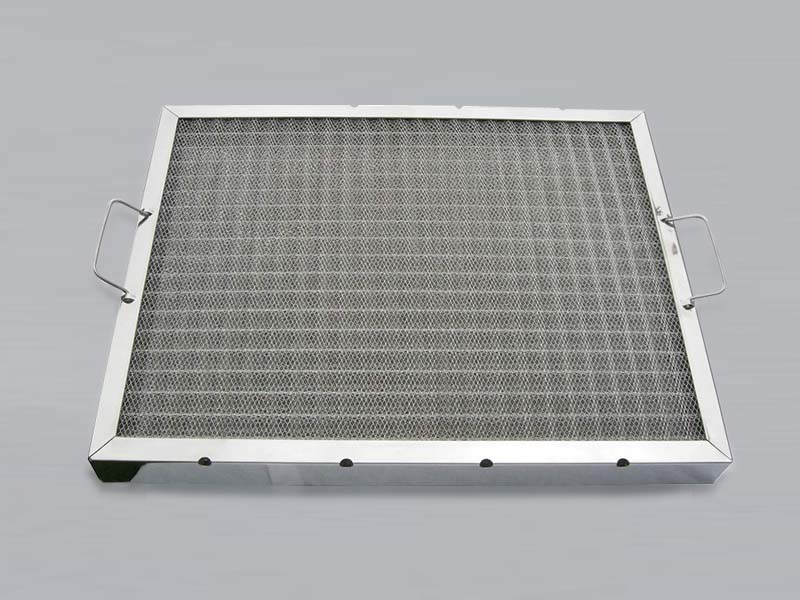
This page covers compact die-formed components. Tower demister pads and framed panel filters have separate installation and performance requirements. See knitted mesh rolls, demister pads or knitted panel filters for those products.
Inquiry for custom compressed filters
Please provide:
- Drawing or sample, quantity and installation details
- Material grade, wire shape/size and base-mesh construction
- Finished dimensions, tolerances, mass and bulk-density requirements
- Zoned structure or composite materials
- Medium, flow, particle/droplet target and test method
- Temperature, system pressure, pressure-loss limit and allowable differential pressure
- Compressed height or travel, load, recovery and fatigue requirements
- Cleaning, inspection, sampling and acceptance criteria
Related Products
Products
Request A Quote
Complete our interactive form to receive a custom quote based on your needs.