
By Jack Sun · October 13, 2026
Quick definition
A material grade identifies a material within a particular designation system. Grade name, product standard, delivery condition and performance requirements describe different aspects of the specification. 304, 316L, UNS numbers and EN material numbers provide reference points; approximate counterparts are not automatically interchangeable. Density is a material property under stated conditions, not evidence of filter efficiency or pressure capability.
A drawing may say “316,” an old document “stainless,” and a sample may attract a magnet. Preserve the information that is actually known, then check the relevant documents and manufacturing state. Color, feel and a magnet cannot establish grade, welding suitability and corrosion performance together.
This is a reference for wire mesh and industrial filter materials. Product pages and agreed project documents establish the actual supply and manufacturing specification.
1. Separate material name, grade and product standard
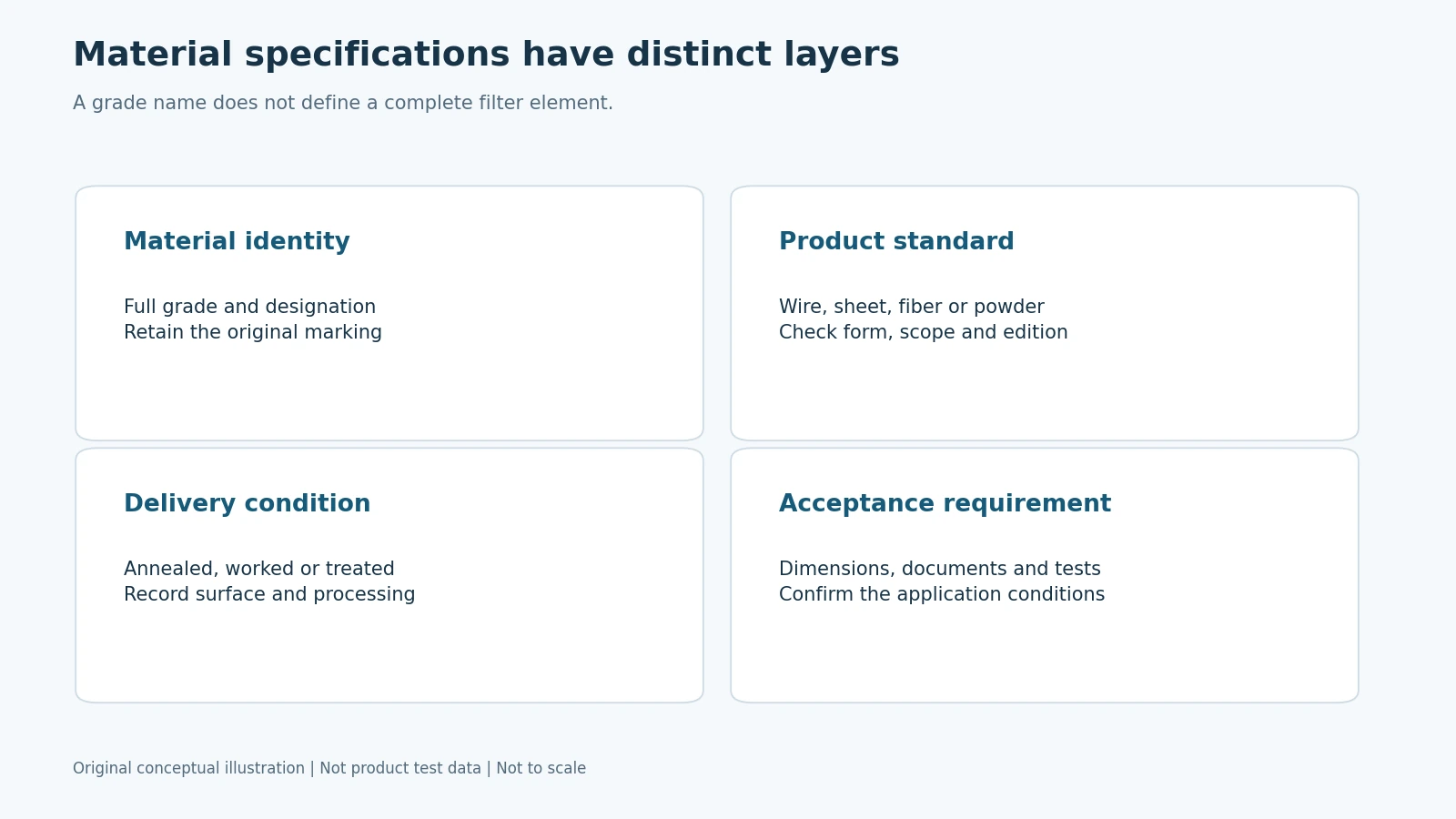
Original conceptual diagram: a grade name does not define a complete filter element.
“Stainless steel,” “nickel,” “titanium” and “copper” are material categories. Hastelloy and Inconel names also require a specific alloy: one grade's density, temperature information or corrosion behavior cannot be assigned to the entire family.
UNS and EN designations help identify materials. A product standard defines requirements for the particular product form. Sheet, wire, bar, fibers and powder do not share all dimensional, tolerance or delivery requirements merely because their chemical names resemble one another. For example, ASTM A580/A580M addresses stainless steel wire; it is not a performance specification for a complete filter element [1].
Record delivery condition separately: annealed, cold drawn, rolled, sintered, cleaned or coated. Sheet data can help explain basic properties, but sheet strength, tolerances and surface requirements should not become acceptance values for fine wire, felt or an assembled cartridge without justification.
2. Stainless steel grades chart: identification references
The following table starts a document check. It is not an equivalent-substitution table. Confirm chemistry, product form and mechanical requirements in the applicable edition [2,3].
| Common name | UNS reference | Common EN reference | What remains to be checked |
|---|---|---|---|
| 304 | S30400 | 1.4301 | Product form, condition, dimensions and environment |
| 304L | S30403 | 1.4307 or 1.4306 | These EN grades differ in requirements, not just numbering |
| 316 | S31600 | 1.4401 | Requirements are not automatically identical to a low-carbon grade |
| 316L | S31603 | 1.4404 | Any specified low-carbon variant, raw-material standard and condition |
A common name can have regional variants, and composition ranges can differ. Retain the original designation in purchasing records rather than translating every near match into one “equivalent” grade.
Dual certification requires documentation and compliance with the relevant requirements. A low measured carbon content does not by itself establish dual certification. When material documentation is missing, record that gap; a website chart cannot replace the original certificate.
Our relevant product specifications use the confirmed 316L designation. Listing 316 here explains the distinction and does not alter those supply specifications or add an unconfirmed alloy range.
3. 304 vs 316 stainless steel: compare conditions
First identify the exact variant and environment. Molybdenum in 316-type grades can improve resistance to localized corrosion in some chloride environments, but does not establish suitability for every acid, salt, temperature or crevice condition [3].
The “L” designation concerns low-carbon requirements. Low carbon helps reduce sensitization under certain welding conditions; it does not improve resistance to every corrosion mechanism or establish identical mechanical behavior at the same wire size and element geometry [2].
Record fluid composition, relevant contaminants such as chlorides, temperature, concentration, residence and cleaning conditions. Deposits, crevices, surface processing, welding and contact with other metals also matter. Nickel Institute guidance discusses strongly oxidizing acid conditions where a universal ranking of 316L above 304L is inappropriate [3].
Grade alone does not establish a fixed service life, unconditional seawater resistance or one maximum temperature for every component. Restricted environments require suitable data, samples or agreed testing. A micron grade cannot establish corrosion suitability either.
4. Metal density references and units
Density relates mass to solid material volume. 1 g/cm³ = 1,000 kg/m³. Applicability depends on grade, temperature, condition and source. These are published raw-material or association references, not measurements of our factory samples.
| Defined material/source | Reference density, g/cm³ | kg/m³ | Conditions and basis |
|---|---|---|---|
| ATI 304 material data | 7.90 | 7,900 | Producer's property table; no separate temperature stated for this density entry [4] |
| Nickel 200/201 data | 8.89 | 8,890 | Raw-material bulletin; not a shared value for all nickel alloys [5] |
| C11000 copper | Approximately 8.91 | Approximately 8,910 | Independently converted and rounded from 0.322 lb/in³ at 68°F (20°C) [6] |
| Commercially pure titanium Grade 2 data | 4.51 | 4,510 | Raw-material data; not automatically equivalent to every Chinese titanium grade [7] |
Where the source does not state temperature beside the density, do not relabel it as an exact 20°C value. Use these figures for preliminary estimates; use project-specified data when mass tolerances or temperature effects matter. Calculator defaults should remain editable with the material identified.
Decimal places do not establish measurement uncertainty. The C11000 conversion starts with a rounded imperial reference and is not a high-precision test of a particular batch. Alloy composition, porosity and coating cannot be ignored by changing only the material label.
5. Solid density versus porous bulk density
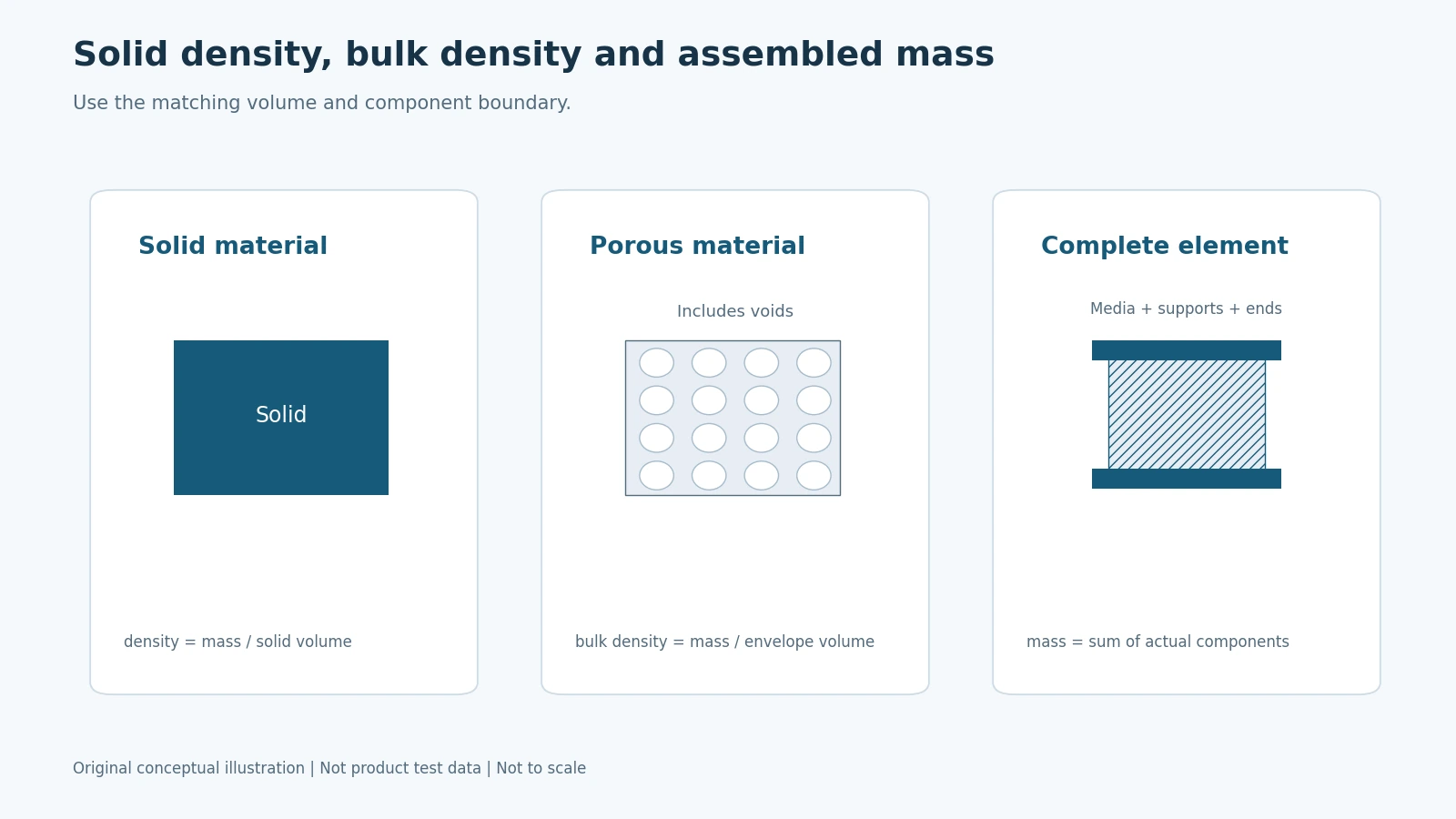
Original conceptual diagram: solid material volume, porous envelope volume and assembled filter components are different quantities.
Solid wire, fiber or powder density differs from the envelope-based bulk density of sintered felt, mesh or compressed knitted components. The latter volume includes voids. Multiplying solid-metal density by the full cylindrical envelope of a cartridge does not establish its mass.
Define the volume used for porosity. An assembled element also includes caps, supports, welds and seals. Calculate different materials and structures separately or use a measured mass record. Three-dimensional porosity and two-dimensional open area are different parameters; neither is a removal efficiency.
For a uniform, bare, solid round straight wire, mass equals density × cross-sectional area × length. At 7.90 g/cm³, a 0.20 mm wire 10 m long has a calculated mass of approximately 2.48 g. This geometry example excludes weaving crimp, coating and manufacturing tolerances; it is not a weighing report.
The metal wire weight and length calculator accepts material density as an input. First confirm the actual wire path, layers and dimensions. The sintered-metal porosity calculator requires a defined volume basis.
6. Magnetism, rust and surface condition
Is stainless steel magnetic?
Stainless steel includes different metallurgical families. Some austenitic grades develop measurable ferromagnetic response after cold work [3]. A change after drawing or weaving cannot, by itself, identify or reject 304 or 316L.
Why does stainless steel rust?
Color alone does not identify the cause. Record location, exposure, deposits, cleaning and neighboring materials, then investigate surface contamination and base-metal corrosion as appropriate. Photographs document visible conditions; material documents and applicable testing establish other properties.
Cleaning, pickling, passivation and electropolishing are processes with specific purposes, not synonyms for a grade name. State the required treatment and surface condition. “316L” alone does not prove that a particular finishing treatment has occurred.
Food, pharmaceutical and hydrogen projects may also require cleanliness, documentation and component-level verification. A material's relevance to an application does not establish sanitary, leak-tightness or other certification of a complete product.
7. Record a complete material requirement
Record the original material name and full grade, standard/edition, product form, delivery condition, dimensions/tolerances, surface treatment, fluid/temperature, relevant pressures, cleaning conditions, certificate/traceability requirements and performance validation.
Retain original units and designations for drawing-based work. For new projects, define the application before the structure. With a sample, reconstruct measurable dimensions and establish material and performance separately. A density figure does not complete selection or manufacture.
8. Frequently asked questions
Is 316L always better than 304?
Compare environment, temperature, concentration, processing and acceptance requirements. There is no unconditional ranking.
Can 316 and 316L be substituted directly?
Check the applicable standard, condition and project requirements. Similar names do not authorize substitution.
Can a UNS number replace a product standard?
It identifies material; product-form and acceptance requirements still need an applicable specification.
Does magnetism mean a sample is not stainless steel?
No. Magnetism depends on metallurgical family and processing and does not independently identify grade.
Does rust prove that the material is counterfeit?
No. Establish material identity and exposure conditions separately from the visible symptom.
Can solid density calculate an entire porous element's weight?
You also need voids, individual structures and material volumes. The full envelope is insufficient.
Are TA2 and Grade 2 completely identical?
Check each standard and material document. A common counterpart is not proof of identical requirements.
Can density establish pressure capability or filtration efficiency?
No. Structure, condition and the relevant tests need separate confirmation.
Summary
Read grade, product standard, delivery condition and application conditions together. Use density for estimates with a defined material and volume basis. Use designation charts as document references and visible surface behavior as observations, not substitutes for material and performance acceptance.
References
- ASTM A580/A580M-23, stainless steel wire specification.
- BSSA: 304/316 and their low-carbon variants.
- Nickel Institute: The nickel advantage.
- ATI 304 material data.
- Special Metals: Nickel 200/201.
- Copper Development Association: C11000.
- ATI commercially pure titanium Grade 2.
References identify property sources and their scope. The example mass calculation and purchasing organization are independent editorial work.
Author background: Jack Sun has long worked in metal wire mesh weaving and industrial filter element manufacturing. Our company is based in Anping, Hengshui, Hebei, China.