
Knitted Wire Mesh Rolls — Single-Wire and Multi-Wire
Filtalloy supplies knitted wire mesh rolls and tubular knitted mesh made from continuous wires formed into interlocking loops. Single-wire and multi-wire constructions, round or flat wire, metal, polymer and mixed-material options are available to the agreed specification.
This page covers the mesh material, roll and sleeve forms, and custom crimping. Cut, layered or compressed functional components are separate products with their own finished-part requirements. Interlocking loops provide flexibility and compressibility; recovery and permanent deformation depend on material, loop structure and compression.
Single-wire and multi-wire knitted mesh
Single-wire mesh uses one feed wire. Multi-wire mesh uses several wires fed together and knitted into the loops; the feed-wire count is not the number of mesh layers. We supply 1–12 feed wires, including suitable same-material or mixed-material combinations.
Multi-wire construction can increase the amount of wire and contact surface in each loop. Surface area per unit mass, fatigue life, load response and suitability for high-temperature duty still depend on wire size, alloy, loops and subsequent forming. Multi-wire mesh is not automatically more heat-resistant than single-wire mesh.
Roll and sleeve supply options
- Single-wire or multi-wire loop constructions.
- Round-wire or flat-wire options.
- Flattened rolls and unflattened tubular sleeves.
- Plain mesh or post-knit crimped/corrugated mesh.
- Material, feed-wire count, loop geometry and weight specified for further processing.
- Lengths supplied to order with packaging and handling requirements agreed.
Temperature, corrosion compatibility, filtration performance, shielding effectiveness and damping response are confirmed for the final application. Material name or roll specification alone does not guarantee finished-component performance.
Downstream uses of knitted mesh material
Rolls and sleeves are often cut, crimped, layered or compressed into application-specific components. This page supplies the material and forming options; the linked component pages describe the finished products.
- Gas–liquid separation: material for layered mist-eliminator pads in towers, evaporators and oil-mist assemblies. Droplet capture and coalescence depend on the finished pad and process; foam-breaking duty is assessed separately.
- Coarse filtration and prefiltration: material for breathers, air or oil pre-separation, dust or grease interception, and suitable support or spacer layers. It is not offered here as a precision micron-rated solid-particle filter.
- Noise, vibration and elastic compensation: material for formed pads, rings and support components. Their compression, damping and service requirements belong to the finished-part design.
- EMI/RFI components: copper, nickel, tinned copper and other specified conductive meshes for shielding or grounding assemblies; effectiveness depends on contacts and the complete enclosure.
- Electrochemical assemblies: custom material for conductive contact or elastic support layers in electrolysis and related equipment. Ordinary rolls do not establish electrode, catalyst or electrolyser performance.
- Other industrial projects: support and media components for food, pharmaceutical, environmental and metallurgical process equipment, subject to material and process requirements.
Bare knitted mesh is not a gas-tight seal. Flame-arresting or explosion-related component projects require an independently engineered and validated assembly; the roll itself carries no safety-performance claim.
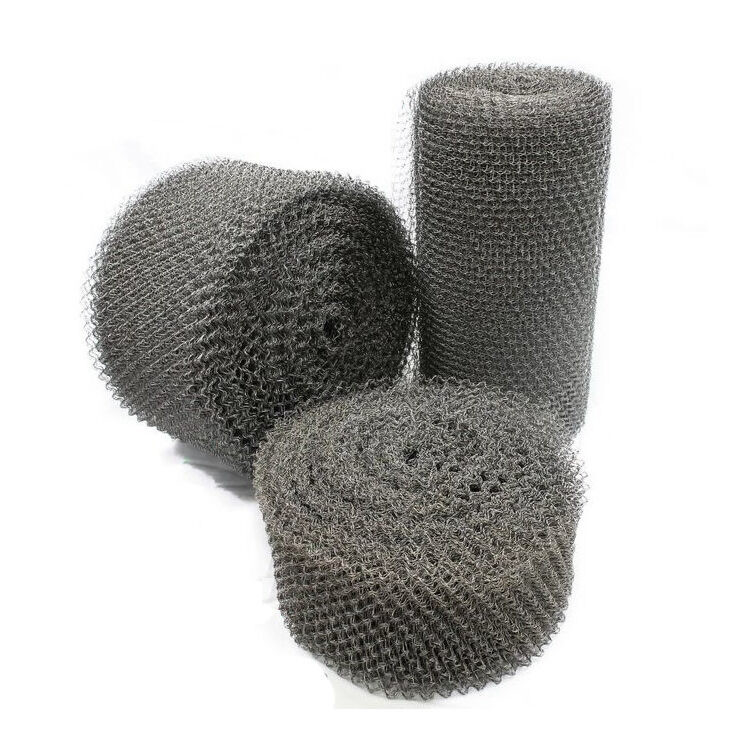
Materials for knitted wire mesh rolls
All illustrated material groups remain available. Specify the exact grade and environment; corrosion resistance and temperature limits are confirmed for the selected material and duty.
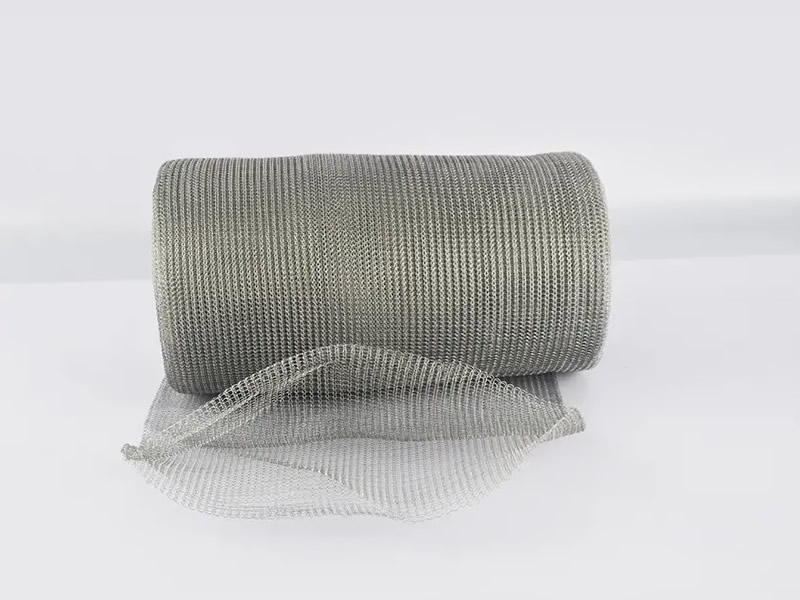
KMR-1: Stainless Steel Knitted Wire Mesh
- Stainless steel 304, 316, 316L, 309, 310S and 321
- Galvanized steel and plain carbon steel
- Tin-plated copper-clad steel
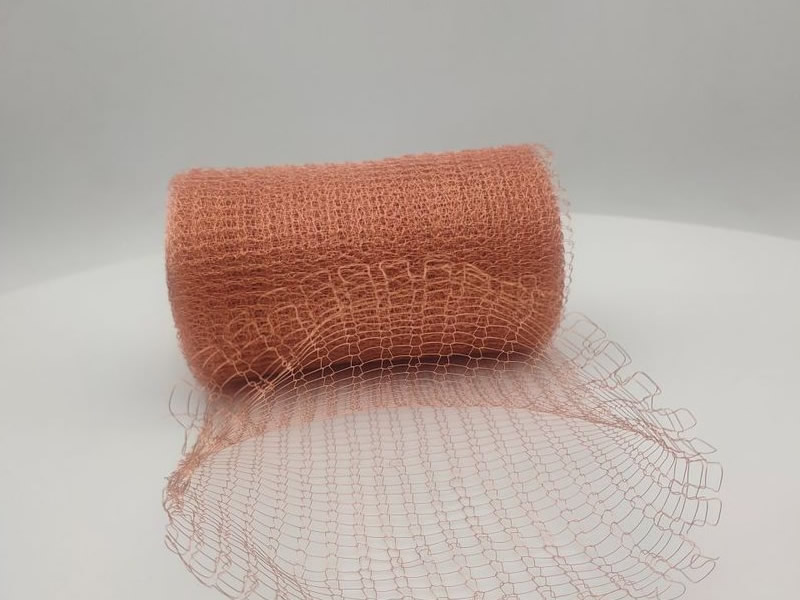
KMR-2: Copper Knitted Wire Mesh
- Copper
- Tinned copper
- Brass
- Phosphor bronze
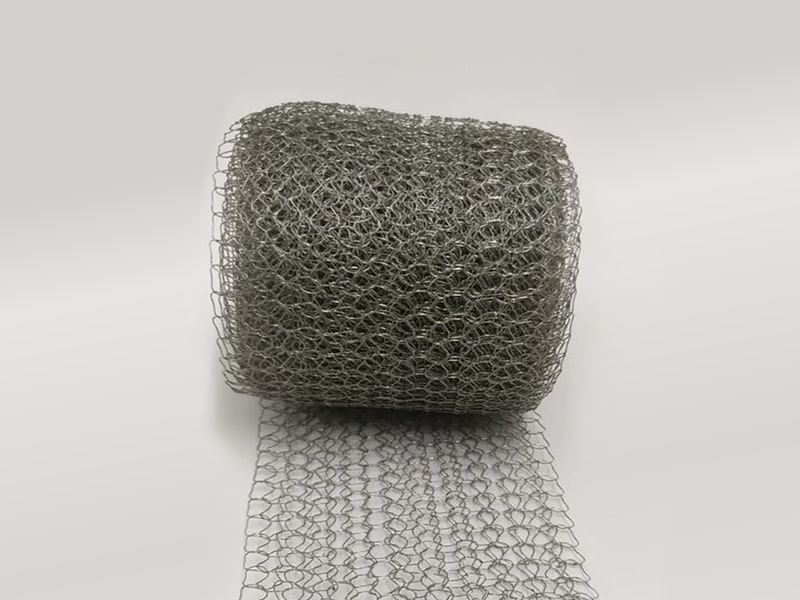
KMR-3: Other Metal Knitted Mesh
- Aluminum
- Nickel
- Titanium
- Monel alloys
- Inconel alloys
- Hastelloy alloys

KMR-4: PP Knitted Mesh
Polymer knitted mesh is available in PP, PE, PTFE and PVC, with the exact material and operating conditions confirmed.

KMR-5: Knitted Mesh in Mixed Material
Mixed-material knitting includes nylon with metal wire and PP with metal wire. Specify each feed material and its wire or filament dimensions.

KMR-6: FeCrAl Fiber Knitted Mesh
FeCrAl fiber knitted mesh is available to the agreed material and structure specification.
Knitted mesh roll and tubular dimensions
- Round-wire diameter: 0.1–0.4 mm; common sizes 0.20, 0.23, 0.25 and 0.28 mm.
- Flat wire: width and thickness confirmed to drawing.
- Feed-wire count: 1–12 wires knitted together, not 1–12 mesh layers.
- Tubular mesh diameter: 6–1200 mm. This is the tube diameter, not flattened roll width.
- Flattened width: specified separately, with the measuring and stretching condition agreed.
- Length: supplied to order and packaging requirements.
- Forms: flattened rolls, tubular sleeves and crimped/corrugated rolls.
Specify whether dimensions refer to relaxed tubular mesh, flattened double-layer mesh or an extended state. These dimensions must not be used interchangeably.
Round-wire and flat-wire knitted mesh
Specify round-wire diameter or both flat-wire width and thickness. The existing two specification tables below remain unchanged as reference data; confirm the order specification and measurement basis for the required material and form.

KMR-7: Single Round Wire Knitted Mesh – Flat Roll

KMR-8: Single Flat Wire Knitted Mesh – Flat Roll

| Specification of SS Knitted Mesh - Round Wire | ||||||
| Types | Typical Wire Diameter | Flattened Width | Number of Stitches Per cm on Length | Number of Stitches Per cm Across Lay Flat | ||
| mm | inch | mm | inch | |||
| Fine Mesh | 0.08 – 0.15 | .0031” - .0059” | 6 - 160 | .24” - 6.30” | 3.5 | 4.4 |
| Medium-fine Mesh | 0.15 - 0.18 | 0.0059” - .0071” | 40 - 600 | 1.57” - 23.62” | 2.4 | 3.5 |
| Standard Mesh | 0.18 - 0.35 | .0071” - .0138” | 30 - 1200 | 1.18” - 47.24” | 1.6 | 1.9 |
| Coarse Mesh | 0.25 - 0.40 | .0098” - .0157” | 30 - 1000 | 1.18” - 39.37” | 1.6 | 0.74 |
| Super Coarse Mesh | 0.40 - 0.50 | .0157” - .0197” | 200 - 350 | 7.87” - 13.78” | 0.5 | 0.5 |
| Kitted mesh rolls can be produced based on customers’ requirement. Products are supplied in form of rolls, ready-made into packages or finished elements with specified outer diameter/density request. | ||||||
| Specification of Knitted Mesh - Flat Wire | ||||||
| Types | Typical Wire Size (Thickness × Width) | Max Flattened Width | Hole Number | Material | Weight | |
| mm | mm | inch | Kg/m² | |||
| Standard | 0.1 × 0.4 | 100 | 3.94” | 40 | SS302 | 1/0.5 |
| 0.1 × 0.4 | 180 | 7.09” | 60 | SS302 | 1/0.5 | |
| 0.1 × 0.4 | 400 | 15.75” | 140 | SS302 | 1/0.5 | |
| 0.1 × 0.4 | 100 | 3.94” | 40 | Copper | 1/0.7 | |
| High Efficiency | 0.1 × 0.3 | 100 | 3.94” | 70 | Stainless Steel | 1/0.6 |
| 0.1 × 0.3 | 100 | 3.94” | 80 | Stainless Steel | 1/0.6 | |
| 0.1 × 0.3 | 150 | 5.91” | 90 | Stainless Steel | 1/0.6 | |
| 0.1 × 0.3 | 400 | 15.75” | 200 | Stainless Steel | 1/0.6 | |
| High Penetration | 0.1 × 0.4 | 160 | 6.30” | 20 | Stainless Steel | 1/0.4 |
| 0.1 × 0.4 | 150 | 5.91” | 30 | Stainless Steel | 1/0.4 | |
| 0.1 × 0.4 | 400 | 15.75” | 70 | Stainless Steel | 1/0.4 | |
| Kitted mesh rolls can be produced based on customers’ requirement. Products are supplied in form of rolls, ready-made into packages or finished elements with specified outer diameter/density request. | ||||||
Multi-wire and crimped roll structures
Crimping or corrugation is a post-knitting operation, not an inherent feature of the knitted loops. Single-direction, single-herringbone and double-herringbone forms are available. Crimp depth is the vertical peak-to-valley distance; pitch is the spacing between adjacent peaks. Pattern angle and measurement direction are specified on the drawing.
Depth, pitch, angle and pattern are confirmed from your drawing or sample and the selected tooling. A tool defines a related set of geometric parameters; changing tooling can change the corrugation, subject to the base mesh and agreed process.
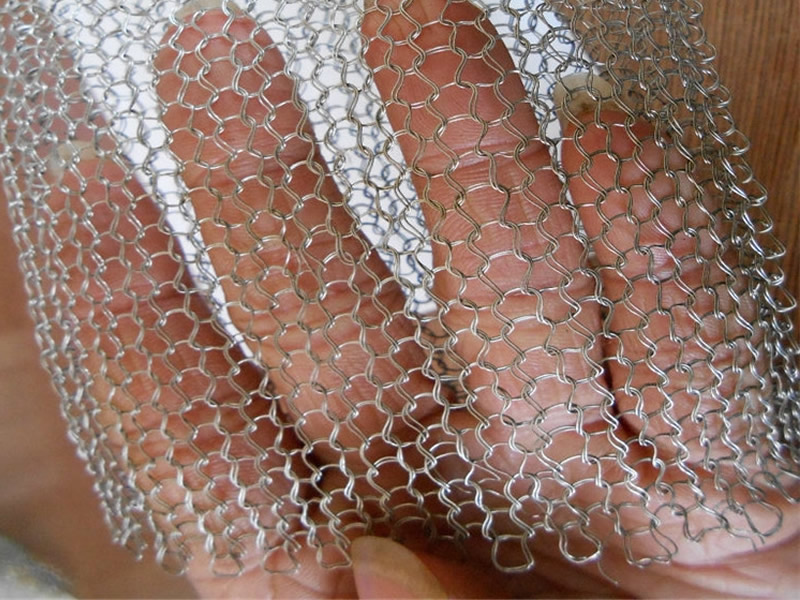
KMR-9: Double Wire Knitted Mesh – Flat Roll
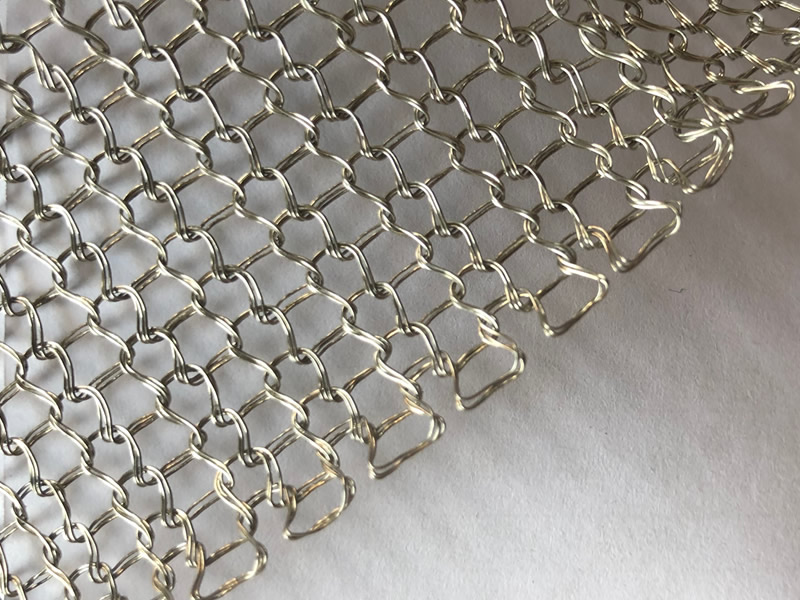
KMR-10: Triple Wire Knitted Mesh – Flat Roll

KMR-11: Twelve Wire Knitted Mesh – Flat Roll

KMR-12: Four-wire knitted mesh — double-herringbone crimp

KMR-13: Single-direction crimped knitted mesh
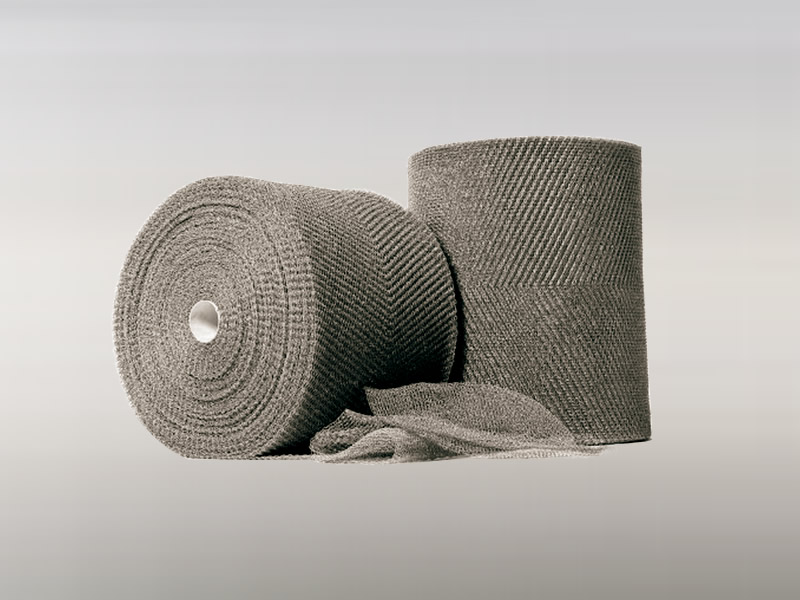
KMR-14: Herringbone-crimped knitted mesh

KMR-15: Brass Knitted Mesh after Flattening

KMR-16: Round knitted sleeves without Flattening
Roll specifications versus compressed-part specifications
For uncompressed mesh, use feed-wire count, wire size, stitch count or loop dimensions and areal weight to define and check the material. Agree the relaxed or extended state and whether g/m² refers to a single unfolded layer or a flattened double layer. Free-state bulk density and porosity are secondary references that depend on the measuring condition; no universal porosity range is promised.
Compressed parts use finished dimensions, mass, bulk density and, where specified, calculated porosity. These values do not replace the roll specification and do not alone guarantee pressure loss, filtration, damping or sealing performance. Porosity calculations for mixed materials also require their composition and material densities.
Manufacturing inspection
- Materials: metal certificates/MTC checked against the specification; polymer and mixed-material documentation checked as applicable. PMI can be agreed for metal components.
- Wire size: sampled round-wire diameter or specified flat-wire dimensions; each feed wire checked for multi-wire constructions.
- Feed-wire count: number and identity of wires fed to knitting verified.
- Dimensions: tubular diameter or flattened width checked at multiple positions in the agreed state.
- Weight: samples weighed to verify the agreed areal-weight basis. Compressed-part density is a separate finished-component check.
- Corrugation: depth, pitch and angle checked only for crimped products.
- Broken wires: visually inspected; continuous wire breaks are not accepted, and local defects are assessed against agreed criteria.
- Missed stitches: missing loops and skipped stitches checked against the agreed defect limits.
Custom rolls and sample reproduction
Material for a new project
Discuss the downstream component, environment and forming requirements. We review material, feed-wire count, loop structure and supply form before agreeing the mesh specification.
Manufacture to drawing
Send the material, wire, loop, dimensional, weight and corrugation requirements with measurement conditions and acceptance criteria.
Recreate from a sample
A sample helps recover material geometry and knitting details. Uncertain alloy, original measuring state or functional requirements must be confirmed before reproduction.
Knitted wire mesh rolls FAQ
Does multi-wire mean multiple mesh layers?
No. It means multiple feed wires knitted together into the loop structure. Layer count is a separate specification.
Is the 6–1200 mm range a flat roll width?
No. It refers to tubular mesh diameter. Flattened width and measuring state must be specified separately.
Can you supply flat and tubular mesh?
Yes. Flattened rolls, unflattened sleeves and the illustrated crimped forms are available.
Is corrugation formed during knitting?
No. It is a subsequent forming process. Depth, pitch, angle and pattern are agreed from the drawing or sample and tooling.
Can roll density be used as compressed-component density?
No. The material state and volume basis differ. Specify each stage separately.
Does multi-wire mesh always have better fatigue or heat resistance?
No. Performance depends on material, wire dimensions, loops, forming and service conditions. Select and validate the finished structure for the duty.
Inquiry for Our Product
Please provide:
- Material grade for every feed wire or filament
- Single-wire or multi-wire construction and feed-wire count
- Round-wire diameter or flat-wire width and thickness
- Stitch count, loop dimensions and the measuring direction/state
- Tubular diameter or flattened width, length and packaging
- Areal weight and its area basis: single unfolded layer or flattened double layer
- Crimp pattern, depth, pitch and angle, if required
- Drawing or sample, downstream use, environment, acceptance criteria and quantity
Related Products

Products
Contact Our Engineers
Complete our interactive form to receive a custom quote based on your needs.