By Jack Sun · Filtalloy
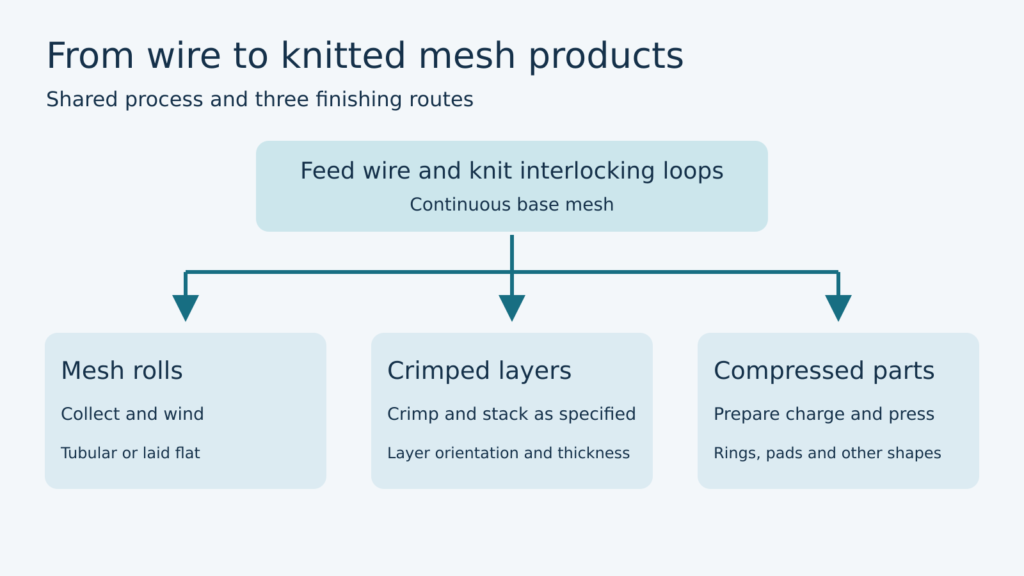
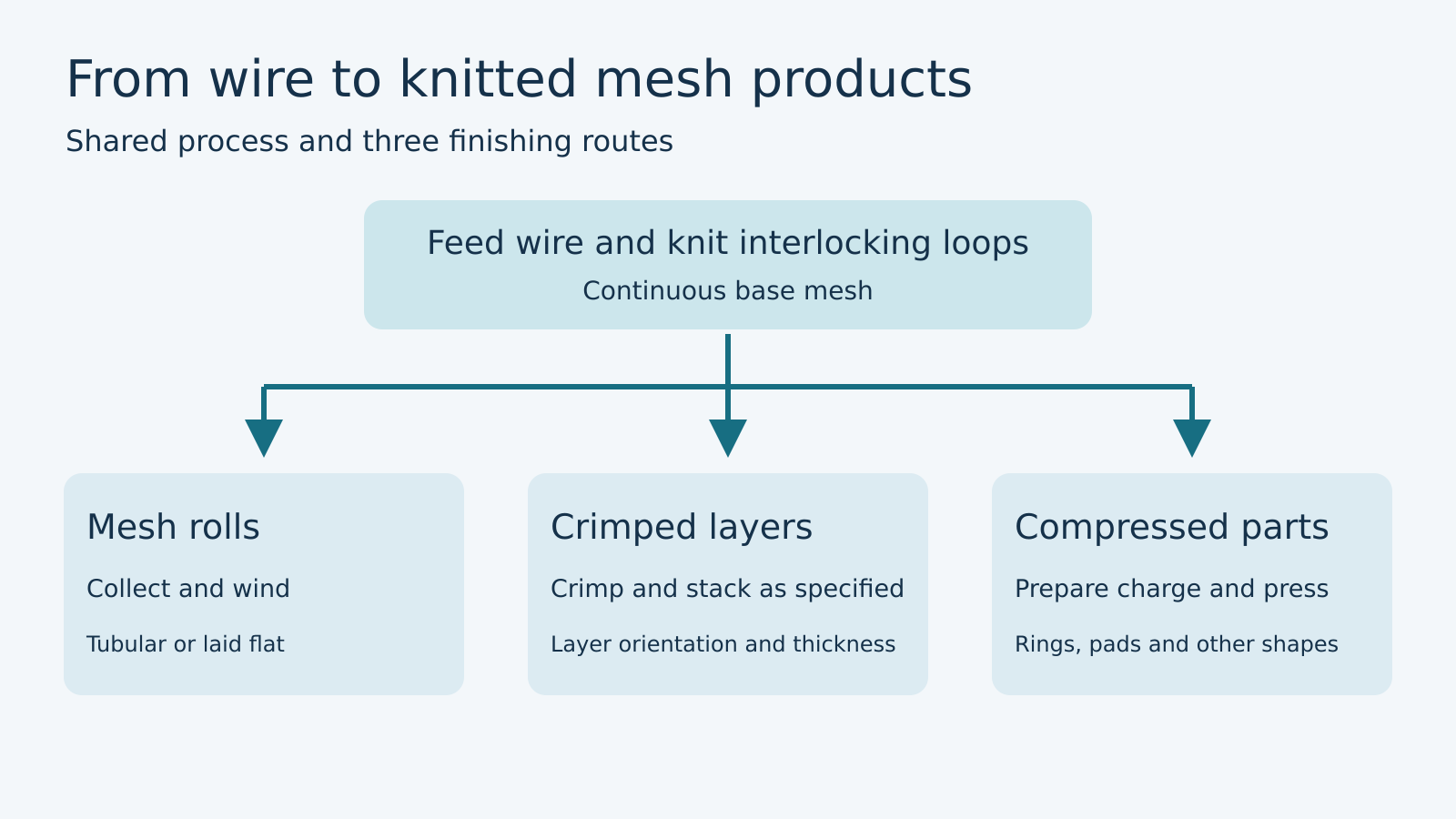
Knitted wire mesh is made by drawing metal wire into successive interlocking loops. A common starting form is a continuous tube. That tube can be flattened and rolled, crimped and layered, or cut and die-pressed, depending on how the mesh will be used.
How metal wire becomes knitted mesh
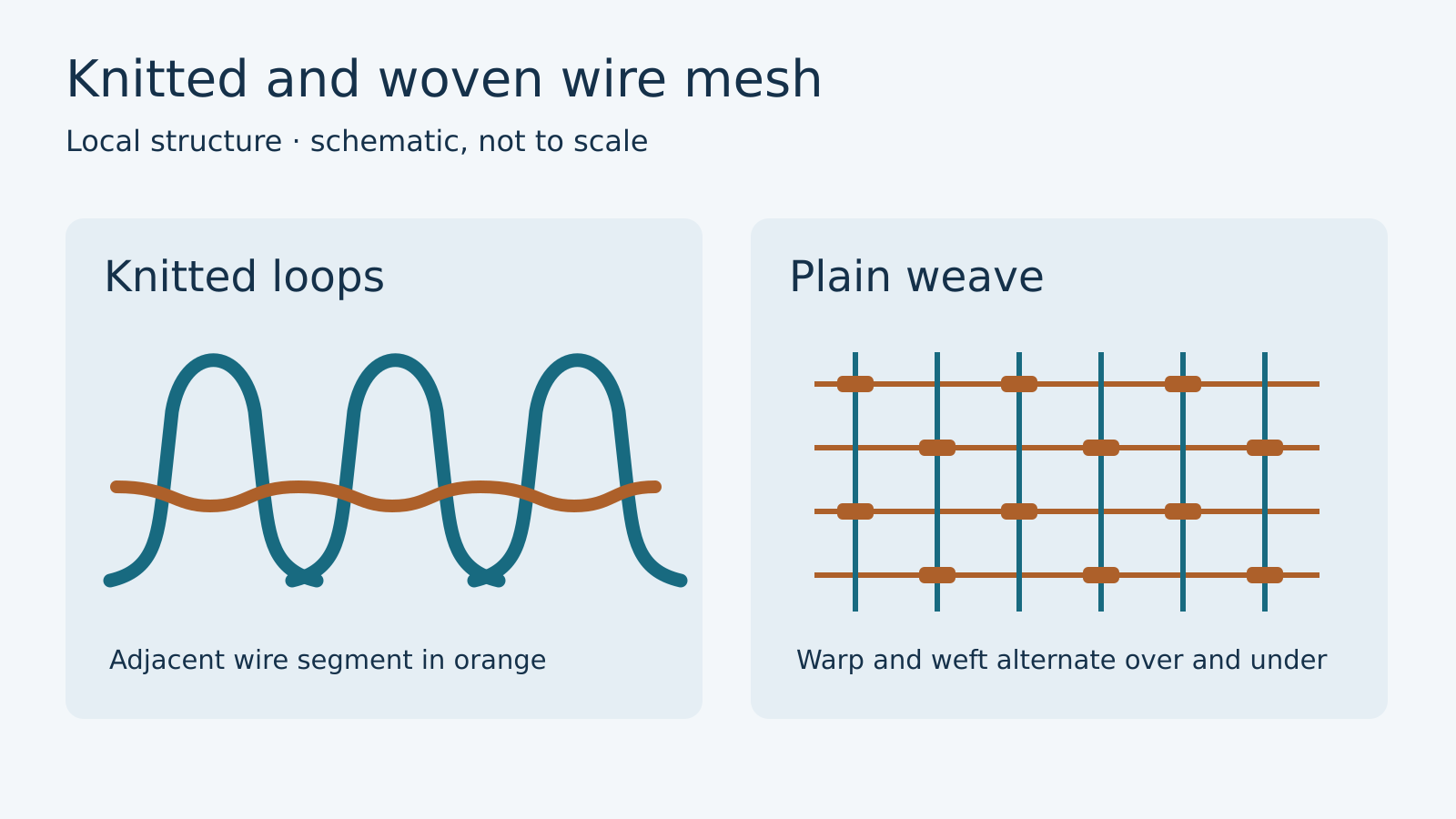
Wire feeds through guides to a set of needles that form new loops through earlier loops. Wire diameter, number of wires fed together, feed tension and machine settings influence the resulting mesh. Unlike a woven cloth with warp and weft crossings, a knitted mesh consists of linked loops that can move and deform relative to one another.
Wire needs to feed consistently without sharp kinks or damaged surfaces. Inspect a trial length for dropped or irregular loops, local changes in width and wire breaks before judging the rest of a roll.
Three routes from the same basic mesh
Flattening and winding
A tubular knit can be collapsed and wound without cutting the folds. Specify whether the dimension is the tube diameter or the laid-flat width. A flattened tube has two walls joined along the folds. Specify slitting separately if the job calls for independent flat sheets.
Crimping and layering
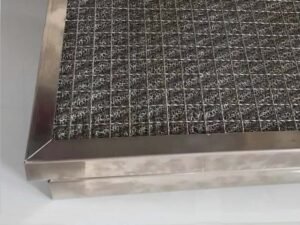
Crimping adds a wave to the knitted material. Wave height, pitch and direction, together with the way the layers are stacked, influence the spaces between layers. A panel specification can distinguish core thickness from the frame size and record the layer count, orientation and installed thickness.
Compression molding
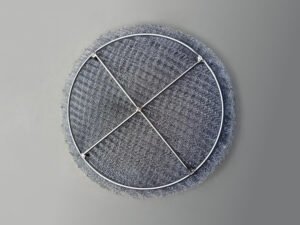
A controlled quantity of knitted mesh is cut, folded or gathered into a preform and pressed in a die. The result may be a ring, pad or shaped support. The die establishes the outer geometry, while the amount and placement of mesh and the direction of compression influence the internal structure.
What to check after forming
For rolls, check wire diameter, the agreed width convention, roll length and visible defects. For crimped layers, check wave height, pitch and direction where those features affect fit or flow. For pressed parts, check finished dimensions and individual mass. A resilient support may also need a specified compression direction and load–displacement test.
Two compressed rings with the same outside dimensions and mass can have different loop contacts and deformation behavior. Where that behavior matters, verify it on the finished part under the specified loading conditions. Research on compressed metal-wire structures
Drawing and sample checks
A drawing should name the delivery form first: roll, layered core, framed panel or pressed component. Show the dimension reference and functional tolerances. With a used sample, photograph the whole part and its edges, record the dimensions and mass as appropriate, and identify wear or distortion separately. Material grade and the original resilience requirement may need to be confirmed from a specification or by an agreed test.
Frequently asked questions
Is flattened tubular mesh one layer or two?
It is one continuous tube with two walls in the flattened cross section. Specify whether the folds are to remain intact.
Do wave height and pitch matter if the drawing already gives total thickness?
Yes, when the wave and layer arrangement affect fit or performance. The same overall thickness can come from different crimp and stacking arrangements.
Can equal mass and dimensions establish equal spring response?
Use the original load–displacement requirement, where available, and verify the new part in the specified direction and test setup.
Jack Sun has long worked in metal wire mesh weaving and industrial filter-element manufacturing. Filtalloy is based in Anping, Hengshui, Hebei, China.