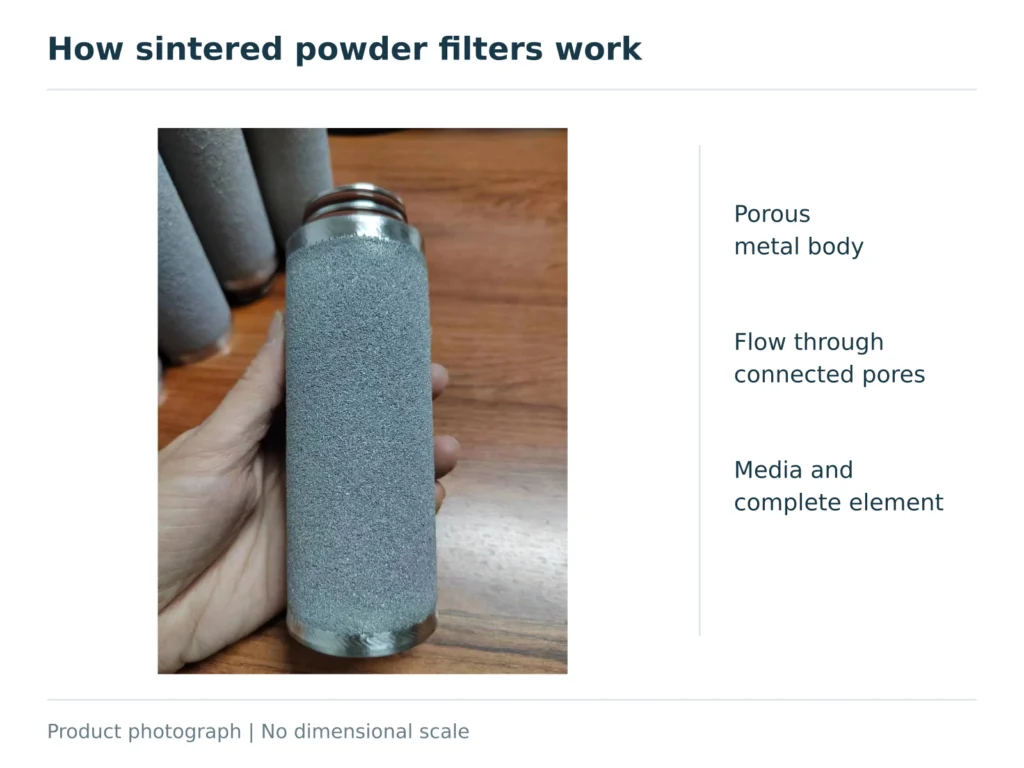
A sintered metal powder filter has a solid skeleton of bonded metal particles and a network of pores between them. Connected pores provide flow paths for liquid or gas. Contaminant particles can be retained at the surface or inside those paths; accumulated solids may also form a surface cake.
To understand the sintered filter working principle, read the micron rating together with the pore structure and flow-test conditions. These describe particle retention and fluid resistance from different angles.
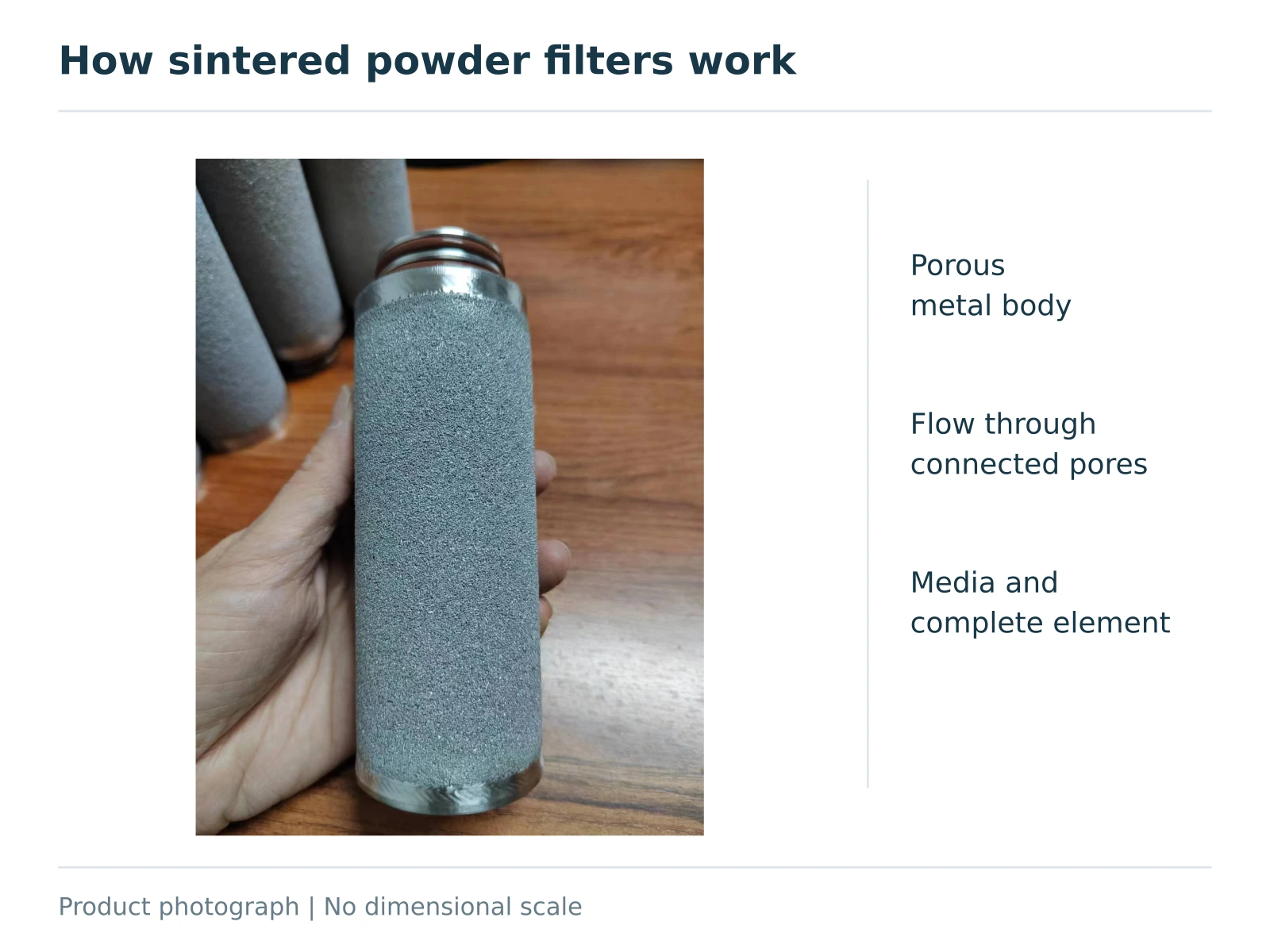
1. How the metal skeleton and pores form together
Sintering must produce stable bonds while retaining the intended porous structure.
Metal powder is formed and sintered so that particles bond at their contacts. A porous filter is not intended to become a fully dense metal component. The spaces remaining between the bonded particles form the pore network.
The powder particles used to manufacture the medium and the contaminant particles it later captures are different things. Powder size is a manufacturing variable; it is not itself the finished filter's particle-removal rating.
Powder characteristics, forming and sintering conditions influence the resulting structure. A study of sintered 316 stainless steel filters illustrates these relationships for its own materials and process conditions [2]. Its measured values should not be treated as universal product specifications.
This article concerns porous metal made from sintered powder. Woven sintered mesh and metal fibre felt have different starting structures and are not interchangeable descriptions of the same medium.
2. How fluid passes through the pores
A pressure difference drives flow through paths that connect the inlet and outlet surfaces.
The paths can branch, change direction and narrow. Their geometry differs from a set of identical straight drilled holes.
| Pore feature | Connection | Relevance to through-flow |
|---|---|---|
| Through-connected path | Joins the upstream and downstream surfaces | Carries flow through the medium |
| Blind branch | Opens into a path or surface but ends within the material | Does not independently provide a complete through-path |
| Closed pore | Isolated from the connected network | Does not carry through-flow |
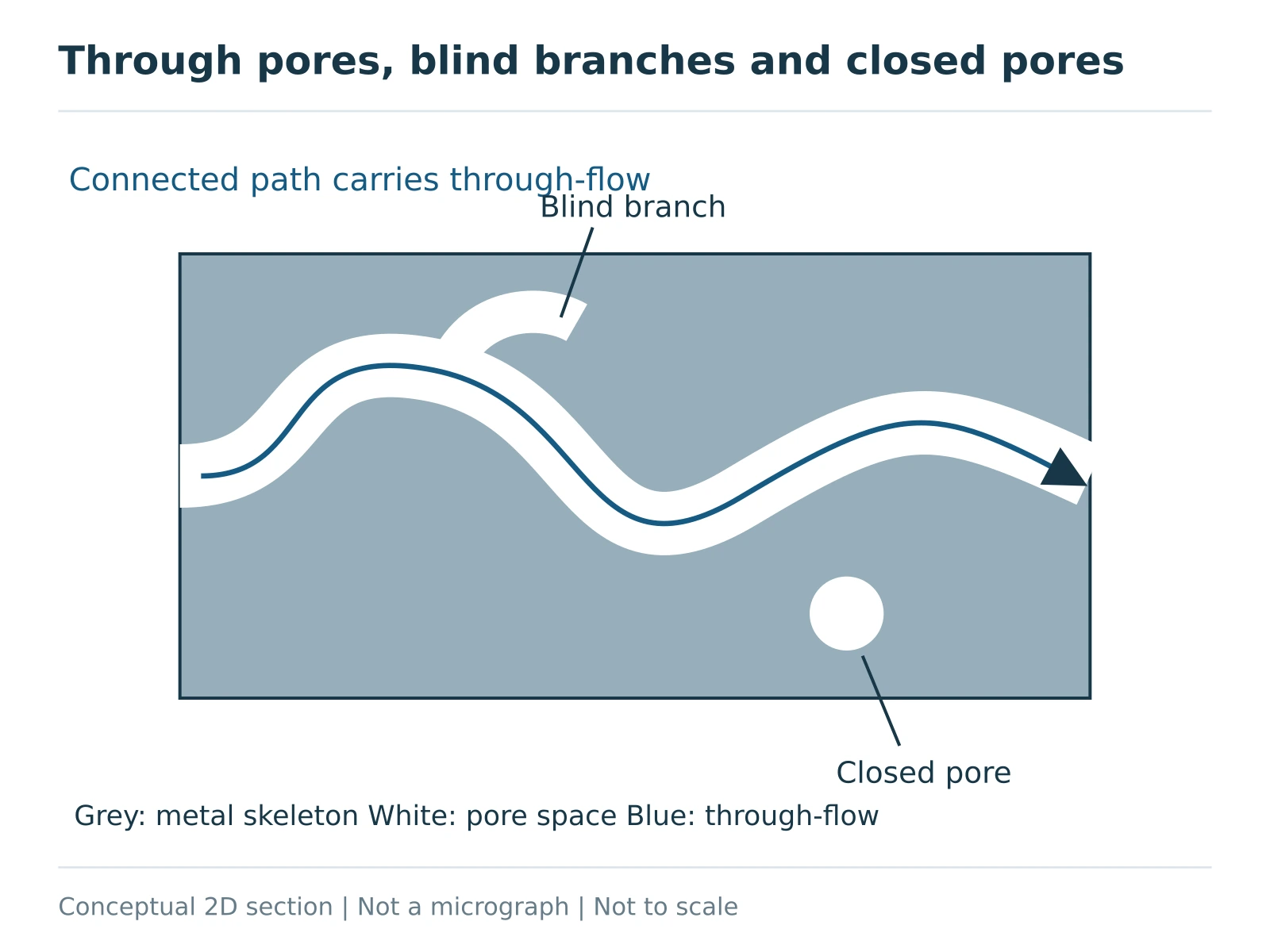
Total void fraction alone does not reveal how much of the pore network carries flow or how restrictive its narrow regions are. ISO 4022 addresses determination of fluid permeability for permeable sintered metal materials [1]; a permeability result needs its measurement conditions.
3. Where contaminant particles are retained
Retention may occur near the surface or within the interconnected pore paths.
A particle that cannot pass an entrance can remain near the surface. Particles entering the network may be retained further inside at constrictions or through interactions with the medium. The outcome depends on pore geometry, particle properties and operating conditions.
As retained solids accumulate, a surface cake may develop. That deposit becomes part of the flow resistance and may change subsequent retention. Increasing pressure loss therefore reflects the changing filter system, rather than only the clean metal structure.
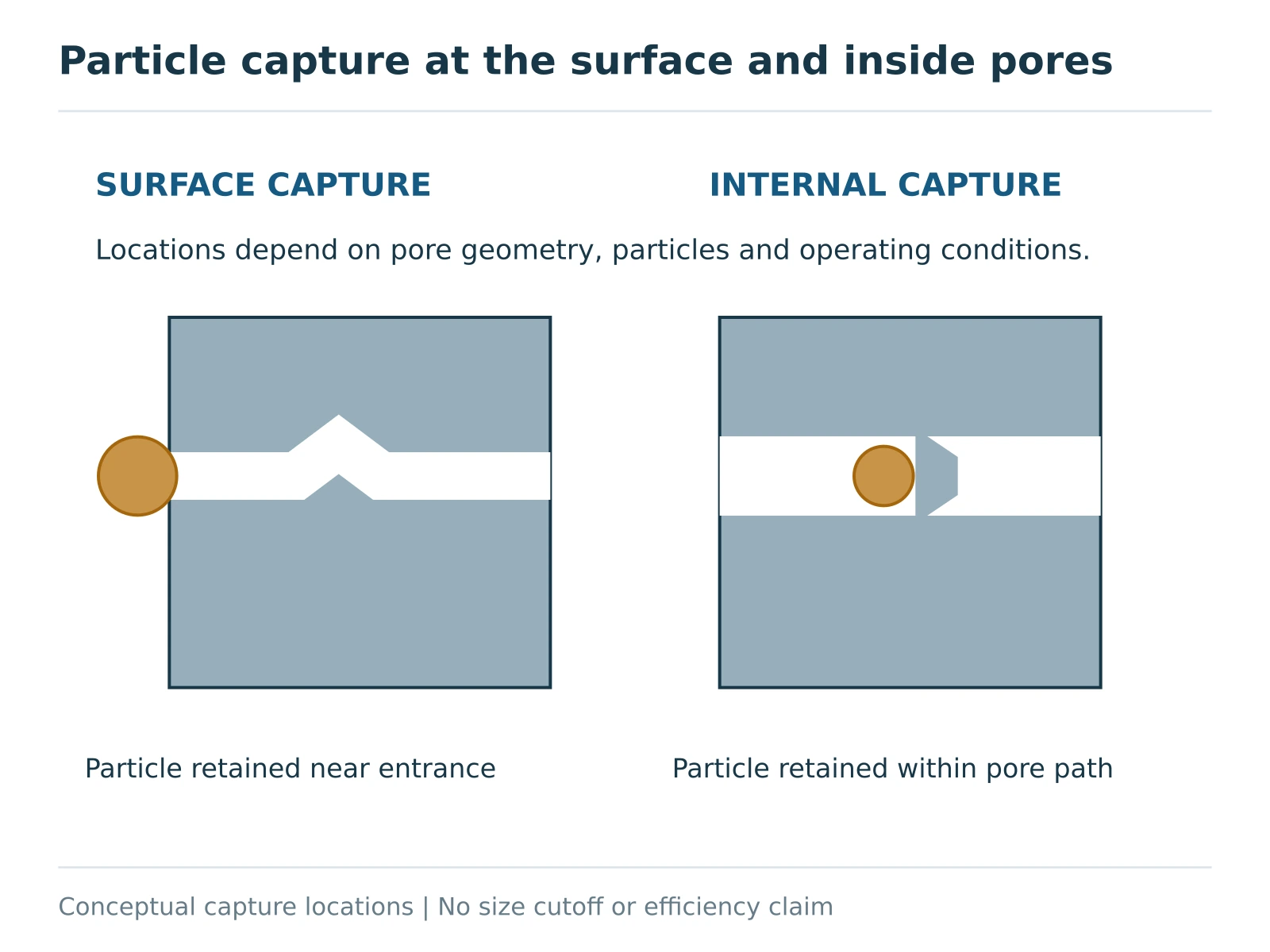
After cleaning, check permeability recovery under comparable test conditions as well as visible surface cleanliness. Internal deposits may remain even when the surface looks clean.
For a uniform medium, consider capture and resistance across the wall. For an asymmetric construction, identify the filtration and support regions from its specification before interpreting their roles.
4. Distinguish porosity, pore measurements and filtration rating
These quantities describe different properties and should not substitute for one another.
| Quantity | What it describes | What it does not establish alone |
|---|---|---|
| Porosity | Fraction of bulk volume occupied by pores, under its stated definition | Pore connectivity, permeability or particle removal |
| Pore-size measurement | A pore characteristic determined by a specified method | Complete-element retention under every condition |
| Filtration rating | Particle removal defined by a stated method and criterion | Every pore dimension or a universal size cutoff |
Two media can have similar porosity and different pore connections, constrictions and permeability. Likewise, manufacturing powder size does not directly equal the finished pore size or filtration rating.
ISO 4003 describes a bubble-test method for permeable sintered metal materials [3]. Such pore-related testing can support characterization or quality control within its scope, but it should not be relabelled as a complete particle-retention test.
If a specification says “10 μm,” ask what the number represents, how it was determined and what acceptance criterion applies. See our filter micron rating and efficiency guide for the distinction between a rating and its supporting definition.
Research into controlling pore structure and permeability also highlights the need to consider these properties together [4]. Values reported for a particular experimental material are not automatically specifications for another filter.
5. How wall thickness and pore structure affect flow
Thickness matters together with permeability, effective area, fluid properties and operating conditions.
For a uniform flat medium under linear viscous-flow conditions, holding permeability, fluid properties and superficial velocity constant, increasing flow-path thickness increases pressure loss. This conditional relationship is not a direct calculation for every thick-walled cylindrical element or compressible gas flow.
A cylindrical wall has a radial flow geometry. An asymmetric wall may contain regions with different permeability. These cases require a model appropriate to the actual construction and flow regime rather than an unqualified thickness multiplier.
Effective filtering area also differs from external outline area. Ends, joints, blocked regions and connection features may not contribute to active flow.
Fluid viscosity and gas compressibility affect the result. A flow value without its fluid, temperature and pressure conditions is difficult to compare. A rising operating differential pressure can also involve flow changes, temperature, deposits or the rest of the circuit; it does not uniquely identify one media fault.
When comparing wall thicknesses, check the defined retention requirement and flow-test result together. Thickness alone does not establish finer filtration.
6. From porous material to a complete filter element
The complete element includes its porous body, end connections, joints and sealing interfaces.
The fluid must follow the intended route through the medium. A seal or connection that permits bypass can change complete-element performance even when a media specimen meets its own requirement.
Characterization of a material coupon and verification of an assembled element answer different questions. Define which item is tested, the fixture, flow direction, conditions and acceptance criteria.
For an asymmetric design, use the actual specification to identify the filtration region, supporting region and intended flow direction. A section drawing or construction record can clarify relationships that a product photograph leaves hidden.
Our porous metal filter product page covers available forms. See also asymmetric sintered metal filters when a differentiated wall structure is relevant. Contact Our Engineers with your drawing or existing specification to clarify the construction and verification required.
7. Frequently asked questions
Does finer manufacturing powder always mean finer filtration?
Powder characteristics influence the finished structure, but forming and sintering also matter. A manufacturing powder size cannot replace a finished-medium retention specification.
Does higher porosity always mean higher flow?
Porosity alone omits connectivity, constrictions and path geometry. Compare permeability or flow results under stated and comparable conditions.
Can the filtration rating be calculated from porosity?
Porosity alone is insufficient. A rating requires a defined particle-removal method and criterion; pore measurements address related but different characteristics.
Is a thicker filter always better?
Thickness can affect resistance and structural behaviour, but it does not independently determine retention, allowable pressure or service life. Judge the actual construction against the task and its defined tests.
References
[1] ISO 4022:2018, *Permeable sintered metal materials — Determination of fluid permeability*. Official standard information. Cited for scope, not an unreviewed full test procedure.
[2] Shin Kwang Jae and Lee Dong Hi, study of fabricated sintered 316 stainless steel filters. Korean Journal of Metals and Materials article. Experimental conditions and results belong to that study.
[3] ISO 4003:1977, *Permeable sintered metal materials — Determination of bubble test pore size*. Official standard information. Scope reference only.
[4] Lee D. H. et al., *Enhancing Filtration Performance of Sintered Metal Filters Through Pore Structure Modification Using Fine Flake-Shaped Particles*, Archives of Metallurgy and Materials, 2026, 71(2), 605–609. Published paper. No experimental result is presented as our product guarantee.
Jack Sun works with metal mesh weaving and industrial filter manufacturing in Anping, Hebei. This explanation connects material structure with the information needed to read a filter specification; product performance remains tied to the specified construction and verification conditions.