
By Jack Sun · Updated October 22, 2026
Quick definition
A filter micron rating describes a filtration specification related to particle size. Filtration efficiency describes the fraction of particles removed under stated conditions. Compare the size definition, efficiency basis, test method and operating conditions together.
Two elements marked “10 μm” may use different media, challenge particles and acceptance criteria. This guide explains specifications for woven wire mesh, sintered mesh, metal fiber felt and sintered powder media. General definitions do not establish the measured performance of any particular product.
1. What does a filter micron rating mean?
One micrometer (μm) is 0.001 mm, so 10 μm is 0.01 mm. This conversion establishes size, not removal efficiency. Check whether the stated number describes a geometric aperture, a nominal filtration grade, a particle size at a specified efficiency, or an equivalent pore size from a bubble test.
Read a specification as size plus performance conditions. Identify the particle threshold, required removal level, test fluid, flow and evaluation method. Mesh count alone cannot determine the aperture: square woven mesh needs both mesh count and wire diameter. Dutch weave, fiber felt and sintered powder do not follow the same square-aperture calculation.
See the wire mesh size calculator for applicable geometric calculations.
2. Pore size vs particle size
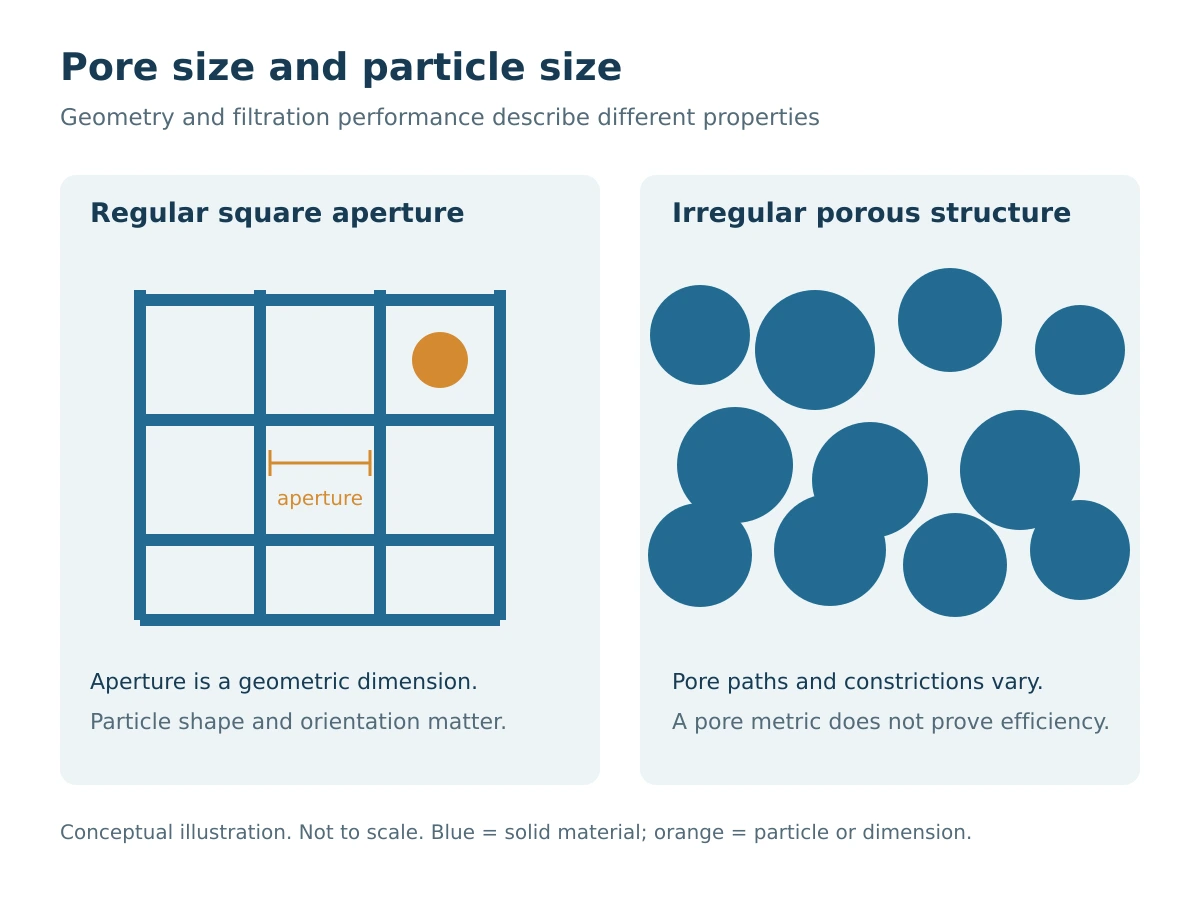
Pore size describes a passage through the medium; particle size describes the contaminant using a specified measurement method. Irregular particles have shape, orientation and sometimes deformability. Their passage also depends on pore distribution, structure, flow, deposits and element integrity. Fiber capture involves more than simple sieving.
A pore-size number alone cannot establish that every larger particle is stopped or every smaller particle passes. ISO 4003 describes bubble-test pore-size determination for permeable sintered metals as a quality-control method. It does not directly determine a precise pore-size distribution or filtration grade. [1]
A bubble result can help assess pore structure or consistency with an agreed wetting liquid and procedure. It cannot independently establish “99.9% removal” at that pore size. Use an application-appropriate particle-removal test when an efficiency result is required.
3. Nominal vs absolute micron rating
A nominal rating identifies a grade according to a supplier’s specification or an agreed definition. The word does not specify a universal removal percentage. An absolute rating also needs an explicit definition: it may refer to a geometric limit, a defined challenge test or a stated efficiency threshold.
| Specification | What it states | What to verify |
|---|---|---|
| 10 μm nominal | A named nominal grade | Grade definition, efficiency and test basis |
| 10 μm absolute | A named absolute grade | Definition, threshold, method and conditions |
| 10 μm aperture | A geometric opening | Tolerance, distribution, seals and actual retention |
| β10(c) = 200 | A ratio at a calibrated size threshold | Method, conditions, statistical interval and averaging |
Neither “nominal” nor “absolute” has a single universal percentage in this guide. Do not assume that absolute means 100%, 99.9% or one fixed beta value. Reconcile definitions before comparing or replacing elements. An untested nominal metal medium should not be presented as having an absolute or beta performance guarantee.
4. Filtration efficiency and filter beta ratio
Efficiency by particle count, by mass, and within one size interval can give different results. State the basis before comparing data. Fine particles can dominate counts while contributing relatively little mass.
Beta ratio filtration calculations
For the same particle threshold and volume basis:
βx = Cu,x / Cd,x
Cu,x and Cd,x are upstream and downstream particle number concentrations. Equal-volume samples allow a count ratio; unequal sample volumes require normalization. The corresponding count removal efficiency is:
ηx = (1 − Cd,x / Cu,x) × 100% = (1 − 1 / βx) × 100%
The ISO 16889 counting variables use cumulative concentrations of particles larger than x, rather than only particles exactly equal to x. Preserve the report’s threshold convention. The “(c)” notation relates to the applicable particle-counter calibration basis. ISO 16889 and ISO 11171 provide the relevant hydraulic-test and liquid particle-counter context. [2][3] These equations explain arithmetic; they do not replace the complete test and statistical procedure.
A calculated example
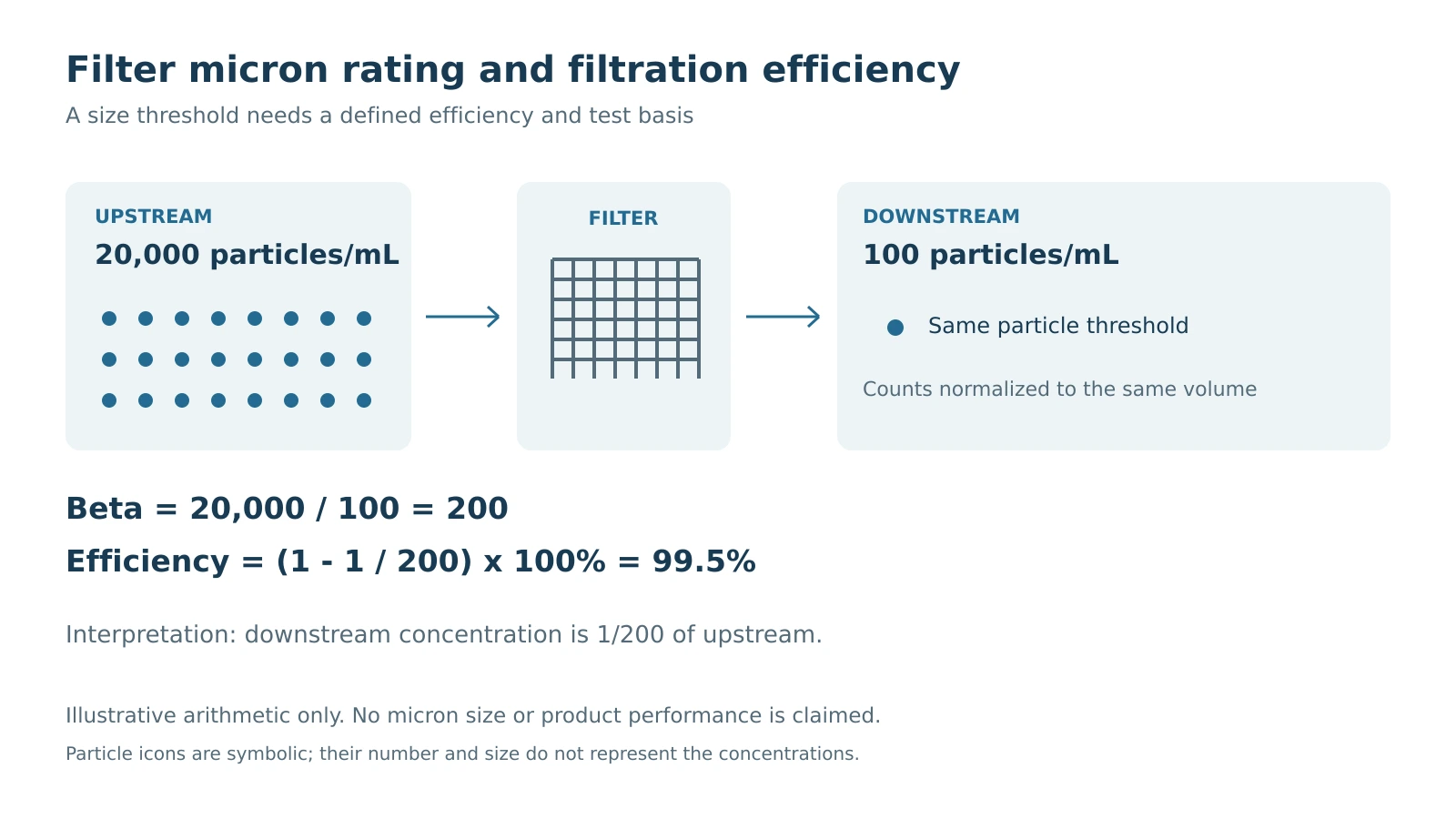
If upstream concentration is 20,000 particles/mL and downstream concentration is 100 particles/mL on the same basis, beta is 200 and efficiency is 99.5%. These are teaching values, not our product test results.
| Beta ratio | Count efficiency | Downstream/upstream |
|---|---|---|
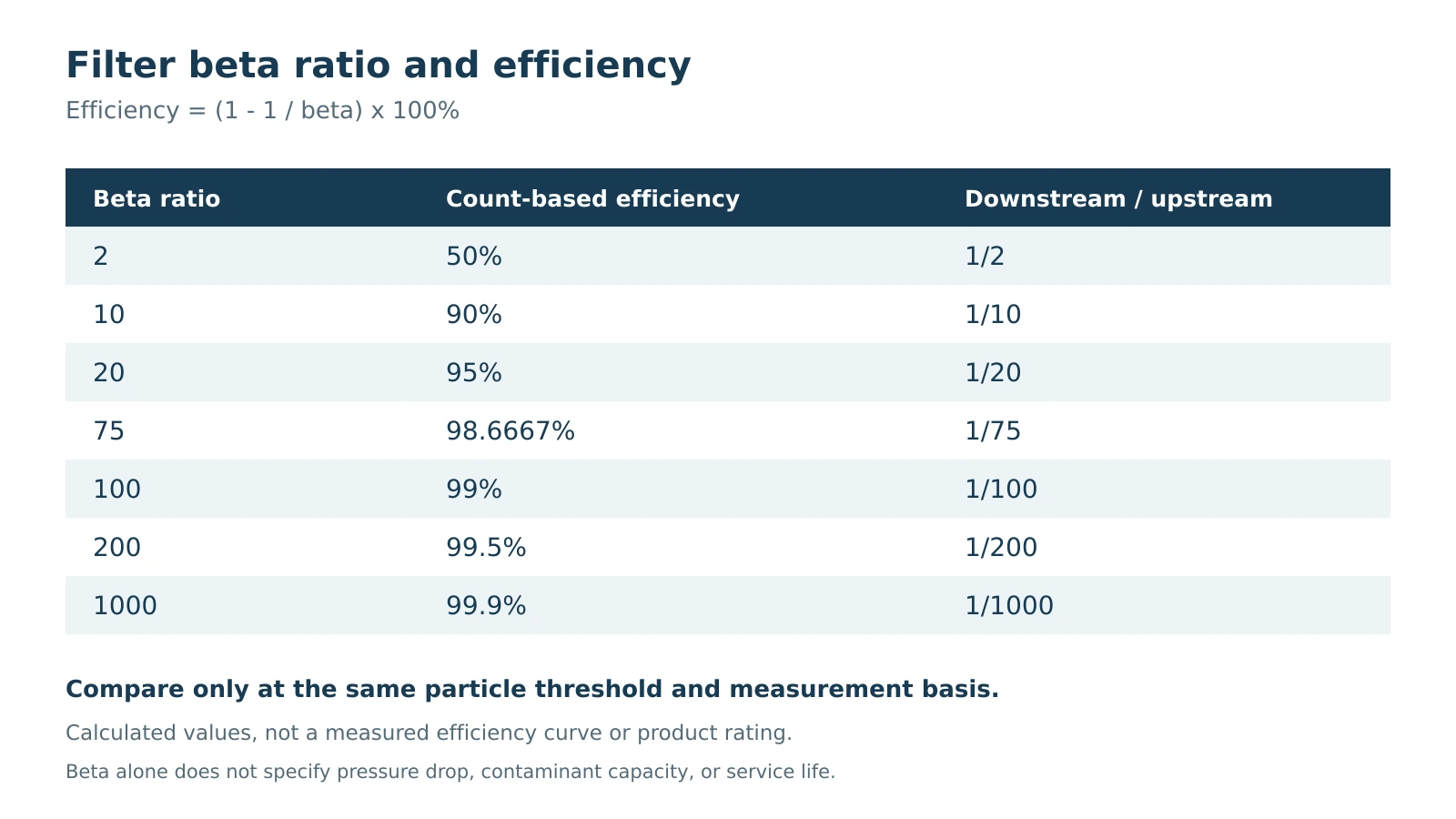
| 2 | 50% | 1/2 |
| 10 | 90% | 1/10 |
| 20 | 95% | 1/20 |
| 75 | 98.6667% | 1/75 |
| 100 | 99% | 1/100 |
| 200 | 99.5% | 1/200 |
| 1000 | 99.9% | 1/1000 |
Read beta with its particle size. One result cannot establish performance at every size, dirt capacity, pressure drop or service life. Zero downstream counts in a finite sample do not independently prove infinite beta or exactly 100% efficiency: sample volume, detection capability and reporting rules matter. Zero upstream counts leave no valid denominator for this calculation.
5. Test conditions and the filter efficiency curve
ISO 16889 is a multi-pass evaluation method for hydraulic filter elements, covering particle removal, contaminant capacity and differential-pressure characteristics. Its scope does not automatically cover every liquid application of metal media. [2]
Record fluid, temperature or viscosity, flow, contaminant, size/counting basis and test stage. Initial efficiency, a loading-stage value and a whole-test average are different report items. A filter efficiency curve may plot efficiency, penetration or beta against particle size; confirm both axes before comparing curves.
Loading can alter resistance and retention, but “dirtier is better” is not a universal rule. Startup, cleaning, pulsation and damage also require evaluation. Compare clean pressure drop, effective area and flow alongside retention. Finer filtration is useful only when it suits downstream requirements and maintenance. Check system bypass, installation and seals separately.
6. Reading metal filter media specifications
| Medium | Structural information | Additional performance evidence |
|---|---|---|
| Square woven mesh | Warp/weft counts, diameters, aperture, tolerances | Retention requirement for the actual particles and conditions |
| Dutch weave or sintered mesh | Weave, warp/weft specification, layers, nominal grade | A matching grade definition and test report |
| Sintered metal fiber felt | Thickness, porosity, grade, support | Efficiency, flow/pressure data and complete-element testing |
| Sintered powder metal | Material, dimensions, nominal grade, pore indicators | Application-appropriate particle-removal evidence |
Porosity is a volume fraction; open area is generally an area fraction. Neither directly converts to filtration efficiency. Distinguish a media coupon, a complete element and the installed system: coupon data do not establish the integrity of welds, end caps, connections or seals.
Specify both what must be manufactured and how it will be accepted. For strict efficiency requirements, agree on test methods, reports and sample validation before production.
Interpreting a 1–50 μm fiber-felt request
A requested range such as 1–50 μm does not define one common performance ladder. At any chosen size, establish whether the number names a supplier grade, a geometric or pore-related result, or a particle threshold with a stated removal requirement. A unit conversion gives 1 μm = 0.001 mm and 50 μm = 0.05 mm; it adds no retention evidence.
For a drawing-based replacement, keep the existing grade designation and its original definition together. If the definition is missing, record that gap rather than silently turning a nominal label into an absolute rating. For a new removal requirement, identify the particle-size convention, the required result and an applicable evaluation method before comparing candidate media.
Check the actual offered grade separately from the requested number. The fiber felt product page retains a supplier reference dataset, while the specifications and test data guide explains its fields. Neither a nominal row nor an interpolated value establishes an unlisted grade or a tested efficiency curve. Pressure drop and capacity remain separate comparisons.
7. MERV vs HEPA and liquid filtration metrics
Air and liquid filtration use different evaluation systems. EPA describes MERV in relation to air-filter capture of particles from 0.3 to 10 μm. It is not a pore size or a direct conversion from hydraulic beta. [4]
EPA’s HEPA explanation uses at least 99.97% efficiency for 0.3 μm particles. ISO 29463-5 evaluates elements at the most penetrating particle size (MPPS). Read each within its own system; MPPS is not universally fixed at 0.3 μm. [5][6]
| Metric | Main purpose | Does not independently establish |
|---|---|---|
| Aperture or pore size | Passage geometry | Removal percentage at a particle size |
| Nominal/absolute grade | A defined filtration grade | Interchangeability without definitions |
| Beta/count efficiency | Removal on a specified counting basis | Capacity or service life |
| MERV | Air-filter rating in its test system | A liquid-filter micron rating |
| HEPA/MPPS testing | Defined high-efficiency air performance | An untested metal medium’s rating |
| Pressure drop | Flow resistance under stated conditions | Adequate particle removal |
These comparisons make no MERV or HEPA claim for our metal media.
8. Preparing a verifiable filtration requirement
D50 is a particle-distribution statistic, not an automatic filter selection. Define the size range to control and acceptable penetration. Record:
- Process fluid and composition.
- Particle material, size range and measurement method.
- Required grade and its nominal, absolute or efficiency definition.
- Particle threshold and count or mass basis for an efficiency requirement.
- Test method, version, statistical rules and acceptance conditions.
- Flow, temperature, viscosity and relevant pressures.
- Clean and terminal differential pressures and element strength requirements.
- Dimensions, connections, seals, flow direction and cleaning method.
For example, agree to report count efficiency at a stated size threshold under an agreed test fluid and flow, together with clean and terminal pressure drop. Confirm the equipment requirement and feasible validation before assigning numbers. If only an old sample or a “10 μm” label is available, submit the original documents and identify what remains unknown.
9. Frequently asked questions
Does a 10 μm filter stop every 10 μm particle?
The label alone is insufficient. Check the grade, size measurement, efficiency, test conditions and complete-system seals. ### Does absolute mean 100% efficiency? Check the supplier’s explicit definition, challenge test, threshold and detection capability. ### Is beta 200 equal to 99.5% efficiency? Yes, mathematically on the same threshold, volume and count basis. It cannot be generalized to other sizes or conditions. ### Can a bubble test replace an efficiency test? It evaluates a different property. Pore-related quality-control results and particle-removal results must be interpreted separately. [1] ### Is a finer filter always better? Select for the downstream target, flow, pressure drop, effective area and cleaning needs. ### Does high differential pressure prove good filtration? It describes resistance. Corresponding particle data are needed to evaluate removal. ### Can equal micron ratings be interchanged? Also compare definitions, materials, structure, flow/pressure behavior, dimensions, connections and seals; validate samples when required. ### Can MERV or HEPA be converted into a metal liquid filter rating? No direct conversion establishes untested liquid-filtration performance.
References
- ISO 4003:1977 — Bubble test pore size.
- ISO 16889:2022 — Hydraulic filter multi-pass evaluation.
- ISO 11171:2022 — Liquid particle-counter calibration.
- US EPA — MERV rating.
- US EPA — HEPA filter.
- ISO 29463-5:2022 — Filter element test method.
Related guides
Particle size and distributions · Metal mesh identification · Replacement cartridge measurement
About the author: Jack Sun has long experience in wire weaving and industrial filter manufacturing. Our company is based in Anping, Hengshui, Hebei, China. Project manufacture and acceptance follow the confirmed drawing, operating conditions and agreed requirements.