By Jack Sun · Filtalloy
A washable metal panel filter is ready for reinstallation when its cleaning condition, media and frame integrity, fit and retention meet the specified requirements. After restart, compare airflow and pressure drop under suitable conditions and check downstream performance.
For a confirmed washable knitted metal panel, finish the required rinsing, draining and drying before inspecting the core, supports, frame, joints and seals. Reinstall according to the original construction, secure the assembly and then complete the operating checks.
This guide covers washable knitted metal panels used for industrial grease, oil mist or specified coarse filtration. A model reference, drawing or old panel is a practical starting point. First confirm which parts can be washed and whether the core is removable. Follow the equipment maintenance procedure for access, removal and restart.
Contents
- Confirm the assembly and post-cleaning condition
- Inspect the media and frame
- Reinstall removable cores and fixed panels
- Compare airflow and pressure drop after restart
- Reuse, replace the pad or replace the panel
- Record and frequently asked questions
Confirm the assembly and post-cleaning condition
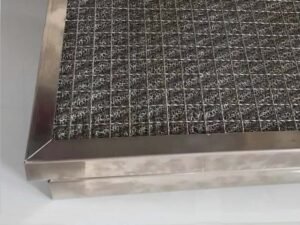
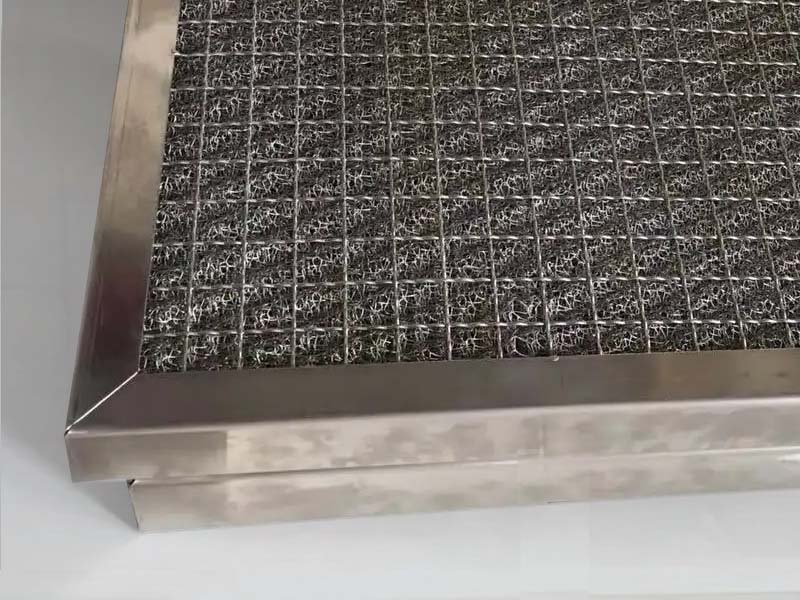
A panel typically combines a frame, filtration core and support. Its design may also include seals, adhesive, clips, handles or drains. Review the cleaning method for the complete construction.
For example, a stainless mesh core inside an aluminum frame with an edge seal requires compatibility checks for each component and connection. Use the drawing, materials information and equipment documents to resolve uncertainty.
Filtalloy supplies complete panels, removable-core assemblies and separate replacement pads to drawings. Washability and maintenance depend on the specified materials and construction. Knitted panel filter construction and supply
Draining, drying and surface condition
Complete the specified rinse, then let liquid drain from the mesh layers, folded frame edges and drainage features. Reach the equipment’s required condition before examining the core and mating surfaces. Drying time depends on layers, construction, environment and the maintenance requirement.
Separate unwanted cleaning-agent or contaminant residue from a surface treatment required by the original design. Some purpose-designed permanent filters require a specified coating after cleaning.
For example, Trane manual CLCH-SVX07D-EN lists washing, drying, application of a specified filter coating, further draining and drying, and reinstallation for its permanent filters. This illustrates why the original surface condition matters. The chemical, coating and waiting time in that manual apply to its particular equipment and filters. Trane manual, Air Filters, printed page 132
Inspect the media and frame
Separate core condition from frame condition when deciding whether to clean further, replace a pad or replace the complete panel. Support the frame during handling. Avoid pulling the mesh to test its restraint.
Media and support
Inspect both accessible faces and visible edges for these conditions.
- Concentrated grease, dust, other deposits or visibly blocked regions.
- Collapsed, rolled or displaced layers, or unexpected gaps between supports.
- Broken wires, loose strands, corrosion thinning or detached material.
- Damaged supports, connections or media-retaining features.
A side view can reveal local thickness changes. Light transmission can help locate obvious blocked areas or gaps. Internal cleanliness and capture performance require the applicable inspection or functional check.
For grease duties, examine internal layers and the lower edge for residual buildup. For coarse dust service, look for adhering deposits, hard accumulations and changes caused by cleaning. If residue remains difficult to remove, review the method and component condition before further treatment.
Frame, joints and seals
An apparently intact core still needs a frame that seats correctly.
| Location | Observe | Installation consequence |
|---|---|---|
| Frame edges and corners | Warping, twisting and dimensional change | Affects seating, perimeter contact and clamping |
| Joints and fixings | Cracks, loose connections, damaged or missing clips | Affects restraint of the core or whole panel |
| Seals and adhesive | Detachment, cracking, missing sections or deformation | Can create perimeter bypass and needs the specified remedy |
| Handles and drainage features | Loose joints, blocked openings or incorrect orientation | Affects handling, retention or drainage as applicable |
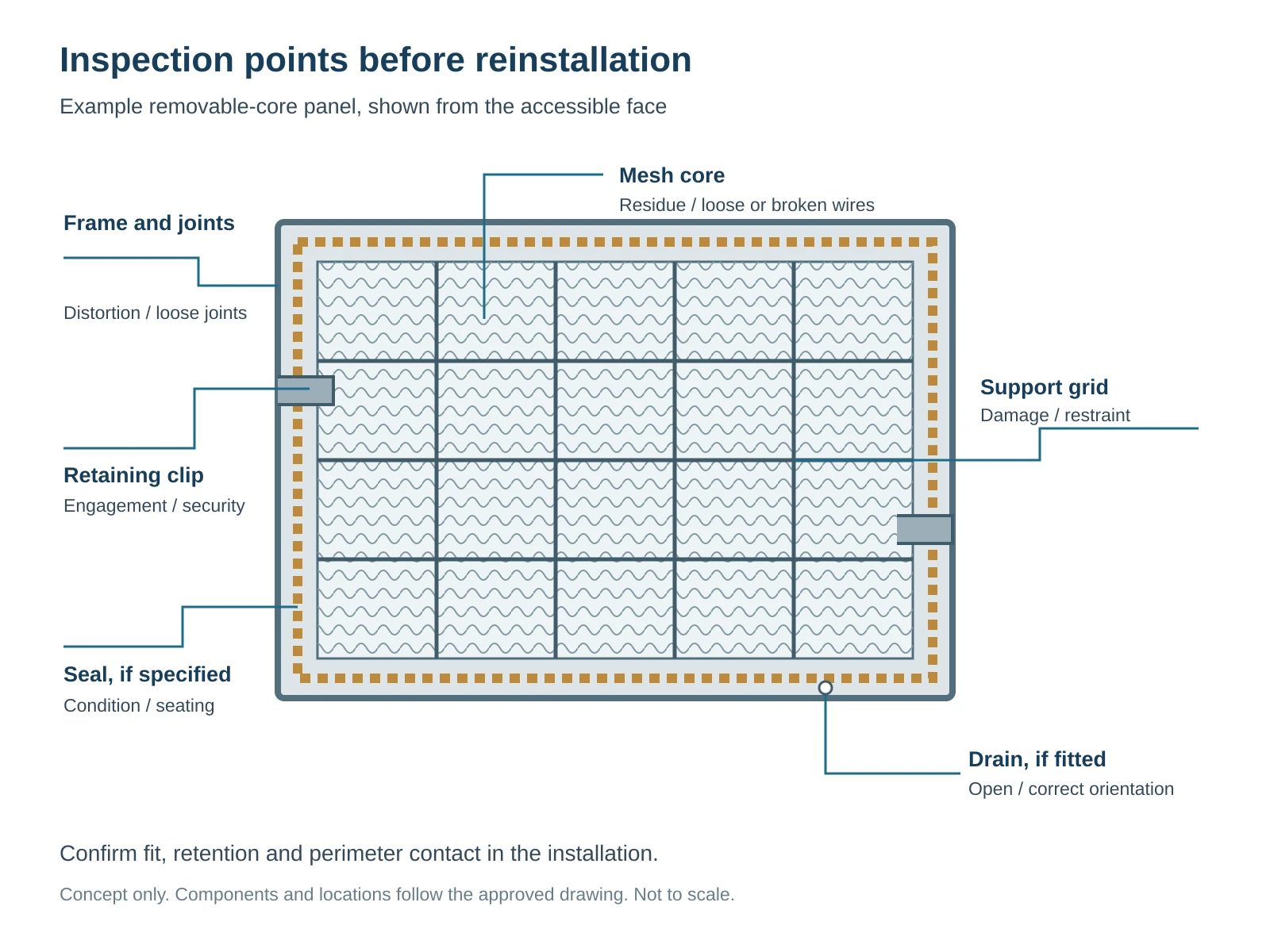
Figure 1. Inspection points on an example removable-core panel. Frame, core, supports, retaining features and optional seals or drains follow the actual drawing. Not to scale.
Reinstall removable cores and fixed panels
Identify the original retaining method before following the relevant route.
Removable-core panel
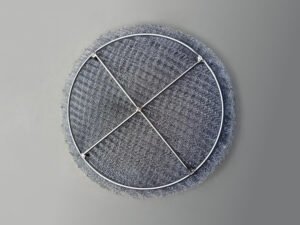
Confirm that the frame is serviceable, then check the cleaned core or replacement pad against the specified dimensions, thickness, material, layers and orientation. Secure its edges using the designed restraint and engage the specified clips or screws.
If a core bulges, prevents closure or remains loose, check the dimensions and assembly requirements. Extra packing or forced compression changes the original installed condition and complicates later pressure-drop comparisons.
Fixed panel
Inspect and reinstall a permanently retained core as a complete assembly. Check that the frame enters its rails or seat, the fixing points align, and the mesh and supports remain secure.
A repair plan should restore core restraint, equipment fit and service requirements together. Confirm any repair or replacement against the equipment and component specification.
Check the perimeter after seating
Follow the drawing, direction marking and installation record for airflow direction. Where drainage features exist, confirm their orientation and that fittings leave the openings clear.
Check frame contact with the seat, seal compression at the designed location and complete, secure retention. For a panel bank, also check neighboring-panel joints and the whole bank perimeter.
Work around the frame and record visible gaps, disengaged clips or unusual distortion. Obtain permitted gaps and seal requirements from the equipment drawing or acceptance documents.
Compare airflow and pressure drop after restart
Retain the operating conditions alongside the readings. Lower pressure drop after cleaning may accompany recovered flow resistance, but airflow or installed condition may also have changed.
Find a comparable baseline
Prefer acceptable historical records for the same panel type, pressure tap span and comparable airflow. Confirm the required dry state and record fan condition, control mode and relevant airflow settings.
At a fixed fan speed, a resistance change can alter airflow. Under constant-airflow control, the equipment may adjust fan output to maintain flow. Record speed or control state and actual airflow where available.
If no history exists, retain the present restart readings after structural and installation checks. Equipment operating limits and the required performance still determine acceptability.
Review pressure drop, bypass and downstream behavior together
| Restart observation | Check alongside it | Follow-up |
|---|---|---|
| Pressure drop returns to a comparable acceptable range | Airflow, tap span, fixings and seals | Continue observing stability and downstream behavior and complete the record |
| Pressure drop remains high | Actual airflow, deposits, mesh compression or deformation, instrument condition | Identify whether the difference comes from the filter or comparison conditions |
| Pressure drop falls but downstream carryover is abnormal | Perimeter fit, core restraint, broken strands or gaps, airflow changes | Investigate bypass, structure and duty; verify the required capture behavior |
| Unusual vibration or noise appears | Fixings, core restraint and frame-to-seat contact | Follow the equipment procedure and inspect retention and fit |
For oil-mist or grease service, also review drainage, upstream loading and airflow if liquid accumulation, dripping or downstream symptoms persist. A single pressure-drop reading does not verify the capture requirement. See the existing metal filter troubleshooting guide for comparison conditions and evidence records.
Reuse, replace the pad or replace the panel
The route depends on the damaged location, whether the core is removable and the verification results. The responsible maintenance personnel confirm release against the equipment requirements.
| Inspection result | Conditions to confirm | Available route |
|---|---|---|
| Cleaning, structural and installation checks pass; restart meets requirements | Product identity, operating conditions and records correspond | Record release, continue use and monitor under the operating procedure |
| Removable core is damaged or deposits remain; frame and supports are serviceable | A matching pad is available and the specified seal and restraint can be restored | Replace the pad and repeat installation and restart checks |
| Frame, supports or retaining structure are damaged | An approved repair plan or complete replacement specification | Repair to the plan or replace the assembly, then verify |
| Media in a fixed assembly is unserviceable | Complete dimensions, construction and equipment fit | Replace the complete panel |
| Appearance and fit are satisfactory but operating symptoms persist | Flow, instrumentation, load, drainage and downstream evidence | Investigate the cause before confirming reuse |
As a hypothetical example, a cleaned removable core has loose wires and has separated locally from its support, while the frame seats correctly. If the frame, supports and retaining structure pass inspection, a matching replacement core can be reviewed and then checked after assembly. The actual decision follows the component inspection.
For supplied parts, existing drawings or photographs can start the review of removable construction and dimensions. Then confirm material, thickness, layers and retention for a replacement pad and resolve missing details progressively.
Record and frequently asked questions
A short reinstallation record
| Record | Information to retain |
|---|---|
| Equipment and location | Equipment ID, panel position, model or drawing revision |
| Cleaning and condition | Procedure, medium, rinsing, draining/drying and required post-treatment |
| Media and support | Residue, loose wires, deformation, restraint, supports and connections |
| Frame and installation | Frame, seal, orientation, clips/screws, perimeter and bank joints |
| Restart conditions | Time, control state, actual flow or known fan condition, tap span |
| Restart behavior | Pressure drop, drainage, downstream observations and unusual noise |
| Decision | Reuse, new pad, complete replacement or further investigation; reviewer |
Why inspect the edges when pressure drop has recovered?
Air can pass through installation gaps. Read the pressure result together with media integrity and perimeter fit. Treat damaged media, distorted frames and missing seals according to their requirements.
Can a filter with a metal frame always be washed this way?
Check the media, seals, joints and complete assembly maintenance instructions. This workflow covers confirmed washable knitted metal panels. Synthetic-fiber, PP and composite cores need their specified cleaning or replacement route.
Can a fixed number of cleaning cycles determine replacement?
Where a project specifies cycle life, retain use and cleaning history under its defined conditions. General reuse decisions also consider contamination, corrosion, deformation, restraint and function. Release criteria need to match the component and duty.
Can a distorted edge be straightened and installed immediately?
First assess the effect on the core, joints, seals and fit. An approved correction needs corresponding checks. Restore structure and fit, then complete the restart review.
The completed record should describe core and frame condition, how the panel was installed and whether restart supports continued service. Drawings, main dimensions and photographs are a practical starting point for replacement pads or complete panels. Knitted metal panels and replacement pads
Jack Sun works in wire mesh weaving and industrial filter manufacturing. Filtalloy is based in Anping, Hengshui, Hebei, China. This checklist supports engineering maintenance communication. Equipment requirements, component specifications and the agreed procedure define release conditions.