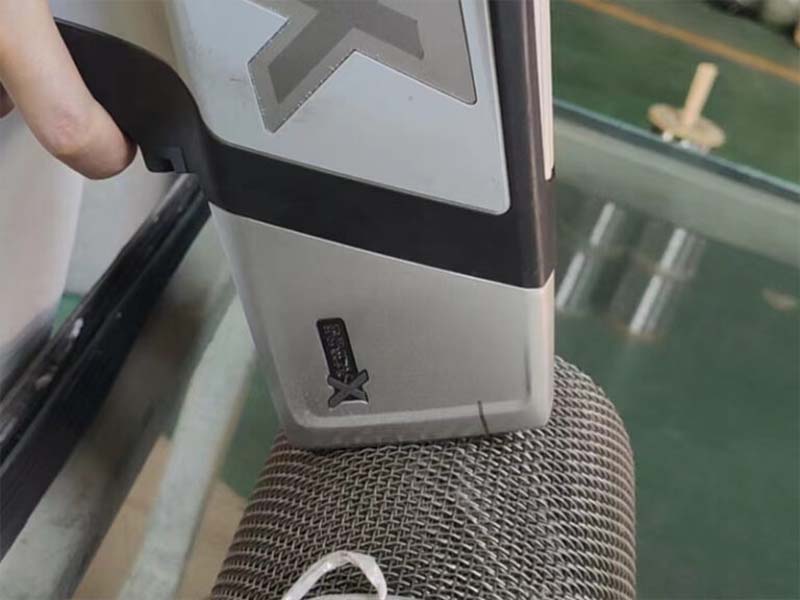
Stainless Steel Woven Wire Mesh for Filtration and Screening
Filtalloy manufactures stainless steel woven wire mesh for filtration and screening. We supply rolls, cut sheets and formed components in 304, 316L and the additional grades listed below.
Plain, twill, herringbone twill and Dutch weave options are available. Mesh count, wire diameter, aperture, width and cut dimensions can be specified together for the order.

Supply Forms and Product Configurations
The views below show product forms and construction details. Send the drawing or existing specification for the configuration you need.


View more product configurations


Stainless Steel Wire Mesh Specifications
Use the ranges below to identify a starting specification, then choose material, weave and wire diameter as one combination. We supply woven mesh across these ranges and review the requested combination with the finished width or cut dimensions for the order.
- Plain weave: approximately 1–400 mesh, with conventional fine mesh available up to about 500–635 mesh.
- Twill weave: approximately 2–635 mesh.
- Dutch weave: approximately 12 × 64 to 500 × 3500.
- Wire diameter: approximately 0.025–4.0 mm; special fine wire can reach about 0.016 mm and coarse wire can reach about 5 mm.
- Aperture: approximately 0.02–21.4 mm.
- Nominal micron rating: approximately 25–21,400 μm; fine mesh products may be specified around 10–40 μm depending on construction.
- Open area: approximately 25%–71%.
For square-opening mesh, choose mesh count and wire diameter together to define aperture and open area. If your drawing already gives a specification, send that reference; for a new choice, start with the required opening and delivery form.
Use the wire mesh specification guide to prepare order requirements and the quality-control guide to define inspection and delivery records. The wire mesh size calculator checks ideal square-mesh geometry. For Dutch cloth, use the specified weave construction and the corresponding filtration evidence.
Stainless Steel Wire Mesh Rolls and Cut Sheets
Standard stock roll sizes: 1 m and 1.2 m widths; 30 m roll length. Other widths and lengths can be customized. Plain weave mesh can be supplied in widths up to 15 m, subject to the selected specification.
Width and edge record for cut material
| Field | What the drawing should distinguish |
|---|---|
| Overall and usable width | Identify the full roll width and intended usable/cutting region separately; use the drawing definition for any edge exclusion. |
| Edge and piece direction | Record selvage / cut / slit edges and warp/weft or A/B direction. Identify whether each strip edge is woven, slit or cut so that the supplied edge matches the part requirement. |
| Joint or length requirement | State any joint restriction, required continuous length and cutting plan for the order; agree the rule for the selected weave or coating and the required delivery form. |
Cut sheets and processing: stainless steel wire mesh rolls can be cut to required sheet or piece sizes. Cut edges, selvage edges, plasma cutting, laser cutting, cut pieces and formed components are available to customer drawings or requirements.
Materials, Weave Types and Supply Options
Materials: 304 and 316L stainless steel, plus the materials listed in our material table below. Material selection depends on the medium, concentration, temperature and operating conditions.
Weave types: plain weave, twill weave, herringbone twill, plain Dutch weave, twill Dutch weave, reverse plain Dutch weave and reverse twill Dutch weave. Square-opening mesh and Dutch weave filter cloth are available. Warp and weft mesh counts, wire diameters and weave construction can be specified to customer requirements.
Special options: high-transparency mesh, extra-wide mesh, PTFE-coated mesh and epoxy-coated mesh. Epoxy-coated mesh can be used as a filter-element support layer; compatibility depends on the coating and service conditions.
| Austenitic | SS304 (Standard and hot sale) SS304L SS309 SS310 SS314 SS316L (Standard and hot sale) SS316Ti SS321 SS330 SS347 |
| Martensite | SS410 |
| Ferrite | SS430 |
| Duplex | UNS 32750 UNS 31803 |
Applications
- Liquid filtration: water treatment, industrial circulating water, hydraulic oil, lubricating oil, coatings, inks, syrup, beverages and edible oils.
- Gas and oil-mist filtration: kitchen exhaust grease filtration, machine-tool oil mist collection and ventilation pre-filtration.
- Solid screening: powder screening, particle classification and screening protection.
- Protection and isolation: machinery guards, screening equipment, vacuum/cleaning equipment and environmental protection systems.
Cleaning and Maintenance
Metal woven mesh can generally be cleaned and reused when the mesh structure remains intact. Low-pressure clean-water rinsing or suitable backwashing can remove loose particles. Oil and grease contamination may be treated with a compatible neutral or mildly alkaline cleaner. Organic solvents such as isopropyl alcohol or acetone may be used for suitable applications with appropriate fire and ventilation controls.
Fine mesh can be cleaned with ultrasonic equipment and a compatible mild cleaning solution. Avoid hard wire brushing, prolonged exposure to strong acids or concentrated alkalis, and direct flame or high-temperature heating that may damage the wire surface or woven structure. After cleaning, rinse thoroughly with clean or deionized water and dry with clean compressed air or by natural drying.
After cleaning, inspect loose or broken wires, local opening shape, edges and joins as well as deposits. Use the wire and opening inspection to assess structural condition, and the required retention check to assess filtration, alongside recovered flow. Use the metal filter troubleshooting guide for the next evidence to collect.
Quality Inspection
Depending on the product and customer requirements, inspection can include dimensions, mesh count, aperture, wire diameter, weave type, broken wires, holes, misweaves, surface contamination, burrs or sharp edges, material verification and packaging identification. Material can be verified by material certificates or spot spectral analysis where required. Pressure drop, efficiency and filtration-grade testing are available on request and are not routine tests for every production batch.
For coated mesh, confirm that the cleaning method is compatible with the coating and operating conditions.
For dimensional reference, see our stainless steel wire mesh size chart. Use the wire mesh size calculator to check the relationship between mesh count, wire diameter and nominal aperture.
Stainless Steel Woven Wire Mesh FAQ
Can you supply stainless steel wire mesh in rolls or cut sheets?
Yes. We supply stainless steel wire mesh rolls in common stock widths of 1 m and 1.2 m with a standard roll length of 30 m. Other widths and lengths, cut sheets, cut pieces and formed components can be supplied to requirements. Confirm the material, weave, mesh count, wire diameter and required dimensions for your project.
Is mesh count the same as micron rating?
No. For square-opening woven wire mesh, aperture depends on both mesh count and wire diameter. A nominal aperture or micron rating is not an absolute particle-retention guarantee. Dutch weave wire mesh must be specified by its construction and the required filtration performance.
Which woven wire mesh types do you supply?
We supply plain weave, twill weave, herringbone twill, plain Dutch weave, twill Dutch weave, reverse plain Dutch weave and reverse twill Dutch weave. Warp and weft mesh counts, wire diameters and weave construction can be customized.
What are the standard roll sizes and maximum width?
Common stock widths are 1 m and 1.2 m, with a standard roll length of 30 m. Other sizes can be customized. Plain weave mesh can be supplied in widths up to 15 m, subject to the selected specification.
Can you supply coated mesh and processed components?
Yes. High-transparency mesh, extra-wide mesh, PTFE-coated mesh and epoxy-coated mesh are available. Cut edges, selvage edges, plasma cutting, laser cutting, cut pieces and forming can be supplied to requirements. Epoxy-coated mesh can be used as a filter-element support layer.
How are temperature, pressure difference and corrosion resistance confirmed?
These requirements are confirmed for each project according to the material, weave, wire diameter, product structure, medium and operating conditions. A single rating does not apply to every woven wire mesh specification.

- Plain Dutch Weave & Twilled Dutch Weave
Reversed Plain Dutch Weave &Reversed Twilled Dutch Weave
Mesh Type We Supply:
Send Your Drawing, Specification or Sample Photos
Send the drawing or existing specification you have, together with the quantity and the parts you need. Sample photos and main dimensions are a useful starting point when a drawing is unavailable.
If you are still defining the product, briefly describe its intended use. We will clarify the additional manufacturing and inspection details with you.