By Jack Sun · October 13, 2026
Quick definition
Dutch weave filter cloth uses different wire diameters and packing densities in the warp and weft directions to form filtration passages. Selection requires the weave, directional mesh counts, both wire diameters, the basis of the filtration rating, and the support and seals of the finished element. A micron number cannot replace this specification [1].
A drawing states “316L, 25 μm,” yet two suppliers quote different mesh counts, thicknesses and prices. First establish whether both suppliers use the same definition of 25 μm. Then compare the candidate structures under the required operating conditions. This guide helps equipment engineers and purchasing teams turn a weave name into a verifiable filter-cloth requirement.
1. Dutch weave and square-opening mesh describe different structures
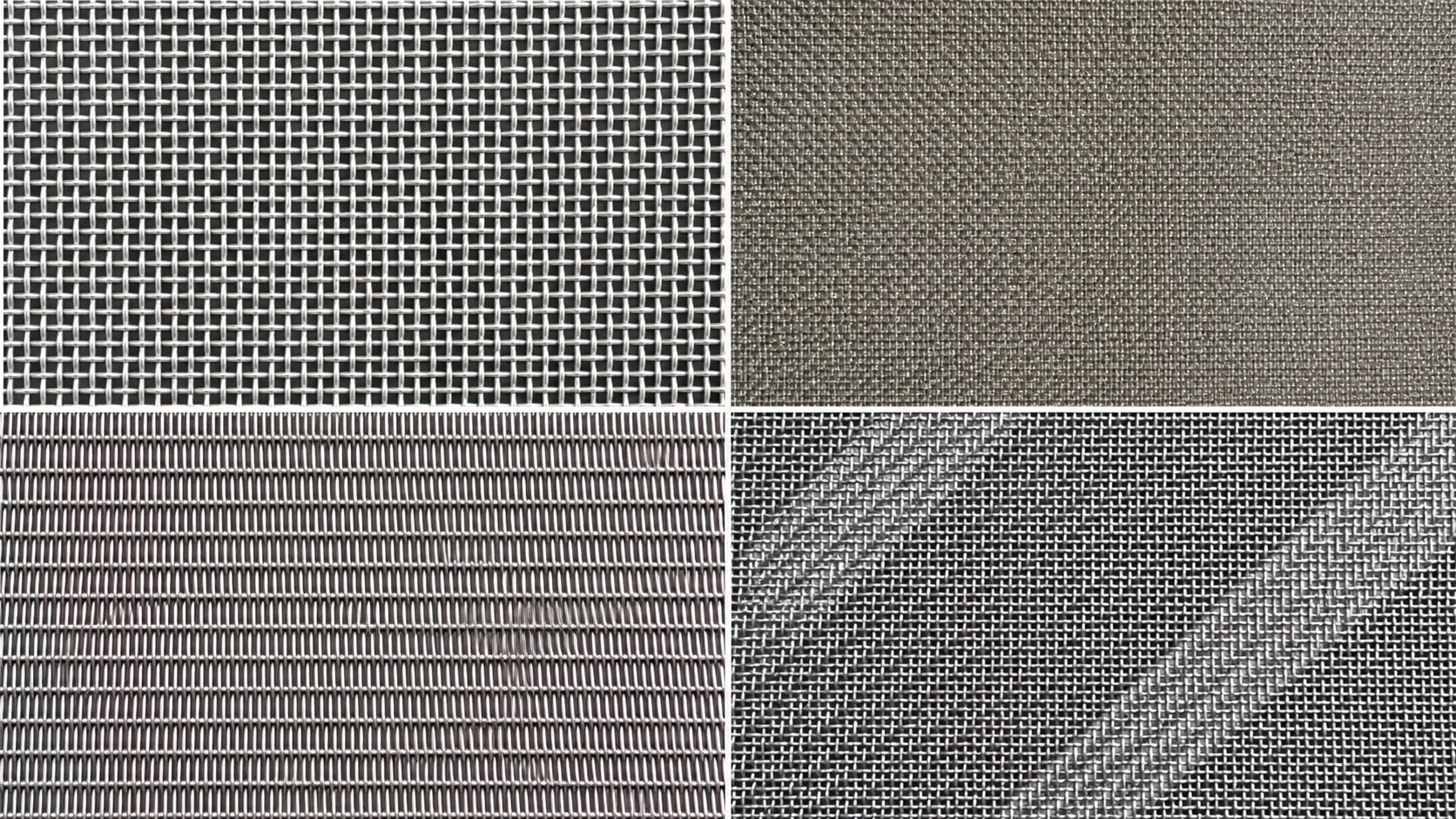
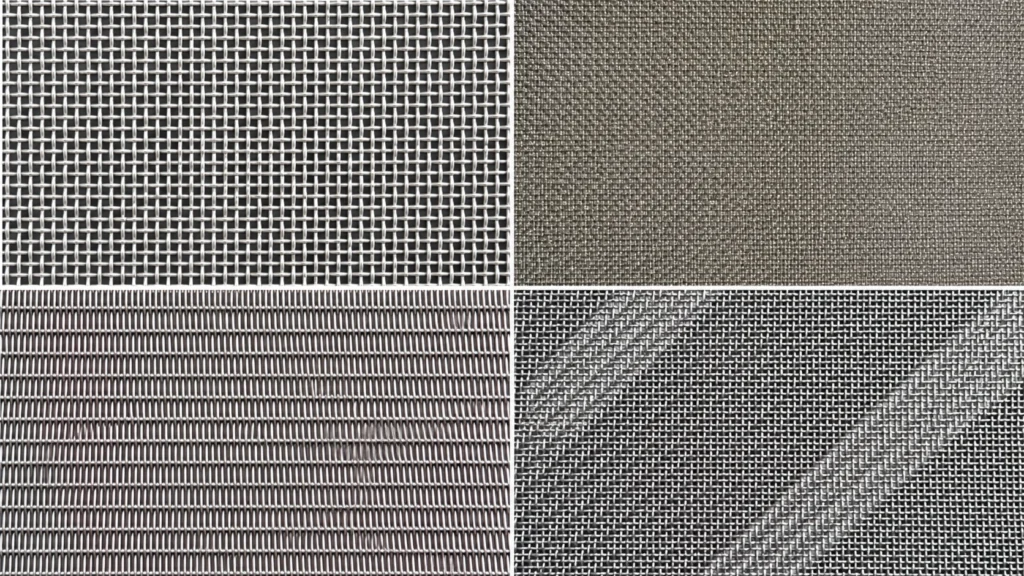
Processed comparison based on factory photographs. Open, dense and diagonal surfaces illustrate different appearances; the image does not establish a filtration rating or identify every Dutch-weave variant.
The net opening of square woven mesh can generally be observed and measured from the face. Dutch-weave passages depend on wire contact, packing and interlacing. A visible surface gap should not automatically be treated as the size of a particle retained by the cloth.
Keep two descriptions separate. Plain and twill describe interlacing patterns; square-opening and Dutch describe the cloth structure. Plain weave does not automatically mean plain Dutch weave. Similarly, twill weave does not automatically mean twill Dutch weave. An order that says only “plain” or “twill” remains incomplete.
The square-opening aperture calculation depends on its geometric assumptions. Dutch weave cannot be assigned a filter grade by inserting one mesh count into a square-mesh equation. Record the warp and weft specifications separately from the filtration rating. See mesh count, wire diameter and micron opening for the square-opening relationship and its limits.
2. Plain Dutch weave: confirm both wire directions
Plain Dutch weave uses one-over, one-under interlacing. In a common arrangement, the warp wires are relatively coarse and widely spaced, while the weft wires are finer and more densely packed. Its passage geometry differs from ordinary square-opening plain weave even though both use a one-over, one-under pattern.
Comparing plain Dutch weave requires more than the two mesh-count numbers. Confirm their warp/weft order, units and corresponding wire diameters. Also record whether the supplied cloth is calendered or has received another finishing treatment. A shared weave name does not establish identical geometry.
For a new design, include a suitable plain Dutch structure among the candidates, then evaluate the particle-retention requirement and clean flow–pressure-drop behavior. This guide assigns no universal pressure capability, micron range or service life to plain Dutch weave. Those properties depend on the particular cloth specification and complete element design.
3. Twill Dutch weave: compare structure and test basis
Twill Dutch weave combines twill interlacing with dense wire packing. A common 2/2 pattern passes over two wires and under two, with interlacing points shifted between successive rows. The order should still identify the actual pattern rather than leave it to an assumption based on “twill.”
The useful comparison is how the thickness, wire arrangement and passage geometry behave at the required grade. The name alone cannot establish that one twill Dutch cloth is finer, stronger or less resistant to flow than a particular plain Dutch cloth.
If a supplier recommends a cloth because it is “finer,” ask which filtration-rating definition supports that statement. Was a flat cloth specimen tested, or a finished filter element? Which fluid, temperature, flow and area were used? These details determine whether the quotation and test data can be compared.
4. Reverse Dutch weave: configuration is not a flipped surface
Reverse Dutch weave changes the warp/weft diameter and packing configuration of conventional Dutch arrangements. Common forms combine finer, more closely packed warp wires with coarser, more widely spaced weft wires. “Reverse” describes that structural configuration; turning ordinary cloth over does not make it reverse Dutch weave.
In addition to filtration and flow conditions, check strip width, edges, operating direction and installation. Where a device uses moving filter cloth, the equipment drawing should establish direction and pulling conditions. Experience with a stationary specimen does not independently guarantee moving-belt performance.
Reverse Dutch weave is not an automatic upgrade for every application. If an existing plain or twill structure meets retention, flow and delivery requirements, define what a different structure should improve and validate the proposed change with samples.
Comparison checklist
| Candidate structure | Confirm first | Do not infer from the name alone |
|---|---|---|
| Plain Dutch weave | One-over/one-under interlacing; both directional counts and diameters | Identical flow for every cloth with this name |
| Twill Dutch weave | Actual twill pattern, thickness and rating basis | Necessarily finer filtration or higher pressure capability |
| Reverse Dutch weave | Warp/weft configuration, direction, width and edges | That reversing the installed face creates this structure |
5. Mesh counts, wire diameters and filtration ratings
Directional mesh counts describe structure. A micron rating is a filtration statement that needs a defined basis. Purchasing records should establish the warp/weft order and list each wire diameter separately. For an old sample, record use, cleaning, stretching and calendering so that changed dimensions are not treated as original weaving specifications.
When comparing nominal vs absolute micron rating, ask for the size definition, test method, decision rule and specimen condition together. Bubble-point conversion and particle-challenge testing describe different measurements. Explain what each result represents before comparing the numbers.
ASTM E3278-21 provides a bubble-point pressure method for woven wire filter cloth. Its public description identifies the need for appropriate conversion factors when relating pressure to pore size. A method for flat cloth specimens should not be treated as a universal test for every finished cartridge [2].
An agreed bubble-point result can therefore support cloth acceptance under defined conditions. It does not by itself establish identical complete-element particle retention in every fluid. Welds, end connections, seals and installation remain separate concerns.
Microscopy and filtration tests also have different jobs. A close view can help identify interlacing and surface condition, but cannot independently certify a micron rating. The filter micron rating and efficiency guide explains these distinctions in more detail.
6. Move from operating requirements to sample validation
Establish comparable operating conditions before ranking the weaves. At minimum, identify the process fluid, temperature, design flow, effective filtration area, particle characteristics and retention requirement. For existing equipment, include clean initial differential pressure, terminal differential pressure and cleaning practice.
Cloths carrying the same nominal grade can have different flow resistance. Published research on Dutch-weave aperture structure discusses the relationship between passage geometry and flow resistivity [3]. For purchasing, the practical implication is to obtain comparable flow–pressure-drop information rather than rely on the grade label. No numerical result for one research specimen is applied here to every specification.
For a new project:
- Define the required particle-retention task and acceptance method.
- Identify the material and fluid, temperature and cleaning conditions.
- Compare directional structure, thickness and appropriately comparable test information.
- Confirm support, seals, cutting and assembly form.
- Validate samples under relevant operating conditions and agree on batch acceptance.
For example, two candidates both say 25 μm, but their rating methods differ and their flow data omit the test area. Obtain the missing information and establish a common comparison basis. Choosing the higher mesh count alone would not resolve the uncertainty. This is a purchasing example, not factory test data.
7. Manufacture, cutting and finished-element acceptance
Use the woven wire mesh quality-control guide to organize traceability, first-piece approval and delivery records. For flow comparisons, the pressure-drop guide separates cloth geometry from measured assembly performance; it does not assign square-mesh coefficients to Dutch cloth.
Manufacturing records should turn the approved directional structure into traceable order requirements. Link raw-material batches, weave settings, process checks, finished dimensions and acceptance records to the delivery batch. A photograph of a weaving machine establishes a manufacturing scene, not the particular Dutch structure being made.
After the cloth becomes a disc, strip or cylinder, acceptance must also address edges, dimensions, welds or fixing points, and seal interfaces. Cloth grade and finished-element integrity are separate checks. Edge damage, assembly gaps and connection problems may affect the finished element even where cloth specimens have acceptable results. These are investigation directions, not causes established from appearance alone.
Organize purchasing information in four groups
| Group | Information to provide |
|---|---|
| Cloth identity | Grade, weave, warp/weft counts and units, both wire diameters, finishing condition |
| Performance task | Target particles or rating, acceptance method, fluid and temperature, flow and effective area |
| Finished design | Roll, piece, strip or cylinder; dimensions, direction, edges, support, connections and seals |
| Acceptance documents | Agreed standard edition, sampling, test conditions, decision rules and batch traceability |
ASTM E2814-22 is a reference for industrial woven wire filter cloth [1]. A contract reference still requires agreement on the applicable object and requirements. Referencing a standard does not mean an order has already been tested against every clause. This guide reproduces no standard tolerance table and makes no standard-certification claim for the factory.
8. Frequently asked questions
Is Dutch weave automatically a depth-filter medium?
Tortuous passages alone do not establish depth-filtration behavior. Passage geometry and particle-capture mechanisms are different questions. Evaluate retention, testing and cleaning behavior rather than replace verification with a “depth” label.
Can the same warp/weft mesh counts be substituted directly?
Also compare both wire diameters, interlacing, material, finishing, thickness and rating basis. Replacement parts need matching dimensions, support and seals as well.
Must reverse Dutch weave be installed in reverse?
The name does not decide installation. Direction follows the actual cloth structure, element design and equipment requirements. Mark it on the drawing rather than write only “reverse.”
Can an old cartridge be used to reconstruct the specification?
It can support dimensional and structural investigation, but loading, wear and deformation may affect measurements. Supply process conditions, operating issues and available drawings. Agree separately on validation of critical rating requirements.
Turn a weave name into a verifiable specification
Plain, twill and reverse Dutch arrangements offer different structural candidates. Return selection to the retention task, the basis of the data, required flow, complete-element support and sealing, and agreed delivery acceptance.
For a new project, start with operating conditions and the target. For drawing-based manufacture, submit the complete structure and acceptance requirements. For sample-based replacement, include the old part's service background. See the woven wire mesh product family and industrial wire mesh specification guide for related requirements.
About the author: Jack Sun has long worked in metal wire mesh weaving and industrial filter element manufacturing. Our company is based in Anping, Hengshui, Hebei, China, a center of wire mesh manufacturing.
References
- ASTM E2814-22: Industrial Woven Wire Filter Cloth. Public catalog reference; paid standard text is not reproduced.
- ASTM E3278-21: Bubble Point Pressure of Woven Wire Filter Cloth. Public method description; no universal completed-cartridge rating is inferred.
- Effect of Aperture Structure of Dutch Weave Mesh on Flow Resistivity, Journal of Chemical Engineering of Japan, 2015, 48(9). Original research source; specimen performance figures are not reproduced here.