
By Jack Sun · October 13, 2026
Quick definition
Filtration methods describe processes in which fluid passes through a medium that retains a target under specified conditions. Separation can also use gravity, centrifugal action, adsorption or other effects. Filtration mechanisms explain how particles contact and remain on a collector, such as size exclusion, interception, inertial impaction or diffusion. Process, mechanism and media structure describe different levels of the requirement.
Removing suspended solids from water, reducing liquid carryover in gas and removing a dissolved constituent are different tasks. Using the word “filter” for each does not establish the same mesh opening, material or acceptance test. Identify the target's physical state and the stream to be recovered before selecting a method.
This guide explains basic processes. It does not claim that our factory supplies every membrane, adsorbent, centrifuge or complete treatment system. Metal mesh and elements may provide filtration, support, protection or droplet contact in particular designs; establish their function through the project specification and verification.
1. Identify what needs to be separated
Particles suspended in a liquid or gas, droplets carried in gas, dispersed liquid phases and dissolved substances need different information. Turbidity can indicate suspended material, while a transparent fluid can still contain dissolved constituents. Appearance does not establish a complete contaminant classification.
Record material identity, particle or droplet size information, concentration, density difference, deformability and available test methods. State whether a particle distribution is based on number, volume or mass. If the target reacts, crystallizes, agglomerates or forms colloids, record sampling and operating conditions rather than applying one static size to every process state.
Identify which stream matters: permeate, retained solids, settled material or separated liquid. Protecting downstream equipment and recovering valuable particles can require different cleaning, discharge and sampling arrangements. The particle-size and distribution guide explains size bases.
2. Compare types of filtration methods and separation processes
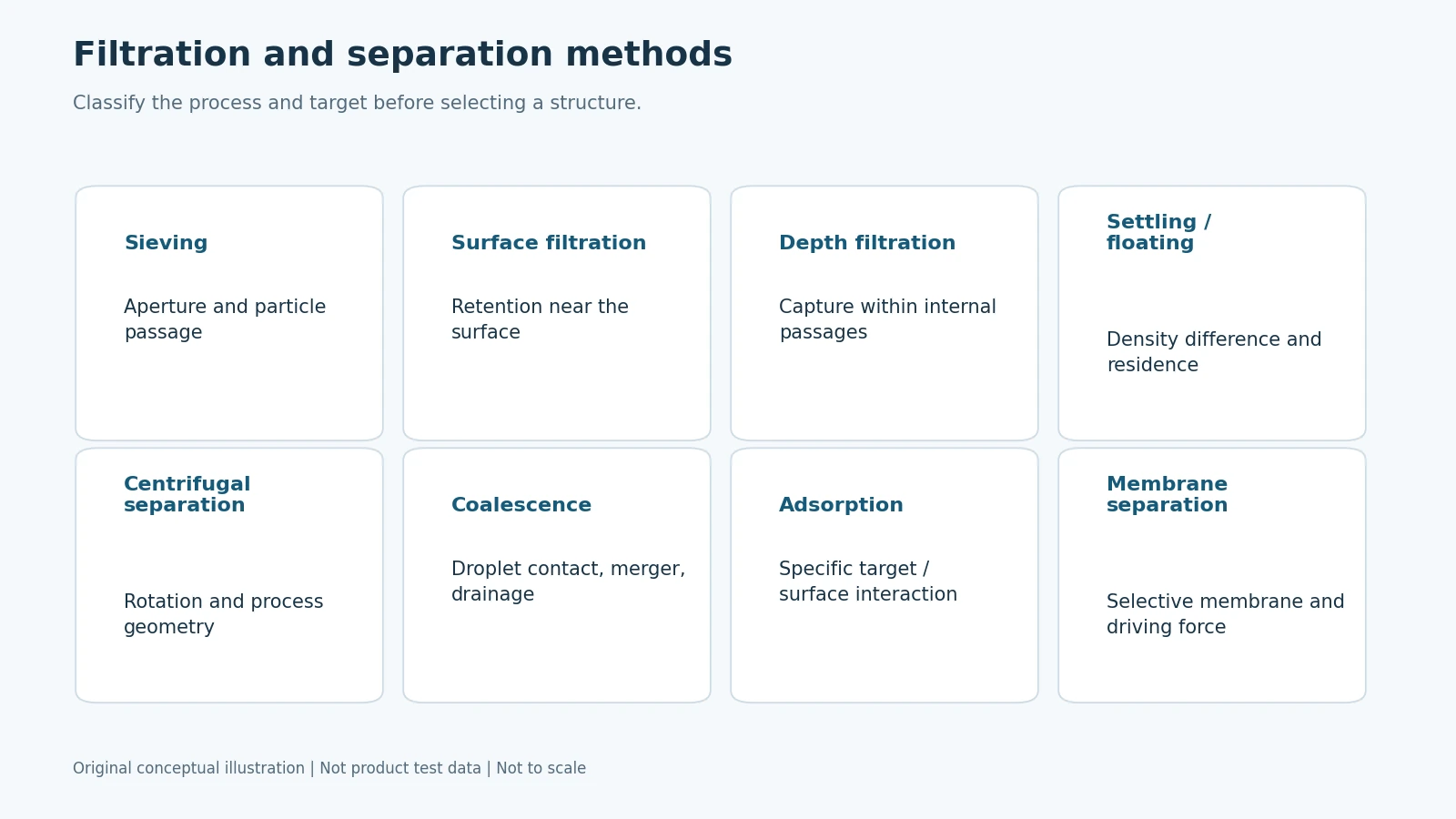
Original conceptual diagram: classify the process and target before choosing a structure. No measured product performance is shown.
| Process | Main action | Typical task | What the name alone cannot establish |
|---|---|---|---|
| Screening/sieving | Defined opening and passing behavior | Particle-size classification or restricting larger particles | A common passing size for every particle shape |
| Surface filtration | Surface retention and deposited-layer effects | Separating particles from fluid | Fixed efficiency from nominal opening |
| Depth filtration | Capture within internal passages | Retaining particles inside media | High holding capacity simply because media is thick |
| Gravity settling or flotation | Gravity and density difference | Settling particles or separating phases | Rapid removal of all fine particles |
| Centrifugal separation | Motion under rotating conditions | Solid–liquid or liquid–liquid separation | Efficiency from rotational speed alone |
| Coalescence and subsequent separation | Droplet contact, merging and removal | Liquid droplets carried in gas or another phase | A solid-particle filtration rating |
| Adsorption | Interaction with a material's surface | Particular dissolved or gaseous constituents | Removal of every constituent without saturation |
| Membrane separation | Selectivity and a driving force | Particles, some macromolecules or dissolved constituents | Removal of every salt or gas by every membrane |
This comparison organizes requirements; it is not a universal equipment-selection rule. EPA treatment guidance distinguishes filtration, adsorption and separation after dissolved constituents are converted into solids [1]. A system may use several stages. Determine the function of each stage rather than relying on an overall equipment label.
3. Screening, surface filtration and depth filtration
For screening, identify opening, particle shape and test method. An irregular particle may pass in a particular orientation; fiber length is not its smallest passing cross-section. Standard test sieves, ordinary square-opening mesh and Dutch weave use different descriptions. Mesh count alone does not determine all filtration requirements.
Surface filtration emphasizes retention at or near the surface. A deposited layer may change retention and resistance, but does not support a general “dirtier is better” rule. Startup, loading, cleaning and damage are different states. Initial performance and established process behavior cannot be interchanged without evidence.
Surface filtration vs depth filtration is not decided simply by thickness or layer count. Depth filtration emphasizes capture within the medium. An actual element may exhibit both surface deposits and internal retention. These names help describe the process; efficiency, capacity and cleaning behavior still require verification.
Woven mesh, sintered mesh, metal fiber felt and sintered powder have different flow-path structures. Along with the retention target, check flow, pressure drop, effective area, material and sealing. “Depth” does not guarantee cleanability; “surface” does not prove that every retained particle stays on the outermost face. See the types of metal mesh guide for structural identification.
4. Settling, centrifugation and coalescence
Settling describes particle motion relative to fluid; flotation involves the corresponding density difference in the other direction. Shape, size, density, fluid viscosity, concentration and residence conditions affect separation. Ideal motion equations have assumptions and cannot treat every complex suspension as isolated spheres.
Centrifugal separation requires geometry, rotation and residence information. Speed is only one parameter. Filtering centrifuges can use a medium and cake; sedimenting designs separate by another path. Describing every centrifuge as one kind of “filter mesh” overlooks its function and validation requirements.
Coalescence means small droplets contact and merge into larger droplets. Drainage or another removal path is still needed afterward. Knitted metal mesh and other contact structures can contribute in suitable designs, but their visible loops do not establish a micron rating for solid particles.
For gas–liquid separation, consider capture, coalescence, drainage and re-entrainment together. Seeing droplets on a surface does not prove that the complete equipment meets its outlet requirement. The wire mesh demister guide addresses the product-specific context.
5. Adsorption and membrane separation
Adsorption uses interactions between a particular constituent and a material surface. Capacity, fluid chemistry, contact conditions and saturation matter. An adsorbent's relevance to one constituent does not establish removal of every dissolved or gaseous contaminant.
Membrane behavior depends on membrane identity, solute or particle, driving force and complete operating conditions [3]. Different membrane processes serve different tasks. A membrane label alone does not establish removal of all dissolved substances.
Ordinary metal openings do not establish dissolved-salt removal. A metal support or protective screen also does not acquire the selectivity of the membrane it supports. Keep structural support, particle retention and dissolved-component treatment as separate functions.
6. Particle capture mechanisms
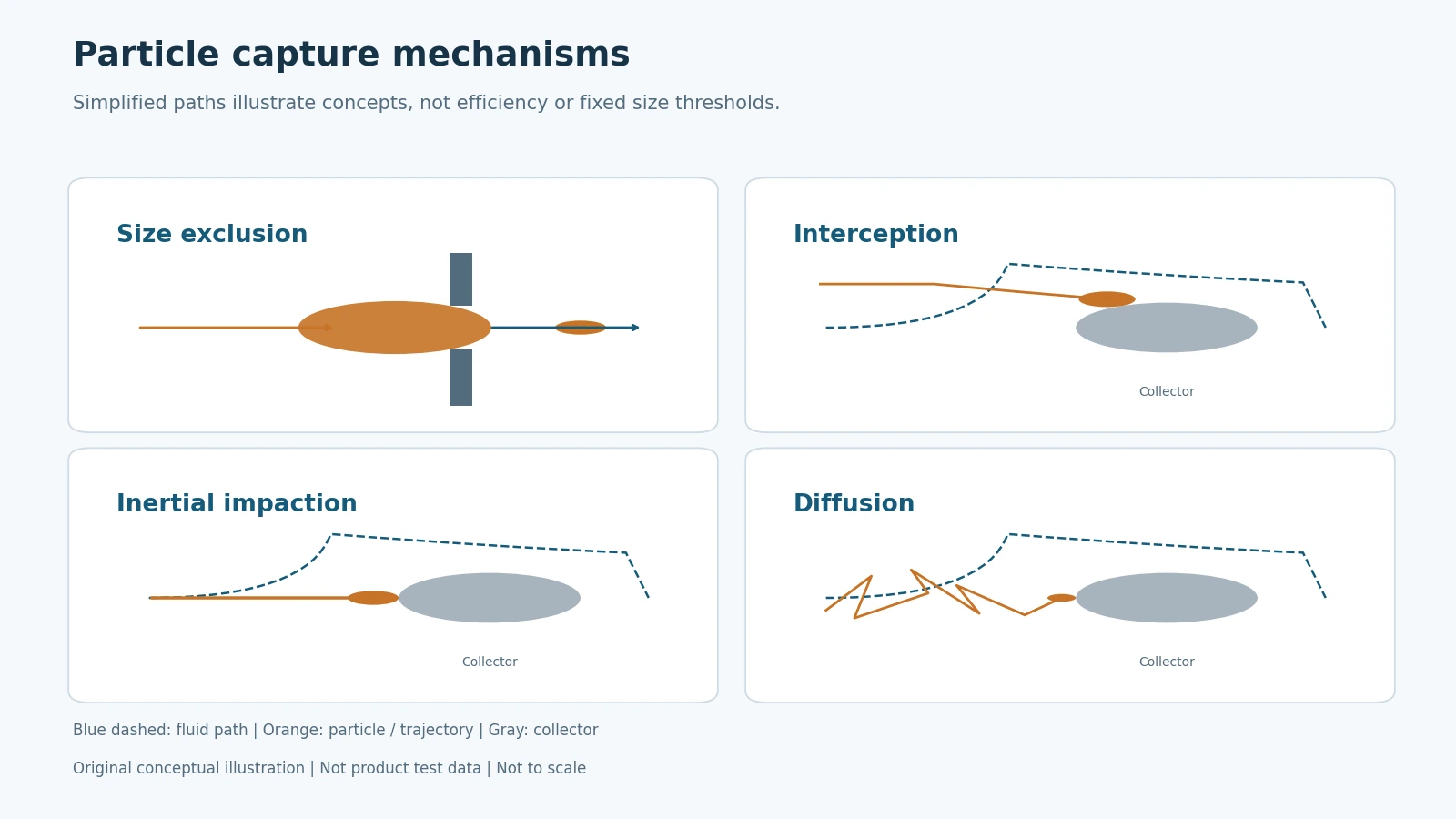
Original diagrams of size exclusion, interception, inertial impaction and diffusion. These teaching concepts do not simulate the measured efficiency of a factory product.
Size exclusion or sieving: passing behavior is limited by openings and structure. Particle shape and the meaning of “opening” still need to be defined.
Interception: a particle following the flow approaches a collector closely enough that its finite size causes contact. The center trajectory alone does not show whether contact occurs.
Inertial impaction filtration: a particle does not fully follow the fluid as it turns around a collector and contacts the surface. Its contribution depends on particle properties, velocity and geometry.
Diffusion filtration: random motion increases opportunities for contact. Brownian motion matters for fine particles in relevant air-filtration conditions, but there is no universal size boundary for every fluid and structure [2,4].
Electrostatic effects can also contribute in specially designed media or equipment. Electrical conductivity does not make ordinary metal mesh an electrostatic filter or a high-efficiency air filter. Charged fiber media and electrostatic precipitators are also different arrangements.
Contact is not automatically permanent retention. Adhesion, rebound, release and operational changes matter. Aerosol concepts explain capture mechanisms but do not let an air-filter curve predict liquid-element or ordinary woven-mesh performance. The filter micron rating and efficiency guide explains MERV, HEPA and beta measurement bases.
7. Turn a process choice into a verifiable requirement
Describe the target and desired stream first, then method, structure and acceptance. Record process fluid, target sizes or constituents, upstream concentration, downstream requirement, flow, temperature, relevant pressure, cleaning method, sampling position and test basis.
For multiple stages, describe pretreatment, main separation and subsequent protection or verification with a specific purpose for each. This is a way to organize information; it does not predetermine that one method will work.
Assess performance at the complete-element and installed-system level. Opening, area and material are design inputs, not separate proofs of removal, pressure capability or integrity. In new-project, drawing-based and sample-based manufacture, retain unknowns and agree on validation. The wire mesh and filtration glossary provides brief definitions.
8. Frequently asked questions
Are filtration methods and mechanisms the same?
Methods describe a process; mechanisms explain capture. Structure describes the medium and element.
Can ordinary metal mesh remove dissolved salts?
Do not infer that ability from an ordinary mesh opening. Establish a suitable treatment process and evidence.
Is depth media always better than surface media?
Suitability depends on the target, flow, pressure drop, capacity and maintenance conditions.
Does a higher mesh count suit every fine-particle task?
Wire diameter, weave, passage structure and efficiency definition also matter.
Does diffusion apply only at one fixed particle size?
Its contribution varies with particle, flow and collector conditions. One boundary does not cover all systems.
Is a coalescer droplet rating a solid-particle rating?
The targets and measurement bases differ and need separate confirmation.
Do all membranes remove all dissolved constituents?
No. Confirm the particular membrane, target and complete operating conditions.
Can a support mesh replace the filtering layer?
Establish support, protection and filtration functions separately for the actual design.
Summary
Identify the target state and desired stream, describe the process and capture mechanisms, then specify the complete structure and acceptance conditions. A material name alone cannot establish every separation capability.
References
- EPA: treatment technology background, process-classification context.
- NIOSH 2003-136, particle filtration and gas-phase air cleaning concepts.
- EPA: Membrane Filtration Guidance Manual, membrane terminology.
- NIOSH: respirators and masks, basic capture mechanisms.
No source performance curve, historical air-rating table or proprietary diagram is reproduced. Illustrations and comparison tables are original editorial explanations.
Author background: Jack Sun has long worked in metal wire mesh weaving and industrial filter element manufacturing. Our company is based in Anping, Hengshui, Hebei, China.