
By Jack Sun · Updated October 12, 2026
Quick definition
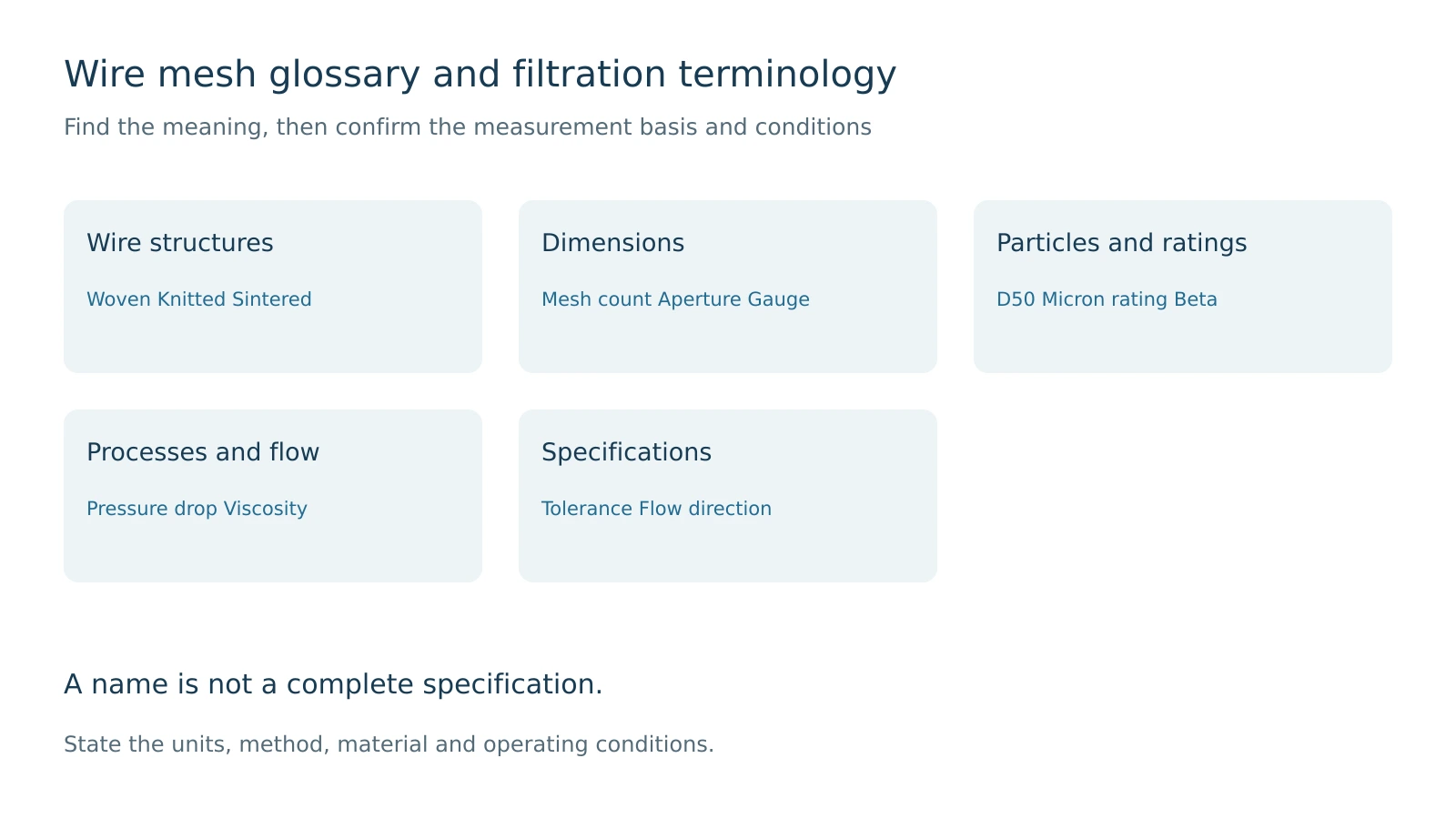
This wire mesh glossary and filtration terminology reference explains names used in drawings, data sheets and industrial purchasing. Its 77 entries cover structures, dimensions, particle metrics, flow and element specifications. Each short definition retains a practical boundary; terminology alone does not prove product performance.
Start with the subject group or A–Z index. Record units for dimensions, and methods and conditions for performance. The related guides provide fuller explanations.
A–Z index
Absolute rating · Aperture · Areal mass · Backwashing · Beta ratio · Bond · Bubble point · Bulk density · Bypass · Clean pressure drop · Coalescence · Custom to drawing · Cut edge · D10 D50 D90 · Demister · Depth filtration · Differential pressure · Dirt holding capacity · Dutch weave · Dynamic viscosity · Effective filtration area · End cap · Expanded metal · Face velocity · Filter cake · Filter element · Filter medium · Filtration efficiency · Flow direction · Flow rate · HEPA · Kinematic viscosity · Knitted wire mesh · LWD and SWD · LWO and SWO · MERV · Mesh count · Micrometer or micron · Micron rating · MPPS · MTC · Nominal rating · Number distribution · Open area · Particle size · Particle size distribution · Penetration · Perforated metal · Permeability · Pitch · Plain weave · Pleated filter · PMI · Porosity · Reverse engineering from a sample · Seal · Selvage edge · Sintered metal fiber felt · Sintered powder metal · Sintered wire mesh · Slot width · Strand · Support layer · Surface filtration · Terminal differential pressure · Tolerance · Twill weave · Volume distribution · Warp wire · Wedge wire screen · Weft wire · Welded wire mesh · Wire cloth · Wire diameter · Wire gauge · Wire mesh · Woven wire mesh
Mesh structures
Wire mesh
Material formed from metal wires; specify woven, knitted or welded construction. Identify material grade separately from structure.
Wire cloth
An industrial term commonly used for woven wire material. Its exact scope depends on the specification; it is not every metal mesh.
Woven wire mesh
Warp and weft wires interlaced in a specified sequence. Includes square weaves and Dutch weaves.
Welded wire mesh
Wire material with welded intersections. Square openings do not establish weaving; inclusion here is a structural comparison.
Knitted wire mesh
Continuous wires formed into interlocking loops, sometimes crimped or compressed. Feed-wire count, layer count and compression state are separate fields.
Warp wire
Wires normally aligned along the material’s weaving length. Confirm direction from manufacturing records and drawings.
Weft wire
Transverse wires inserted across warp wires during weaving. Warp and weft counts and diameters can differ.
Plain weave
Weaving that normally alternates one over and one under. The name alone does not establish aperture or efficiency.
Twill weave
A specified interlacing sequence that can form a diagonal pattern. Specify the weave rather than surface appearance alone.
Dutch weave
Weaving with directional wire-size and density arrangements that form filtering passages. Ordinary square-aperture formulas do not directly apply.
Selvage edge
An edge formed during weaving. Distinguish subsequently cut, bound or welded edges.
Cut edge
An edge produced by cutting or trimming. Specify the cutting process and edge acceptance requirements separately.
Perforated metal
Sheet with holes produced by punching a specified pattern. A sheet with holes may instead be cut or etched; verify processing.
Expanded metal
Sheet slit and stretched into integral strands and bonds. Record raised and flattened forms separately.
Strand
The metal segment between bonds in expanded metal. Elsewhere the word may describe strands in a wire bundle.
Bond
A connecting region between expanded-metal strands. It is not a universal sintering-bond quality rating.
Wedge wire screen
Profile wires connected to supports to form continuous slots. Verify slot, cross section, support and flow direction.
Sintered wire mesh
Wire-cloth material sintered in a specified layer arrangement. Layer counts and functions are not universally fixed.
Sintered metal fiber felt
Porous medium formed by sintering a metal fiber network. Appearance alone does not equate it with compressed knitted mesh.
Sintered powder metal
Porous material made by sintering a metal-powder skeleton. Grade and appearance alone do not establish filtration performance.
Dimensions and geometry
Mesh count
Directional grid repetition, commonly stated per inch under a defined counting convention. It is not the total openings per square inch; state warp and weft.
Wire diameter
Diameter of a circular wire section, commonly in mm or μm. Identify bare wire, coated diameter, individual strand or another state.
Aperture
Clear opening measured in a specified direction. It is not pitch and does not independently establish removal efficiency.
Pitch
Distance between adjacent repeated features using defined endpoints. Identify hole pitch, loop pitch or pleat pitch as applicable.
Open area
Open projected area divided by a stated total reference area. Clarify margins, weld regions and effective-area boundaries.
Porosity
Pore volume divided by total material volume. Different from projected open area and filtration efficiency.
Slot width
Clear slot dimension at a specified measuring location. For wedge wire, state measuring face and tolerance.
LWD and SWD
Long-way and short-way design dimensions of expanded-metal repetition. Confirm drawing endpoints; these are not simply clear openings.
LWO and SWO
Long-way and short-way opening dimensions of expanded metal. Record separately from design dimensions.
Wire gauge
A numbered system identifying nominal wire dimensions. Equal AWG, SWG and BWG numbers may mean different diameters.
Micrometer or micron
A length unit, symbol μm: 1 μm equals 0.001 mm. Micrometer can also name a measuring instrument; read the context.
Tolerance
Permitted variation of a specified dimension or quantity. Decimal places in a nominal value do not define tolerance.
Areal mass
Mass divided by the applicable area, often g/m² or kg/m². Identify single-layer, composite or flattened-tube area basis.
Bulk density
Mass divided by a defined envelope volume. Porous-part bulk density differs from solid-material density.
Particles and filtration metrics
Particle size
A size quantity established by a specified measurement method. Irregular particles may have different equivalent or projected diameters.
Particle size distribution
Size proportions on a stated number, volume or mass basis. Record basis and measurement method together.
D10 D50 D90
Sizes at 10%, 50% and 90% in a cumulative undersize distribution. D50 is the basis-specific median; D90 is not the maximum.
Number distribution
A size distribution weighted by particle counts. Relabeling volume data does not convert it to number data.
Volume distribution
A size distribution weighted by particle volumes. A few large particles can dominate volume.
Micron rating
A filtration specification related to particle size. Also define grade, efficiency, method and conditions.
Nominal rating
A filtration grade stated under a supplier or agreed definition. It has no universal fixed removal percentage.
Absolute rating
A grade defined by an explicit limit, test or performance criterion. The name alone does not mean 100% or a fixed beta.
Filtration efficiency
The fraction removed under a specified basis and conditions. State size range, count or mass basis and test stage.
Beta ratio
Upstream divided by downstream particle number concentration at the same threshold and volume basis. Read with size, method and statistical definition.
Penetration
The particle fraction passing through under the stated basis. Complementarity with removal efficiency requires consistent data.
Bubble point
Pressure associated with a defined bubbling passage through wetted porous material. Pore-related evaluation does not replace particle-removal testing.
Permeability
A property describing fluid passage through a material under stated conditions. State method, units and conditions for a parameter or air-flow result.
Dirt holding capacity
Contaminant capacity reported under defined loading, accounting and terminal conditions. Distinguish injected mass from retained mass; capacity is not service life.
MERV
An air-filtration rating under its applicable test system. No direct conversion establishes a liquid micron rating or beta value.
HEPA
An air-filter category meeting its system’s high-efficiency requirements. Identify the evaluation system; ordinary metal media do not automatically qualify.
MPPS
The size giving lowest efficiency or highest penetration under the test conditions. It is not universally fixed at 0.3 μm.
Processes and flow
Surface filtration
Particle retention primarily at a medium’s surface. Internal capture and filter-cake effects can also coexist.
Depth filtration
Particle capture within internal media passages. Thickness or multiple layers alone do not establish efficiency.
Filter cake
A particle-deposit layer formed on the filtering surface. Its resistance and retention effects depend on the process.
Coalescence
Small droplets merging into larger droplets after contact. Distinct from solid sieving; drainage and subsequent separation matter.
Demister
A device or element reducing droplets entrained in gas. Gas/liquid separation performance is not a solid-particle grade.
Differential pressure
Pressure difference between stated measurement points. Identify element, housing or whole-system boundaries.
Clean pressure drop
Pressure drop of a clean element at stated fluid and flow conditions. Compare temperature, viscosity and measurement boundaries.
Terminal differential pressure
A specified stopping condition for a test or operation. Separate cleaning threshold, test endpoint and structural failure limit.
Flow rate
Volume or mass passing per unit time. L/min and kg/h differ; gas volumes require reference conditions.
Face velocity
Volumetric flow divided by a specified reference area. Different area bases give different values; it is not actual pore velocity.
Dynamic viscosity
A parameter relating shear stress and velocity gradient in the applicable fluid model. Newtonian expressions require their conditions; common units are Pa·s or mPa·s.
Kinematic viscosity
Dynamic viscosity divided by fluid density at the same conditions. Often m²/s or mm²/s; conversion needs density.
Backwashing
Cleaning flow opposite to the specified normal filtration direction. Confirm suitability of the element, equipment and contaminant.
Elements and purchasing
Filter medium
Material performing the specified filtration function. Distinguish filter medium from process fluid.
Filter element
An assembly of medium and required supports, ends or connections. Coupon performance does not establish assembled sealing or integrity.
Pleated filter
An element constructed from pleated medium. Distinguish unfolded area and effective area according to construction.
Support layer
A layer providing mechanical support, spacing or protection. Its aperture does not establish the inner medium’s filtration grade.
Effective filtration area
Area participating in filtration under an explicit definition. Clarify deductions for seals, overlaps and obstructions.
Bypass
A designed or unintended flow path around the specified filtration route. Whole-system removal cannot be established from medium data alone.
Flow direction
The specified fluid path through an element, such as outside-in or inside-out. Confirm from design and drawings rather than shape alone.
End cap
An end component providing closure, location or connection. Confirm material, joining and sealing separately.
Seal
A structure or interface restricting unintended fluid paths. Bare knitted mesh does not automatically form a gas-tight seal.
MTC
Agreed material test or certification documentation. It is not a filter-efficiency certificate; specify document type and traceability.
PMI
Material composition or grade identification using an appropriate analytical method. Method capability has limits and does not establish every material property.
Custom to drawing
Manufacturing to drawings and technical requirements agreed by both parties. Confirm revision, unspecified fields and acceptance rules beforehand.
Reverse engineering from a sample
Reviewing measurable sample dimensions and structure to prepare manufacturing information. Appearance alone does not establish original material or all performance.
Commonly confused concepts
| Pair | Distinction |
|---|---|
| Mesh count / aperture | Count needs wire diameter and an applicable structure to determine opening |
| Wire gauge / mesh count | Gauge identifies wire size; count identifies grid repetition |
| Open area / porosity | Projected area fraction versus volume fraction |
| Pore size / efficiency | Passage geometry versus measured particle removal |
| D50 / mean / filter grade | Basis-specific median versus a defined mean or filtration requirement |
| Process fluid / filter medium | Fluid being treated versus material doing the filtering |
| System pressure / differential pressure | Operating pressure versus difference between stated points |
| Media coupon / complete element | Material sample versus an assembly including connections and seals |
Frequently asked questions
Is mesh count the same as pore size?
No. Applicable geometry, wire diameter and directional convention are needed. ### Can nominal and absolute ratings be compared by number alone? Their definitions, efficiency basis and test conditions must be aligned. ### Does a material certificate establish filter efficiency? Material documentation and particle-removal evidence serve different purposes. ### Does an identical term always mean an identical specification? Read the drawing, units, method, conditions and agreed acceptance definition.
Detailed guides and references
Metal mesh identification · Filtration ratings · Particle size · Wire gauge chart · Replacement measurement
Definitions are editorial summaries, not reproduced standard clauses. Background references include NIST SI prefixes, NPL particle size guidance, EPA MERV, and ISO 29463-5. Manufacturing and acceptance use the confirmed drawing, operating conditions and requirements.
About the author: Jack Sun has long experience in wire weaving and industrial filter manufacturing. Our company is based in Anping, Hengshui, Hebei, China. Project manufacture and acceptance follow the confirmed drawing, operating conditions and agreed requirements.