By Jack Sun
Our company is based in Anping County, Hengshui, Hebei, China, a center of wire mesh manufacturing. I work with metal wire mesh weaving and industrial filter element manufacture. This guide explains demister pad selection from a manufacturing, inspection and purchasing perspective.
Quick Definition
A wire mesh demister pad is a gas–liquid separation element made from knitted wire mesh. It captures entrained droplets, allows them to coalesce and drains the collected liquid. Selection must consider gas velocity, liquid loading, material, mesh density, pad thickness, support and drainage together.
Introduction
Liquid carried by an industrial gas stream can create problems beyond the separator itself. Fine droplets may leave a scrubber, absorption tower or another process vessel and enter downstream equipment. Carryover can cause corrosion, liquid losses, contamination and emission-control problems.
A wire mesh demister pad has a relatively simple structure, but its performance depends on several connected variables: wire diameter, mesh density, pad thickness, material, gas velocity, liquid loading and drainage. Understanding these variables helps explain how a mesh pad works, how it differs from other mist eliminators and what to check when separation deteriorates.
What Is a Wire Mesh Demister Pad?
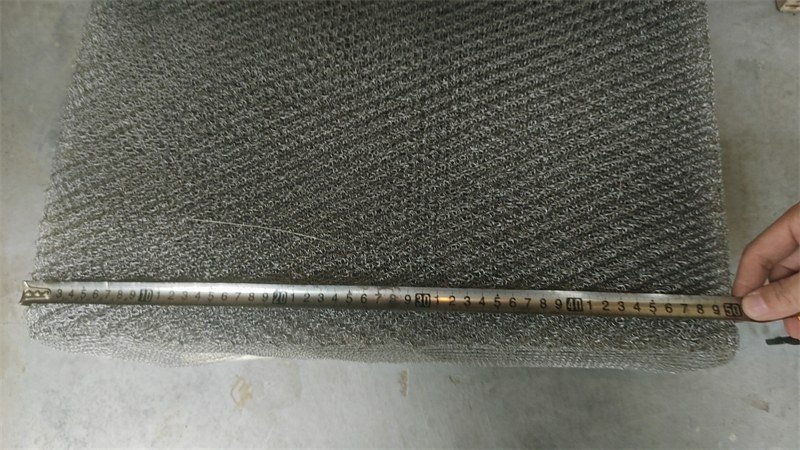
The tape measure in Figure 1 shows a dimensional check on one sample. Its reading is not a universal specification. Acceptance measurements should follow the drawing, agreed measurement position, condition and tolerance.
A wire mesh demister pad removes liquid droplets from a flowing gas. Typical locations include scrubbers, absorption towers, separation vessels, distillation equipment and exhaust-treatment systems. Its main task is gas–liquid separation, rather than solid-particle filtration.
Droplets contact the wires, combine into larger drops and drain from the mesh. Names such as mesh demister, wire mesh mist eliminator, mesh pad mist eliminator and mist eliminator pad often describe the same basic metal mesh separation element.
Benefits of Wire Mesh Demister Pads
Protect downstream equipment
Entrained droplets may contain acidic, alkaline or otherwise corrosive liquids. Removing them before they reach fans, ducts, heat exchangers and other downstream components can reduce contamination and corrosion exposure.
Recover process liquid
Liquid leaving with the gas may contain valuable process chemicals. Capturing and returning coalesced droplets can reduce material losses and help stabilize operation.
Reduce droplet carryover
A demister targets droplets already present in the gas at its location. A visible white plume can also form when discharged gas cools and condenses outside the equipment. White mist alone does not prove demister failure, and installing a pad does not guarantee elimination of every visible plume.
How Does a Wire Mesh Demister Pad Work?
The mesh provides wire surfaces for droplet capture while retaining spaces for gas passage and liquid drainage. Capture depends on droplet size, gas velocity, mesh structure and drainage conditions.
Step 1: Inertial collision
As gas flows around a wire, droplets with sufficient inertia may leave the gas streamline and strike the wire. At very low gas velocity, inertial capture of fine droplets may be insufficient.
Step 2: Droplet coalescence
Captured droplets adhere to wire surfaces and combine with other droplets. The larger drops are easier to drain from the mesh.
Step 3: Gravity drainage
Liquid moves down through the mesh into the collection area. Excessive gas velocity or liquid loading can restrict drainage and cause re-entrainment. Drainage space and installation orientation therefore need to be checked alongside capture.
Increasing mesh density is not an automatic improvement. The design must balance droplet capture, gas passage and liquid removal.
Wire Mesh Demister Pad vs. Mist Eliminator
Mist eliminator is a broader term for equipment or elements that remove liquid droplets from gas. A wire mesh demister pad is one specific type, using knitted metal wire as the separation medium. The appropriate type depends on droplet size, gas velocity, liquid loading, allowable pressure drop, corrosion conditions and the process.
Main Components of a Wire Mesh Demister Pad
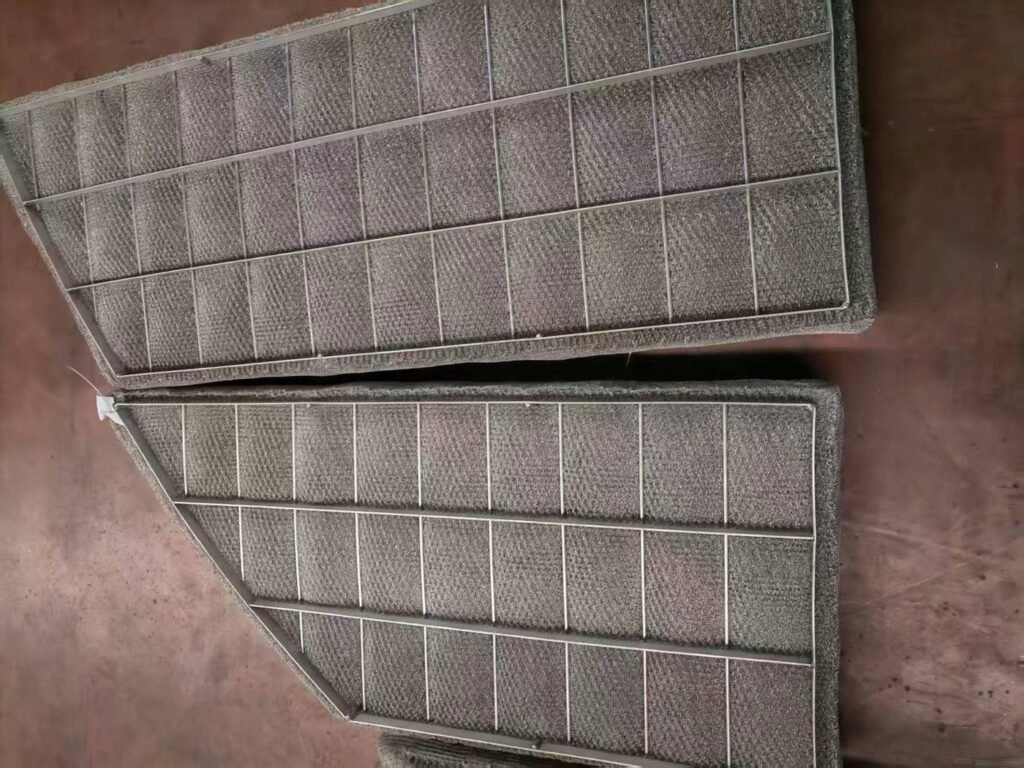
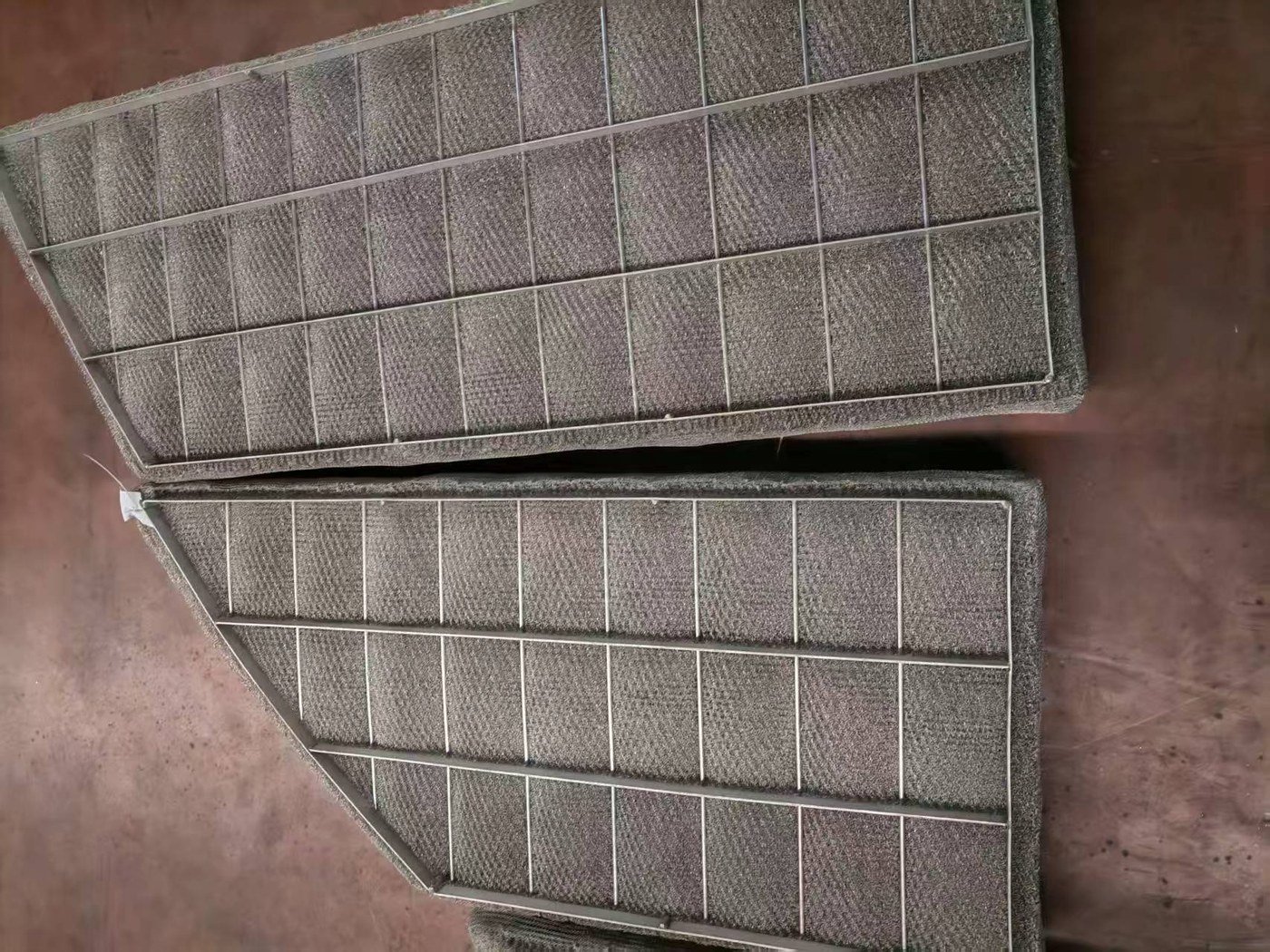
A typical assembly includes the mesh pad, support grids and retaining components. The vessel design, pad dimensions, operating conditions and installation method determine the final arrangement.
Mesh pad
The knitted mesh is the separation medium. Wire diameter, mesh density, compression and thickness influence its contact area and open structure.
Support grids
Support grids keep the mesh in position and resist movement or deformation. Large pads and demanding flow conditions require an assessment of support strength.
Frame and retaining system
A frame can simplify installation, removal, inspection and cleaning. Retaining strips or additional fixing parts may be needed to stabilize the assembly.
How to Choose Materials and Specifications
Measure pad thickness against the agreed specification. Appearance alone cannot establish thickness or density, because compression changes the physical condition of the mesh.
Material selection
Start with the actual medium and environment. Check temperature, chemical composition, chloride exposure, pH, cleaning conditions and expected life. Stainless steel is a common starting point, but the familiarity of 304 or 316L does not establish suitability for a strongly corrosive process.
Mesh density
Greater density may provide more opportunities for droplet contact, while increasing flow resistance and liquid retention. Choose density for the process rather than maximizing it.
Pad thickness
Thickness provides additional capture depth, but more material does not always mean better performance. Evaluate droplet characteristics, gas conditions, allowable pressure drop and available vessel space.
Gas velocity and liquid loading
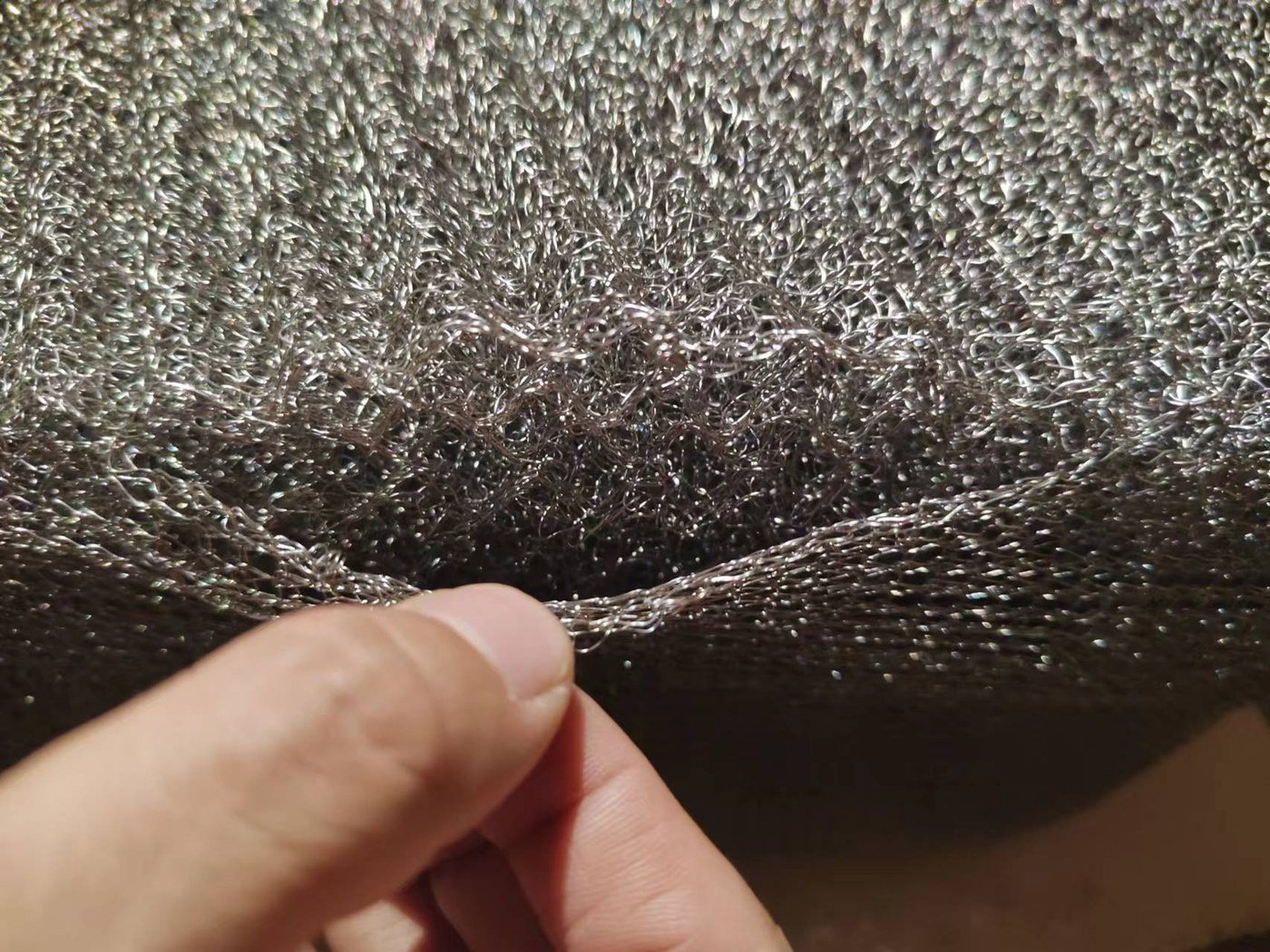
Distinguish standard-condition flow from actual operating-condition volume flow. Calculate superficial velocity using actual flow and the effective flow area. Low velocity can weaken capture; high velocity can impair drainage and cause re-entrainment. Supply minimum, normal and maximum conditions for equipment with a broad operating range. [1]
Mesh density inspection
Bulk density is commonly expressed in kg/m³: the metal mass of the mesh divided by its volume in an agreed condition. Specify whether the frame and support grids are excluded, and agree how thickness and compression are measured. Identical nominal densities can otherwise describe different structures.
Pressure drop
Excessive resistance increases blower load and may affect the whole system. Provide actual gas volume flow, temperature, pressure, gas and liquid densities, liquid loading, droplet size and allowable pressure drop.
The Souders–Brown relationship is a capacity-estimation tool, not a product acceptance standard. Its K value depends on mesh type, liquid loading and operating conditions. A universal K value cannot establish a guaranteed separation efficiency. [1]
Application boundaries
High solids content, viscous liquids, scaling media and restricted drainage require an assessment of blockage and liquid accumulation. Mesh type, pretreatment and cleaning arrangements must follow the application. This guide does not specify a universal operating velocity, minimum captured droplet size or fixed removal efficiency.
Common Applications
- Wet scrubbers and absorption towers
- Flue gas desulfurization (FGD) systems
- Chemical process equipment
- Distillation and evaporation equipment
- Exhaust and emission-control systems
Common Problems and Troubleshooting
Capture, loading, blockage and bypass checks
Compare observations at known gas and liquid conditions before assigning a cause. The checks below help distinguish capture, loading, blockage and bypass; no single pressure reading or visible plume proves a pad fault.
| Observation | Possible explanations | Next evidence to collect |
|---|---|---|
| Carryover at low actual gas flow | Insufficient inertial capture may compete with a changed droplet distribution or gas bypass. | Compare actual operating-condition flow and effective area with the earlier condition; check inlet droplet/load information and continuity of the installed pad. |
| Carryover rises as gas or liquid load increases | Restricted drainage, liquid accumulation or re-entrainment may be involved; high velocity alone does not establish the cause. | Record gas flow, liquid load and wet differential-pressure trend together. Check drainage paths and liquid-level conditions. |
| Differential pressure rises or stays high | Solids or sticky deposits, accumulated liquid and increased throughput can produce competing explanations. | Compare flow and gas conditions before comparing pressure readings. Inspect deposits and drainage, then compare recovery after the agreed cleaning procedure. |
| Poor separation with gaps or displaced sections | Gas may bypass the mesh at the perimeter, segment joints or supports; density changes do not repair an installation gap. | Map segment positions, edge contact, fixing points and support condition. Check the installed layout against the drawing and inspect damaged mesh. |
Poor separation performance
Check mesh density, excessive gas velocity, drainage, damaged mesh, installation gaps and changes beyond the original design conditions.
Corrosion or material damage
Rapid wire corrosion can indicate incompatibility with the medium or temperature. Cleaning can also contribute to damage over time. Reassess material compatibility rather than merely increasing pad thickness.
Mechanical deformation
Possible causes include inadequate support, excessive gas velocity, vibration, handling damage and incorrect installation. Inspect the mesh, support grids and retaining parts together.
Customization and Manufacturing
Demister pads are commonly made to fit a particular vessel. Circular, rectangular and other shapes can be combined with suitable frames and support grids.
An executable manufacturing specification includes dimensions, material, wire diameter, mesh density, thickness, support and operating conditions. Replacement projects should also describe manway dimensions, segment arrangement, fixing locations and the failure condition of the old pad.
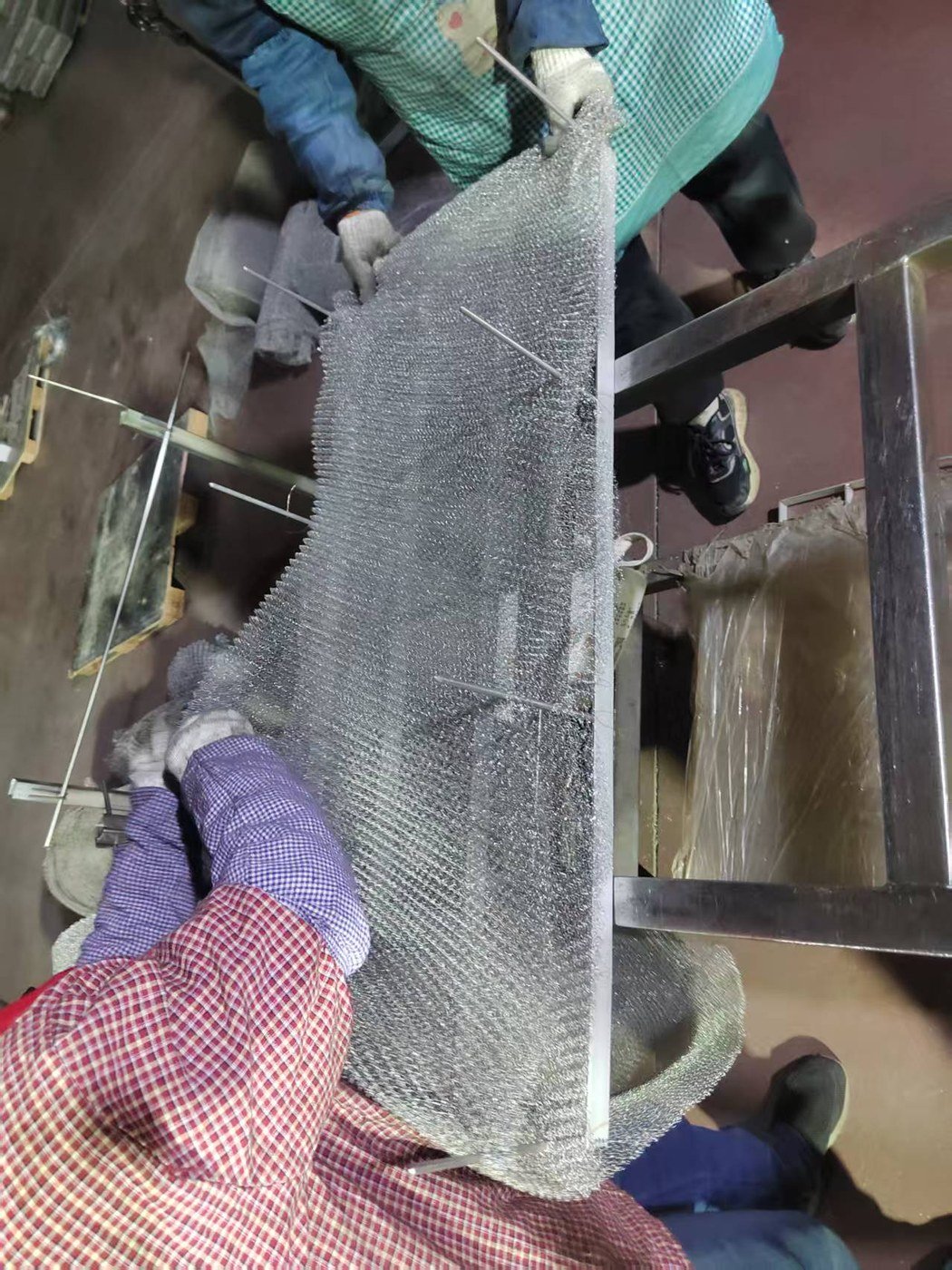
Typical production steps include mesh formation, cutting, layering or rolling, compression to the specified thickness, trimming, support-grid assembly, frame fabrication and final inspection. The exact sequence depends on the design.
Information to provide for an enquiry
- Inside diameter or overall length × width
- Required pad thickness
- Mesh material, such as 304 or 316L stainless steel
- Mesh density, wire diameter or an existing specification
- Support-grid and frame requirements
- Gas flow, temperature, pressure and liquid conditions
- Application, process medium and required separation performance
Inspection and Maintenance
Inspect overall dimensions, mesh condition, thickness, frame quality, support-grid position and assembly stability. Maintenance intervals depend on fouling, scaling and the operating environment.
- Check deformation or displacement.
- Check corrosion and broken wires.
- Look for solids or sticky deposits.
- Confirm that drainage paths remain open.
- Inspect support grids and retaining parts.
Record operating differential pressure, carryover changes and mesh condition so that recovery after cleaning or replacement can be assessed.
Conclusion
The most suitable demister is the one that balances capture, velocity, pressure drop, drainage, material compatibility and mechanical stability in the actual vessel. It is not necessarily the densest pad or the most expensive material.
Clear operating conditions allow the manufacturer to evaluate wire specification, material, thickness, support and overall dimensions more accurately. This is where manufacturing experience becomes useful.
Frequently Asked Questions
What is a wire mesh demister pad?
It is a knitted wire mesh gas–liquid separation element that captures and coalesces entrained droplets, supports liquid recovery and helps protect downstream equipment.
Where are demister pads used?
Typical uses include FGD systems, scrubbers, chemical process towers, desalination equipment and exhaust-treatment systems. Suitability depends on the actual process.
How should stainless steel demister material be selected?
Check medium composition, temperature, chloride concentration, pH, deposits and cleaning. Both 304 and 316L may be candidates, but 316L is not universally suitable for chloride or seawater service. Higher temperature and chloride concentration, or lower pH, can increase localized corrosion risk. Use material data or testing for special media. [2]
How often should a pad be replaced?
There is no universal interval. Inspect unusual differential pressure, increased liquid carryover, broken or corroded wires and deformation. Replacement depends on damage, cleaning recovery and acceptance requirements. White mist alone is insufficient evidence.
Is higher mesh density always better?
No. It can increase contact opportunities but also resistance and retained liquid. Assess density with gas velocity, liquid loading, droplet size and drainage. [1]
Can demister pads be customized?
Yes. Shape, dimensions, material, wire diameter, thickness and density can be matched to the equipment.
Which parameters are needed before purchasing?
Provide vessel dimensions, gas flow, temperature, medium composition, corrosion conditions and required separation performance, together with support and drainage details.
Discuss Your Filtration Needs
Share your drawing, existing sample and minimum, normal and maximum operating conditions. Explore our knitted mesh products, or discuss mesh specification, segmentation, support and inspection requirements for a custom demister assembly.
References
- Poppele, E. W. Correlation of maximum air velocity with liquid entrainment loading for wire mesh mist eliminators (NJIT, 1958). Used to explain capacity, liquid loading and re-entrainment; the experiment is not a product guarantee.
- Outokumpu: The power of corrosion resistance. Used for the influence of chlorides, temperature and pH on localized corrosion.