By Jack Sun · Updated October 20, 2026
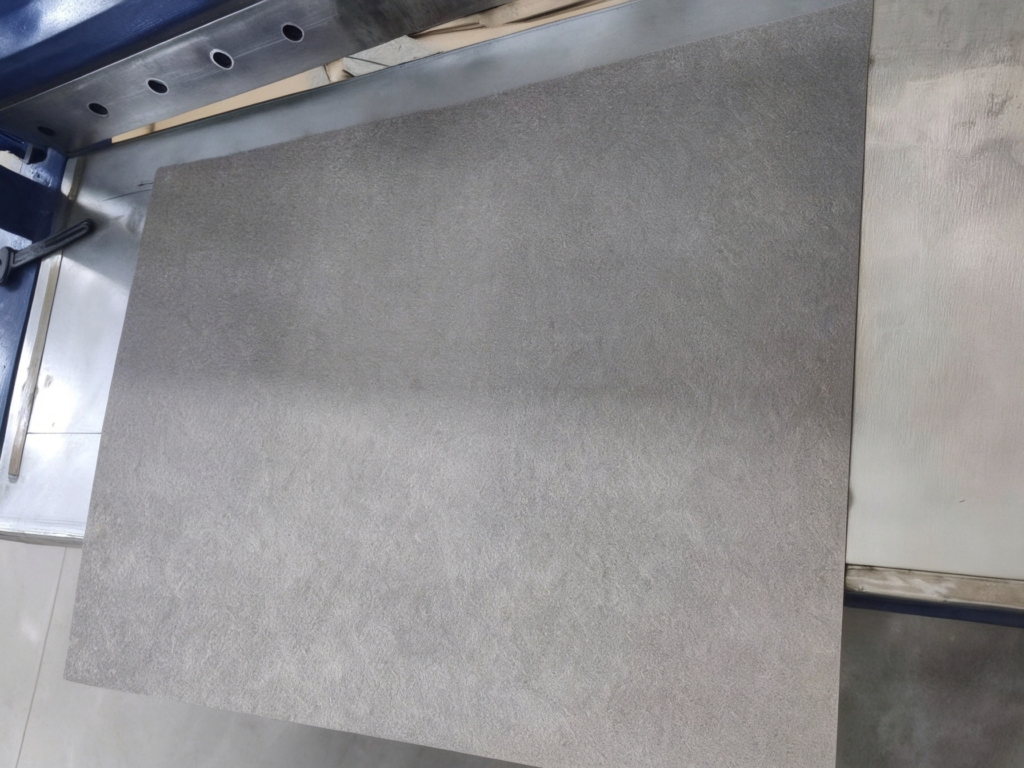
Quick definition: Titanium sintered fiber felt is a porous metal material formed by laying and sintering titanium fibers. Bonded fibers create a skeleton, while interconnected voids provide passages for liquids and gases. It can be supplied without an applied coating or with a surface coating specified for its intended use.
Three aspects help explain titanium felt: the titanium material, the fiber structure and the surface condition.
A sheet can provide support, transport and electrical contact, but these functions do not all come from the words “pure titanium.” Thickness, internal structure and surface treatment can change how otherwise similar products behave.
What kind of material is titanium sintered felt?
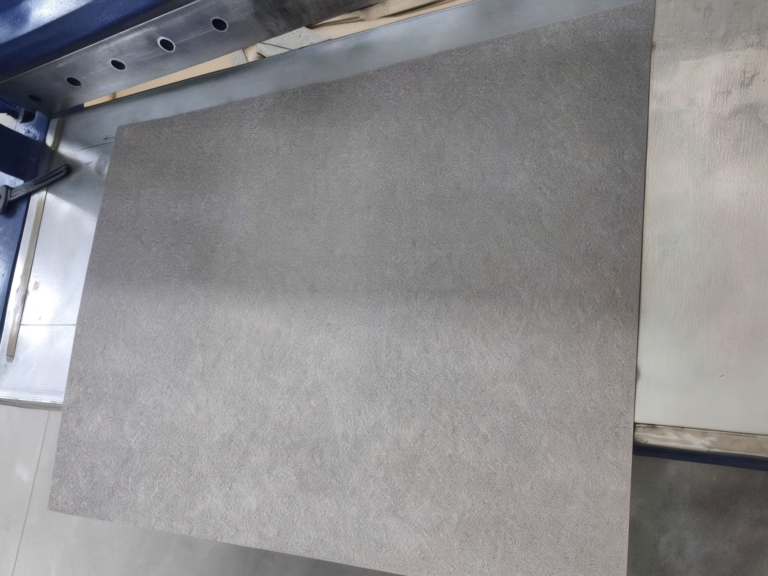
Fine titanium fibers form a web and are bonded at their contact points through sintering. The resulting material retains a porous structure with mechanical integrity.
Unlike solid titanium sheet, it contains an internal pore network. Unlike woven titanium mesh, it is formed from interlaced fibers rather than a regular warp-and-weft weave.
It also differs from powder-sintered titanium. Both can be porous, but the starting material and resulting networks differ. Sharing the same metal does not establish direct interchangeability.
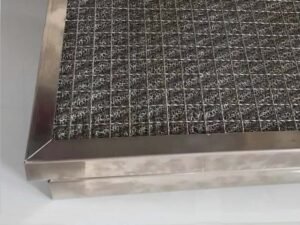
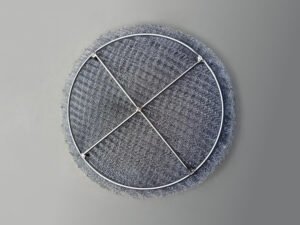
Supply forms can include sheets, strips, discs, drawing-based cut shapes and mesh-supported constructions. Shape and support serve the assembly; neither alone proves a specific application performance. [1]
What the material and porous structure contribute
Corrosion behavior comes from the material and its surface
Titanium’s corrosion behavior is closely associated with its protective surface oxide. That protection is valuable in many suitable environments, but not in every medium.
Composition, concentration, temperature and local conditions can change the result. Hydrofluoric acid and certain acidic fluoride environments are important exceptions; performance in another medium cannot establish suitability there. [2]
“Good corrosion resistance in suitable environments” is consequently more useful than an unrestricted corrosion claim. Ignoring the environment turns a material advantage into a promise it cannot support.
Connected pores provide transport pathways
Pores provide space for liquids and gases to pass. Porosity, however, describes the proportion of void volume rather than the complete arrangement of the pathways.
The amount of empty space and the way that space connects are related but different. Interpret porosity with thickness, connectivity and the installed condition. A ranking based only on the largest percentage can miss relevant structural differences.
The fiber network provides support and conduction paths
Bonded fibers create a metal skeleton that provides support and paths for electron transport.
Electrical conduction through the material does not guarantee low resistance at every installed contact. Surface condition and assembly affect the interfaces with neighboring parts.
Likewise, a porous metal skeleton does not have the same load capacity as a solid sheet of that metal. Thickness, construction and loading matter. Material identifies what the part is made from; structure helps explain what it can do.
Coated and uncoated titanium felt
We supply coated and uncoated titanium sintered felt. The distinction is whether a deliberately applied engineering coating forms part of the delivered surface.
Uncoated does not mean oxide-free
Uncoated felt has no additional engineered coating of the specified kind. It can still carry a naturally formed titanium oxide film.
This matters where electrical contact is important. A surface that protects the underlying material can also affect the contact interface. Pure titanium’s ability to conduct electricity does not guarantee ideal contact under every assembly and operating condition.
Why apply a coating?
For some electrochemical uses, coatings aim to improve interfacial electrical contact and control surface changes during operation.
A study comparing coated titanium-fiber PTLs found different contact and durability behavior among the treatments. Not every investigated coating improved on the uncoated reference. [3] Adding a coating is therefore not, by itself, proof of improved performance.
The useful questions concern the function the coating is intended to provide and whether it maintains that function under the target conditions.
A coating does not replace the underlying structure
The substrate provides the fiber skeleton and pore network; the coating changes a surface or interface function. A coating should not be expected to remove local deformation, structural unevenness or dimensional errors in the substrate.
A protective or conductive coating, a catalyst layer and a microporous layer also describe different functions. Fraunhofer ISE’s titanium microporous-layer research, for example, modifies surface structure to improve contact with the catalyst layer. It should not simply be equated with a conductive protective film. [4]
Understanding the kind of layer and its purpose prevents results for different products from being treated as equivalent.
Main applications of titanium sintered felt
Porous transport layers in PEM water electrolysis
PEM water electrolysis is an important application direction. In a suitable anode construction, titanium felt can act as a porous transport layer, or PTL.
It participates in water delivery, oxygen removal, electrical contact and mechanical support. Our titanium PTL application guide explains its position and functions.
Those tasks have to work together. Passing fluid does not establish adequate support and contact; good electrical contact does not alone establish suitable two-phase transport.
“Can act as a PTL” does not mean that every titanium felt fits every electrolyzer. The value comes from the material, structure and interface acting together.
Filtration in compatible environments
Filtration is another application direction for porous titanium-fiber materials. Manufacturer literature identifies filters, electrode materials and diffusion layers among uses of porous titanium products. [5]
For filtration, titanium provides the material basis while the pore network supports flow and particle retention. The name “titanium felt” alone does not define a filtration rating.
Nor does a rating establish the capability of the complete element. Area, construction, joints and support also matter. A felt intended for an electrolyzer transport layer should not be exchanged with a filtration medium merely because the shape and material appear similar.
Porous substrates for functional surfaces
A titanium-fiber skeleton can also provide a substrate for surface treatment or a functional layer in a defined engineering design.
The substrate and functional layer should have clearly identified roles. Supplying porous titanium felt does not automatically mean supplying a complete electrode with specified catalytic activity. An applied coating is not necessarily a catalyst.
Understanding differences in use
Compare products in identified conditions
Two pure titanium felts can differ in thickness, internal structure and surface treatment. Comparing a coated part with an uncoated part includes the effect of surface treatment; the whole difference cannot be assigned to the fibers.
Clamping conditions can also change contact. Identifying these differences first makes an investigation more useful than repeatedly adjusting substrate parameters without knowing the main cause.
For more detailed manufacturing questions, see how titanium felt quality affects PEM electrolyzers.
Relate dimensions to measurement and assembly
Thickness affects both delivery dimensions and the installed contact condition. Check whether compared readings use comparable measurement conditions, and distinguish free-state thickness from the clamped condition.
This does not require a complex questionnaire for every order. For drawing-based fabrication, we work from the drawing and agreed requirements, discussing specific uncertainties when they affect manufacture or acceptance.
Cleaning depends on the delivered surface
Coated and uncoated products should not automatically receive the same cleaning treatment.
Assess contamination, substrate, coating and component joints together. The description “corrosion-resistant metal” does not make every acid cleaning or other method suitable.
Reuse also depends on the recovered condition and function. A clean-looking surface does not prove that pores, coating or electrical contact have returned to their previous state.
Frequently asked questions
Is titanium felt necessarily a titanium alloy felt?
No. This article mainly concerns commercially pure titanium fiber felt. “Pure titanium” still needs an identified grade and does not mean the absence of every other element.
Can uncoated titanium felt be used in a PEM electrolyzer?
Suitability depends on the specific design and validation. Neither universal acceptance nor universal exclusion follows from the absence of a coating.
Is coated titanium felt always better?
No. Its value depends on the intended function, coating material and process, and stability under the relevant conditions.
Is higher porosity always better?
No. Consider connectivity, thickness, support, contact and the assembly together. One percentage cannot establish overall behavior.
Can titanium felt replace titanium mesh or powder-sintered titanium?
Not solely because all are titanium. Their structures differ, and substitution requires evaluation of the actual component function and design.
Which surface conditions can you supply?
We supply coated and uncoated titanium sintered felt according to drawings and agreed requirements. Specific coating and component details can be discussed for the actual part.
Conclusion
Titanium provides the material basis, the fiber network forms the skeleton and passages, and the surface affects interaction with the environment and neighboring components.
Linking these aspects is more useful than treating corrosion resistance, high porosity or a coating as stand-alone guarantees. It also provides a practical route for understanding differences.
See our titanium fiber sintered felt product page for available product forms.
Technical references
- Filtalloy — Titanium Fiber Sintered Felt.
- TIMET — Corrosion Resistance of Titanium.
- Degradation of PGM and PGM-free Coatings on PEMWE Porous Transport Layers. Original research; its sample results are not guarantees for our products.
- Fraunhofer ISE — Ultrafine Transport Layers for Electrolyzers. Research background, not a declaration of our microporous-layer capabilities.
- Toho Titanium — Company Profile. General application directions, not qualification of an individual component.
By Jack Sun. Jack Sun has long worked in metal wire mesh weaving and industrial filter-element manufacturing. Our company is based in Anping, Hengshui, Hebei, China.