
By Jack Sun · Updated October 23, 2026
Quick definition
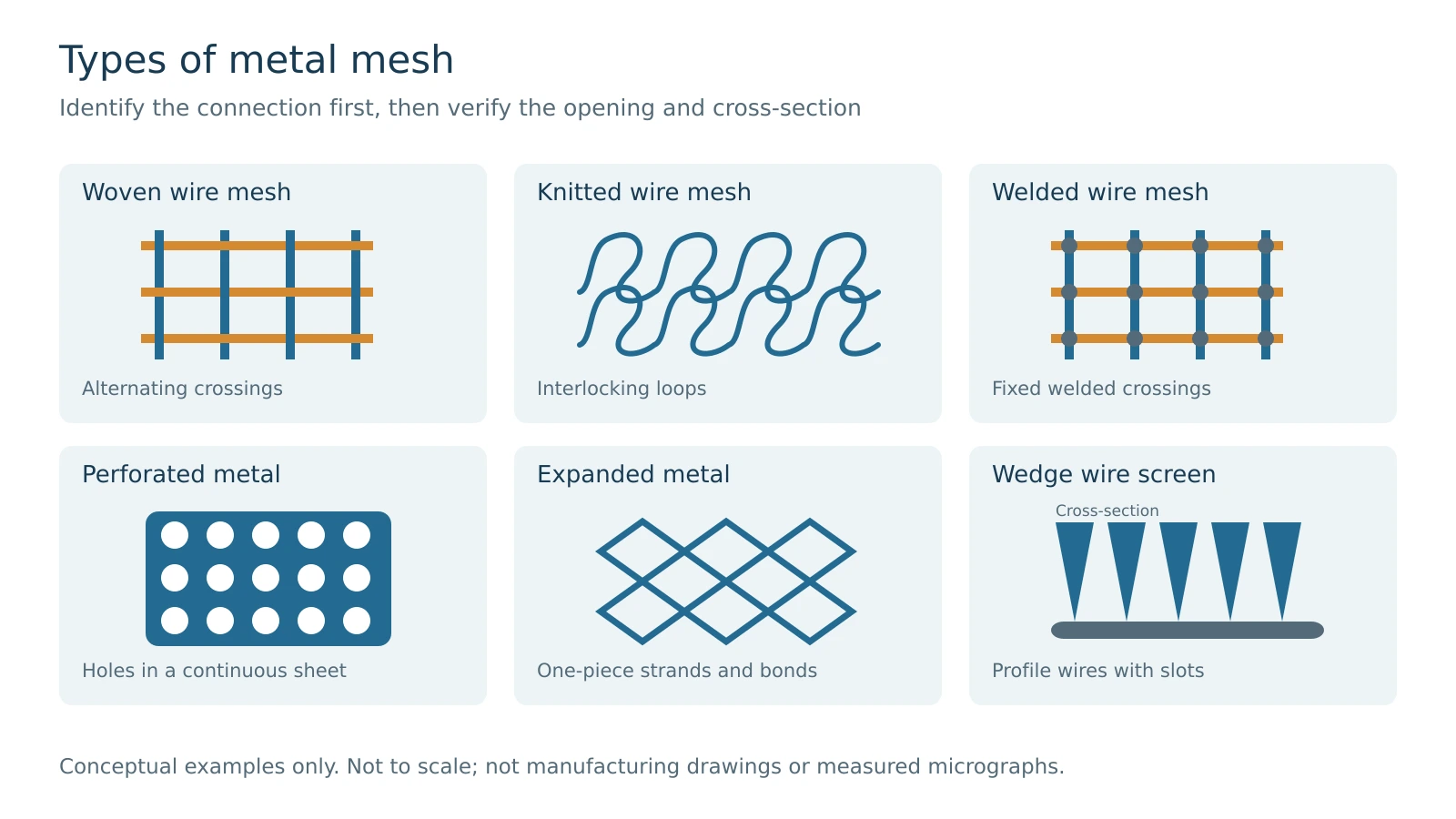
Types of metal mesh are identified by how wires, loops, sheet strands or profile wires are connected, followed by their processing and functional layers. Hole shape alone does not establish the structure or filtration performance.
Use this guide to organize photographs, drawings and sample information. Welded mesh is included for comparison; its inclusion does not establish that we supply every construction or fencing product.
1. Identifying types of wire mesh
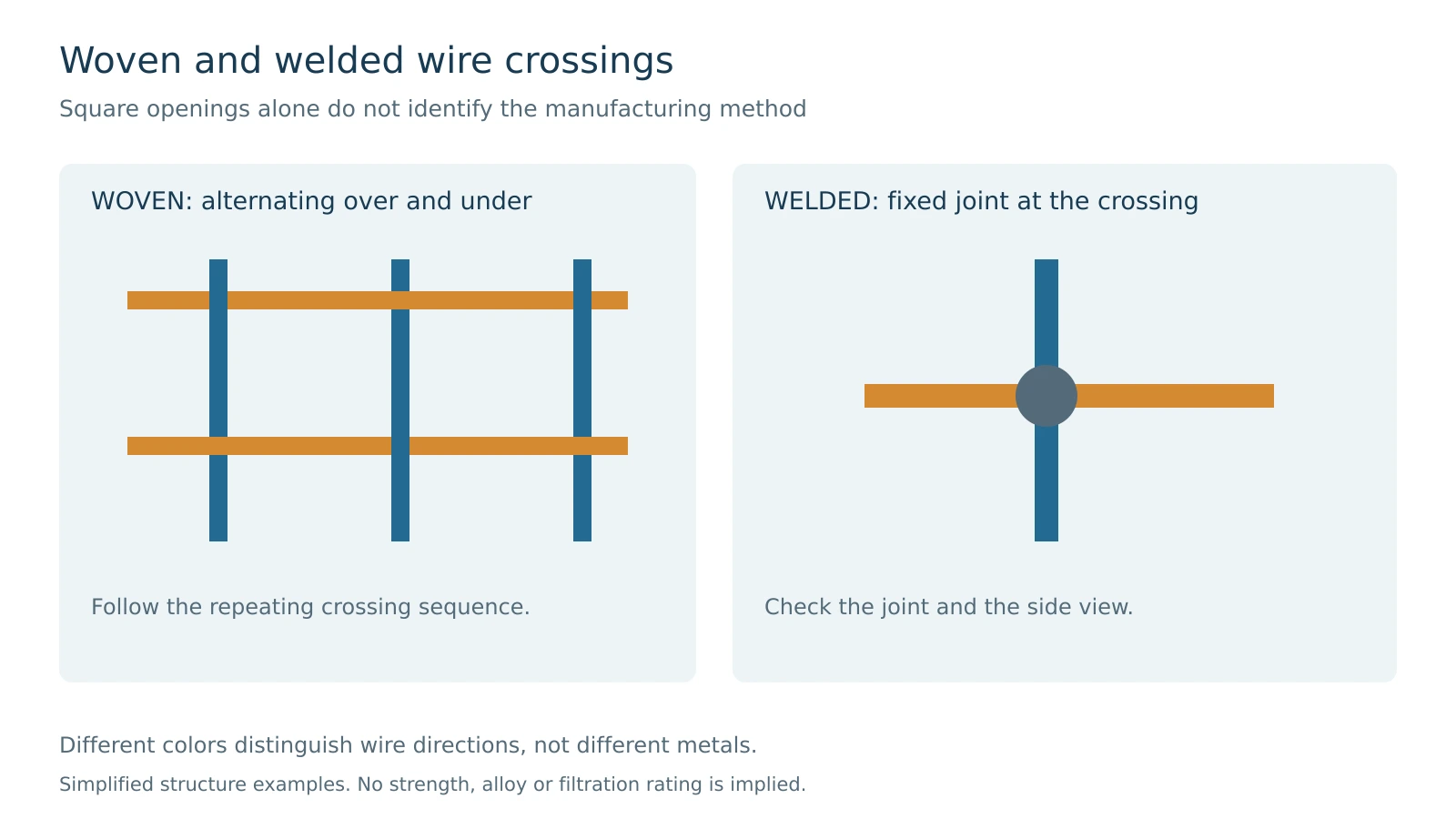
Follow one wire or strand through the sample. Repeated over-and-under crossings suggest weaving. Interlocking continuous loops suggest knitting. Fixed wire crossings without a weaving pattern require a check for welded joints.
For sheet-based structures, inspect the material between holes, hole edges, nodes and thickness. Round holes can also be cut or etched; diamond holes alone do not prove expansion. For parallel slots, inspect the profile-wire cross section and supports before identifying wedge wire.
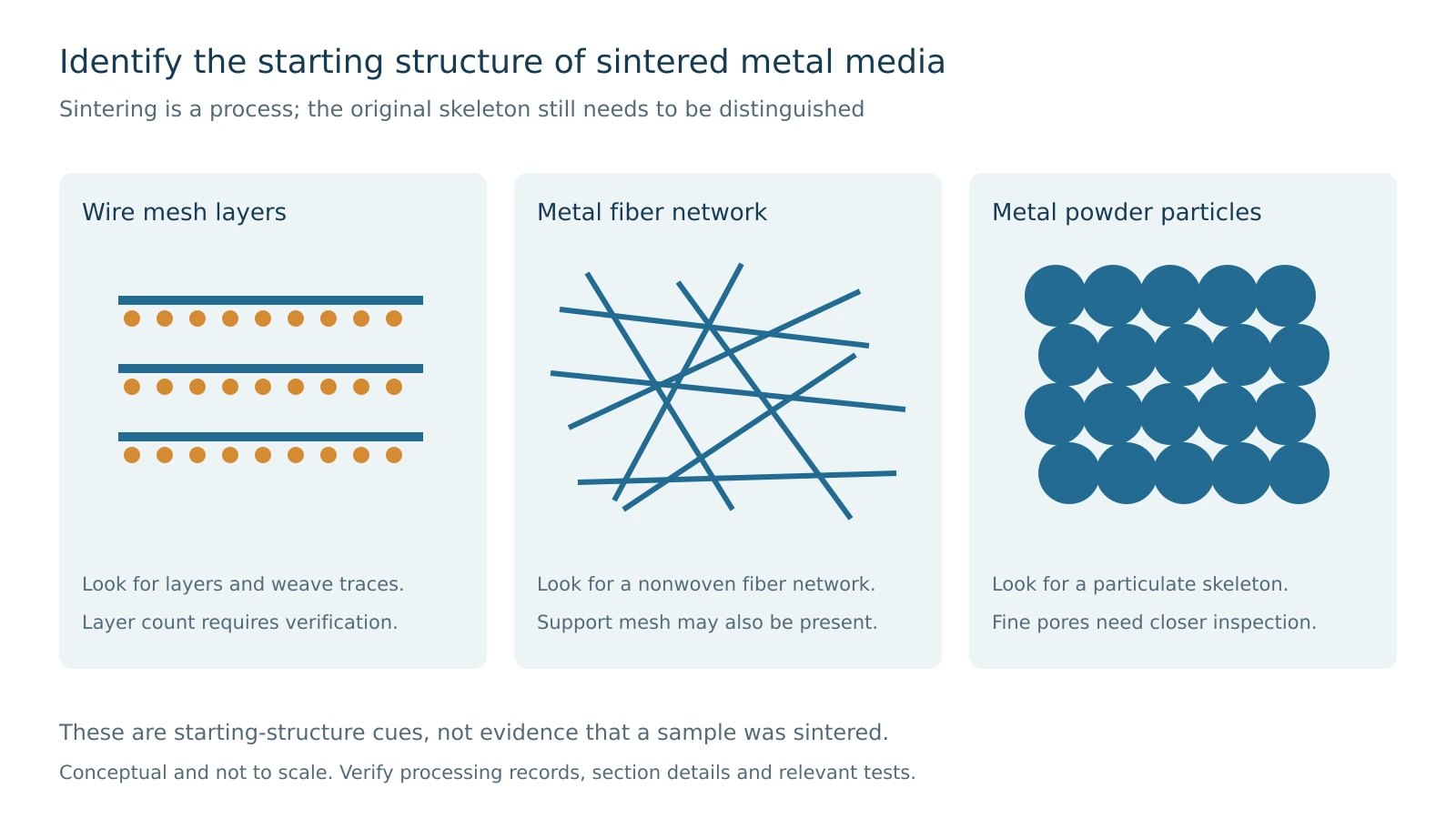
For dense surfaces, inspect edges and sections: layered wire cloth, irregular fiber networks and a powder-particle skeleton indicate different starting structures. A surface photograph cannot establish the internal construction or manufacturing process.
2. Six common metal mesh structures
| Structure | Formation | Identification clue | Specification fields |
|---|---|---|---|
| Woven wire mesh | Warp and weft interlaced | Periodic over/under crossings | Weave, directional counts, diameters, aperture |
| Knitted wire mesh | Continuous interlocking loops | Loop pattern; formed or compressed shapes | Wire diameter, feed strands, loops, areal mass |
| Welded wire mesh | Wires joined at crossings | Fixed intersections | Opening, diameter, joints, dimensions |
| Perforated metal | Holes punched in sheet | Continuous sheet between holes | Hole size, pitch, pattern, thickness, margins |
| Expanded metal | Sheet slit and stretched | Integral strands and bonds | Long/short design dimensions, strands, thickness |
| Wedge wire screen | Profile wires joined to supports | Parallel slots and shaped wire sections | Slot, profile, supports, direction |
Woven wire mesh
Plain weave usually alternates one over and one under. Twill uses another specified crossing sequence and can show a diagonal pattern. Pre-crimped wires may show formed bends at crossings.
Plain dutch weave, twill dutch weave and reverse dutch weave are woven structures, but their unequal wire sizes and densities create passages that cannot be understood as ordinary square apertures. Record warp and weft counts and diameters separately where different.
ISO 9044 and ASTM E2016 have specific scopes and exclusions; they are not universal acceptance standards for every Dutch weave, welded mesh or other metal structure. [1][2] Material grade needs separate evidence: brightness, color or magnetism cannot reliably identify 304, 316L, nickel or another alloy.
Woven wire mesh specifications
Knitted wire mesh
Continuous wire forms interlocking loops rather than a square lattice. Rolls, tubular sleeves, crimped material and compressed shapes are possible forms. Compressed pieces may need an uncompressed sample or manufacturing records for identification.
Single-wire and multi-wire descriptions generally identify feed strands, not layer count. Flattening a knitted tube also produces a two-face form without proving two independent sheets. Record relaxed, stretched or flattened measurement state.
Demisting, coarse filtration, support and compressed components have different finished requirements. Loop size alone is not a precise solid-particle rating; touch does not establish damping, spring recovery or sealing performance.
Welded wire mesh
Crossing wires are joined rather than continually interlaced. Side views help identify the connection. Weld marks may be subtle, so an invisible weld scar does not exclude welding. Record opening, diameter, joint form and thickness; avoid a universal strength ranking against woven mesh.
Perforated metal
The base is sheet, with round, oblong, square or other punched holes. Record hole dimensions, center spacing, layout, sheet thickness and unperforated boundaries. If processing is unconfirmed, describe “sheet with holes” first: cutting and etching can create similar shapes.
Hole pitch is not hole diameter. Margins and weld regions affect usable open area. A perforated protective sleeve does not define the filtration grade of the medium inside.
Expanded metal
Slitting and stretching sheet creates integral strands and bonds, commonly with diamond openings. Each opening is formed by deformation rather than punching out a separate slug. Raised and flattened forms need separate identification. ASTM F1267 distinguishes relevant types and dimensions within its own scope. [3]
SWD/LWD describe short/long design dimensions; SWO/LWO describe openings. Confirm measuring endpoints in the drawing instead of treating pitch as clear opening.
Records for expanded and etched sheet parts
| Sample type | Views and fields to retain | Interpretation boundary |
|---|---|---|
| Expanded metal | Both faces, side view and a strand/bond close-up; mark sheet axes and mesh direction. Keep strand thickness and overall raised height as separate observations, and record raised/flattened delivery state when confirmed. | A front view alone cannot establish thickness, flattening or the final edge condition. Confirm endpoints and state from the drawing. See expanded metal supply information. |
| Etched thin-sheet part | Both faces, sheet thickness, hole-wall/edge views, solid borders and bridge/tag positions. Retain drawings or process records identifying the observed face and any later forming. | Brightness, apparent smoothness or a round hole cannot by itself establish etching or alloy grade. Keep the geometric hole definition separate from a filter rating. See etched metal filtering parts. |
Wedge wire screen
Shaped screen wires joined to support members form continuous slots. Photograph both faces and inspect a side section, supports and joints. Flow direction and slot widening must be confirmed against the design, including inside-out or outside-in cylindrical configurations.
Verify slot tolerance, wire profile, support spacing, dimensions and connection. “Never clogs” or “fully self-cleaning” are not universal properties: particle shape, deposits, adhesion, velocity and cleaning matter.
3. Sintered metal filter media: mesh, fiber and powder
Sintering describes processing, not one universal starting structure.
| Medium | Starting structure | Inspect | Still requires confirmation |
|---|---|---|---|
| Sintered wire mesh | Wire-cloth layers | Both faces, edges, layers | Layer specification, functions, grade, bond quality |
| Sintered metal fiber felt | Metal fiber network | Fine surface and section | Alloy, porosity, thickness, efficiency |
| Sintered powder metal | Metal-particle skeleton | Magnified surface and section | Powder grading, pores, removal performance |
Sintered mesh is not always five layers. Filtering and support layers may differ, making opposite faces look different. Fiber felt may also include mesh support. Surface finishing can obscure powder particles. Sheet or cylinder describes shape, not media type. A cartridge can combine filtration media, a protective sleeve and end connections.
4. Common comparisons
Woven vs welded wire mesh
Both may show square holes. Inspect alternating wire paths versus fixed joints, using side magnification and records; stiffness alone is insufficient.
Expanded metal vs perforated metal
Both may start as sheet. Inspect stretched strands/bonds versus continuous sheet around holes. Flattening and unusual hole shapes can obscure differences.
Compressed knitted mesh vs sintered media
Compression forms loop material mechanically; sintered fiber and sintered mesh use different skeletons and processing. Compression is not sintering, and sintering does not always mean powder. Ask for starting material and section details.
The diagrams for this guide are conceptual illustrations, not factory micrographs or batch inspection evidence.
5. Photographing and recording a sample
Provide an overall view, both faces, an edge and a close-up with a reliable scale. Avoid strong glare and perspective that hide crossings. For composite elements, photograph the medium and supports separately.
Identify caliper measuring points and sample state. Flexible knitted material varies with stretching; compressed pieces may vary with contact force. One reading does not establish batch tolerances. Record observed material information separately from confirmed grade, temperature, corrosion or efficiency requirements.
When uncertain, an objective description is useful: “Cylinder with a round-hole outer sheet and visible woven inner layer; connection dimensions attached; medium not confirmed.”
6. From identification to wire mesh fabrication requirements
Confirm material, structure, aperture or slot, dimensions, processing and functional layers. “Stainless steel mesh” alone identifies neither the structure nor the complete specification.
For custom projects, drawings define measurable dimensions and tolerances; samples help recover observable construction. Retain unknown items. Pore size, mesh count, porosity and open area do not independently establish removal efficiency. See the filter micron rating and efficiency guide.
The appropriate structure depends on fluid, particles, flow, cleaning, strength, forming and acceptance requirements. Support and fine-filtration layers can coexist within one element.
7. Frequently asked questions
Are metal mesh and wire mesh identical?
Names overlap in everyday use. Here metal mesh is broader; wire mesh emphasizes wire structures, while perforated and expanded materials start as sheet.
Do square holes prove woven mesh?
No. Welded structures or holes in sheet can also be square.
Do diamond holes prove expanded metal?
No. Inspect strands, bonds and manufacturing details.
Is a knitted loop size a filter rating?
No direct equivalence exists without the finished structure, application and test definition.
Is all multilayer mesh sintered?
Layers may instead be stacked, welded or mechanically retained.
Can an outer sleeve identify the internal medium?
Inspect the medium separately; the sleeve may only protect or support it.
Can a photograph identify 304 or 316L?
Use material documents or an appropriate analytical method.
Does matching a sample’s appearance reproduce its performance?
Dimensions and observable structure need separate material and performance verification.
References
- ISO 9044:2016 — Industrial woven wire cloth.
- ASTM E2016-22 — Industrial woven wire cloth.
- ASTM F1267-18(2023) — Metal, expanded, steel.
Related guides
Wire gauge chart · Wire mesh glossary · Replacement measurement
About the author: Jack Sun has long experience in wire weaving and industrial filter manufacturing. Our company is based in Anping, Hengshui, Hebei, China. Project manufacture and acceptance follow the confirmed drawing, operating conditions and agreed requirements.