Quick definition: Mesh count describes repeat periods per unit length; micron is a unit of length. For ideal square woven mesh, clear opening depends on both mesh count and wire diameter: a = 25.4/N − d when the count N is per inch and a and d are in millimeters. A geometric opening is not automatically a filtration-performance rating.
“100 mesh” alone does not tell a buyer the opening size. The same count combined with different wire diameters creates different clear openings. Even equal openings do not establish equal installed filtration performance: weave, component structure and agreed testing also matter.
This guide helps engineers and purchasing teams compare specifications, replace mesh and prepare purchase records. Use the Wire Mesh Size Calculator for other geometric combinations. The article explains how to interpret the results rather than supplying a universal conversion table.
Contents
- What mesh count and micron describe
- Why two 100-mesh screens differ
- Calculate a theoretical square opening
- When the formula does not apply
- Opening size versus filtration rating
- Write a purchase specification
- Frequently asked questions
Mesh Count and Micron Describe Different Parameters
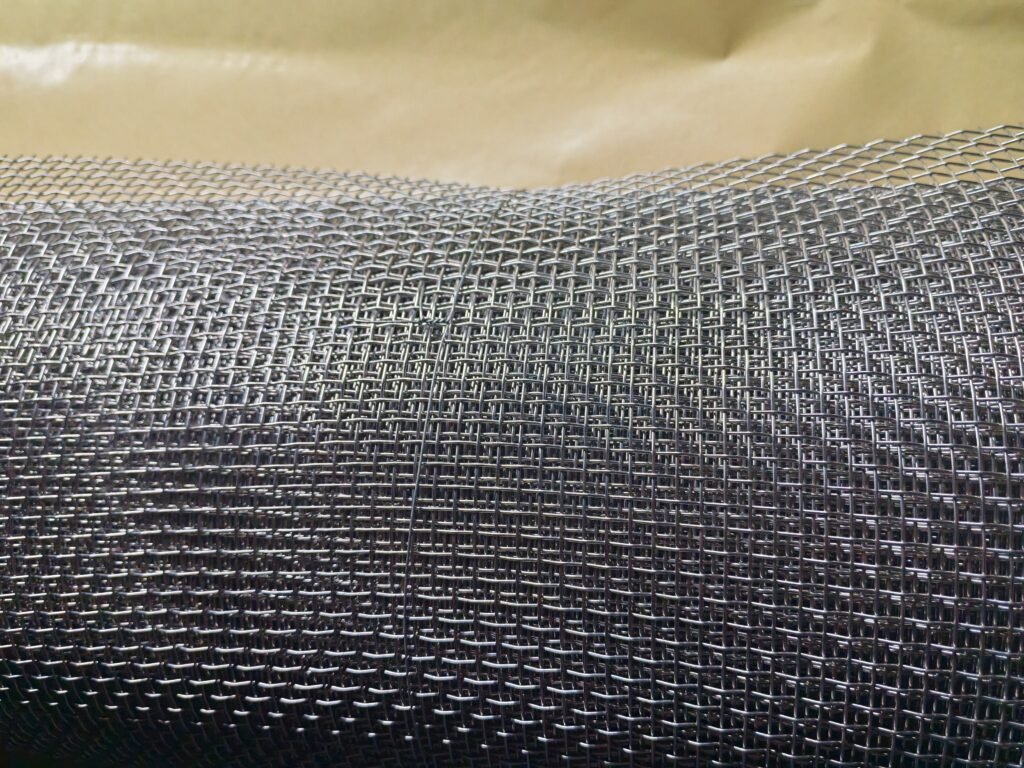
Mesh count usually denotes repeating opening periods along one linear inch. It is not the number of openings per square inch. State the counting unit in the purchase record: a per-inch count cannot be treated as a per-centimeter value.
One millimeter equals 1,000 microns, written μm. In a square-mesh specification, microns may describe the clear distance between neighboring wires. If a document states “100 μm filtration rating,” establish whether it means geometric opening, nominal rating or a performance result under specified test conditions.
The center-to-center spacing of neighboring wires is the pitch. An ideal pitch contains one clear opening plus one wire diameter. Knowing the count establishes pitch, but wire diameter is still required to determine clear opening.
Two 100-Mesh Screens Can Have Different Openings
Consider two ideal single-layer square-mesh combinations. Both have 100 periods per inch and a 0.254 mm pitch. Increasing the wire diameter leaves less space for the opening.
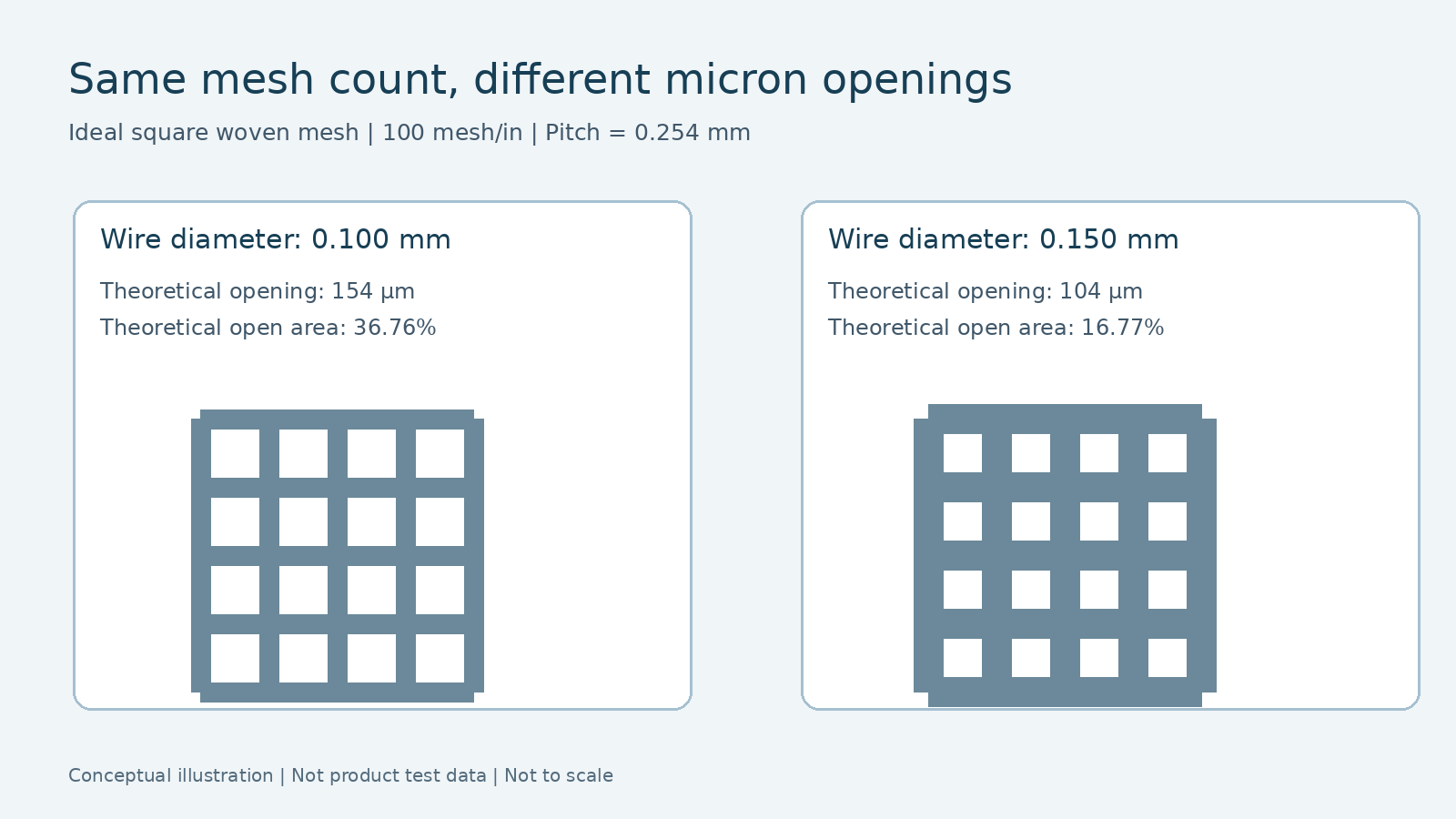
| Parameter | Combination A | Combination B |
|---|---|---|
| Count | 100 mesh/in | 100 mesh/in |
| Wire diameter | 0.100 mm | 0.150 mm |
| Theoretical clear opening | 0.154 mm = 154 μm | 0.104 mm = 104 μm |
| Theoretical open area | 36.76% | 16.77% |
These are independently defined geometric examples, not a stock-model list or filtration-efficiency data. Comparing only “both are 100 mesh” does not establish interchangeability.
Open area also changes with wire diameter. Here it means the fraction of an ideal mesh plane occupied by clear openings. It cannot directly be converted into flow rate, pressure drop or pressure capability. Those results require the operating conditions and component validation.
Calculate the Theoretical Square Opening
For an ideal mesh with equal warp/weft counts, equal round-wire diameters and approximately square openings, let N be count per inch, d wire diameter in millimeters, p pitch in millimeters and a clear opening in millimeters:
- p = 25.4/N
- a = 25.4/N − d
- Opening in μm = a × 1,000
- Theoretical open area = (a/p)² × 100%
With 100 mesh/in and a 0.100 mm wire, pitch is 25.4/100 = 0.254 mm. Subtracting the wire gives a 0.154 mm opening, or 154 μm. Convert all lengths into matching units before substitution.
Check units and structure before calculating. The opening must be positive: a zero or negative result cannot represent the open square structure assumed by the formula. A positive result still does not establish that a factory can weave that combination; manufacturing feasibility needs confirmation.
For a target opening, invert the relationship: N = 25.4/(a + d). A 0.100 mm target opening with a 0.150 mm wire gives 101.6 mesh/in. This geometric estimate cannot simply be rounded to 100 mesh while continuing to promise a 100 μm opening.
The calculator supports preliminary comparison. Purchasing acceptance should use confirmed drawings, samples and inspection requirements, rather than a calculated label alone.
When the Square-Mesh Formula Does Not Apply
Rectangular Openings
Warp and weft parameters differ. Specify each direction’s pitch, opening and corresponding wire diameter separately. An average count or diameter cannot replace both parameter sets.
Dutch Weave Filter Cloth
Dutch weave combines wires differently from square mesh. Its warp/weft counts cannot be converted to a filtration micron rating using this equation. Provide the weave, counts, wire diameters and the rating’s definition and test basis.
Other Media and Multilayer Assemblies
Do not apply the single-layer square model to sintered multilayer mesh, metal fiber felt, powder-sintered media, knitted mesh, perforated sheet or expanded metal. Even where an assembly contains a square-mesh layer, that layer’s opening does not describe the complete assembly’s pore structure or filtration performance.
Mesh Coated After Weaving
Bare-wire dimensions and finished clear openings may differ. State the measurement condition and review the finished opening. If coating or wire deformation makes the round-wire model unsuitable, an estimated diameter cannot replace actual measurements.
Theoretical Opening Is Not a Filtration Rating
Theoretical opening answers a geometry question. Filtration rating describes retention of defined particles under specified conditions. Review the two claims separately.
Sealing bypass, support and multilayer assembly also affect installed results. A nominal, absolute or efficiency requirement should identify the test object, particle-size definition, conditions and acceptance method. A conversion table cannot establish that performance. See the Filter Micron Rating and Filtration Efficiency Guide for the performance side of the specification.
Mean opening, maximum opening and nominal opening are also different acceptance quantities. If anomalously large openings must be controlled, state the inspection item and agreed decision basis in the order.
The public scope of ISO 9044:2016 addresses industrial square woven wire cloth, including terminology, tolerances and testing, and lists exclusions including mesh coated after weaving. Confirm scope before choosing an inspection basis. No copyrighted tolerance table is reproduced here.
Write a Specification That Can Be Checked
If the proposed material is Dutch cloth, move to the Dutch weave specification guide rather than applying the square-opening formula. For the flow trade-off when wire diameter changes, see how open area affects flow and pressure-drop review.
“316L 100-mesh filter cloth” is a starting point for discussion, not a complete delivery specification. Separate geometry, finished form and acceptance so missing information is visible.
| Item | State |
|---|---|
| Material and weave | Actual alloy grade; square or Dutch weave and specific pattern |
| Count | Warp/weft values and counting unit |
| Wire diameter | Both diameters, units, measurement condition and tolerances |
| Opening | Nominal clear opening and any mean/maximum controls |
| Delivery form | Roll, cut piece or assembly; dimensions, quantity, edges and processing |
| Inspection | Applicable standard or agreed requirements, sampling, measurements and report scope |
| Filtration performance | Separate rating definition, test object and acceptance method if required |
A geometry-only discussion example is: “316L plain square woven mesh, 100 mesh/in in both directions, nominal 0.100 mm wires, theoretical 0.154 mm clear opening; delivery dimensions, opening and wire tolerances, sampling and acceptance to be confirmed.” If the equipment requires a retention efficiency, add a separate performance clause; it cannot be inferred from 154 μm geometry.
For replacement mesh, supply the original specification, equipment location and a sample where possible. A photograph helps identify form, but without scale and magnified measurement it cannot reliably determine fine-mesh count, wire diameter or filtration rating. The Wire Mesh Specification Guide covers the broader purchasing record.
Frequently Asked Questions
Does 100 mesh always mean 150 microns?
No. For industrial square woven mesh, wire diameter also determines opening. If a standard sieve table associates a designation with one opening, verify its standard and specification before applying it to another mesh.
Does higher count always mean finer filtration?
At the same wire diameter within the applicable square model, higher count reduces theoretical opening. Across different suppliers or weaves, compare wire diameter and pore structure as well as count.
Are meshes with the same opening interchangeable?
Not on opening alone. Compare count, diameter, weave, alloy, dimensions, support, restraint and operating requirements.
What should I provide if I only know a micron target?
Clarify whether it is a clear-opening target or a performance rating, then provide the fluid, equipment location and available specification or sample. A square-opening target can be compared using candidate wire sizes; a performance rating requires a test basis.
Specification Summary
Record mesh count, units and wire diameter together to calculate a theoretical square opening. Check weave and measurement state, then specify tolerances and finished form. Keep filtration-performance requirements separate from geometric calculations.
Author: Jack Sun has long-term experience in woven metal mesh and industrial filter-element manufacturing. Filtalloy is based in Anping, Hengshui, Hebei, China. The equations and comparison values above are independent ideal-geometry calculations, not measured product-performance claims.
Related resources: Wire Mesh Size Calculator · Woven Mesh Products · Woven Wire Mesh Applications