Quick definition: Woven wire mesh for oil and gas filtration is a metal screening medium that can be made into supported screens, baskets, cylinders and other components for a defined particle-removal duty. Its suitability depends on the contaminant, fluid, flow conditions and complete element construction—not just the mesh count.
A request for “a stainless steel oil and gas filter” leaves several important questions open. A pump-inlet strainer, an oil-circuit filter element and a gas-line particle screen can see very different fluids, flow conditions and consequences of blockage.
This guide helps equipment engineers define a woven-mesh component and gives purchasers a checklist for comparing offers. It focuses on particles and component construction. The oil and gas application page provides the broader product overview.
1. Start with the equipment position and contaminant
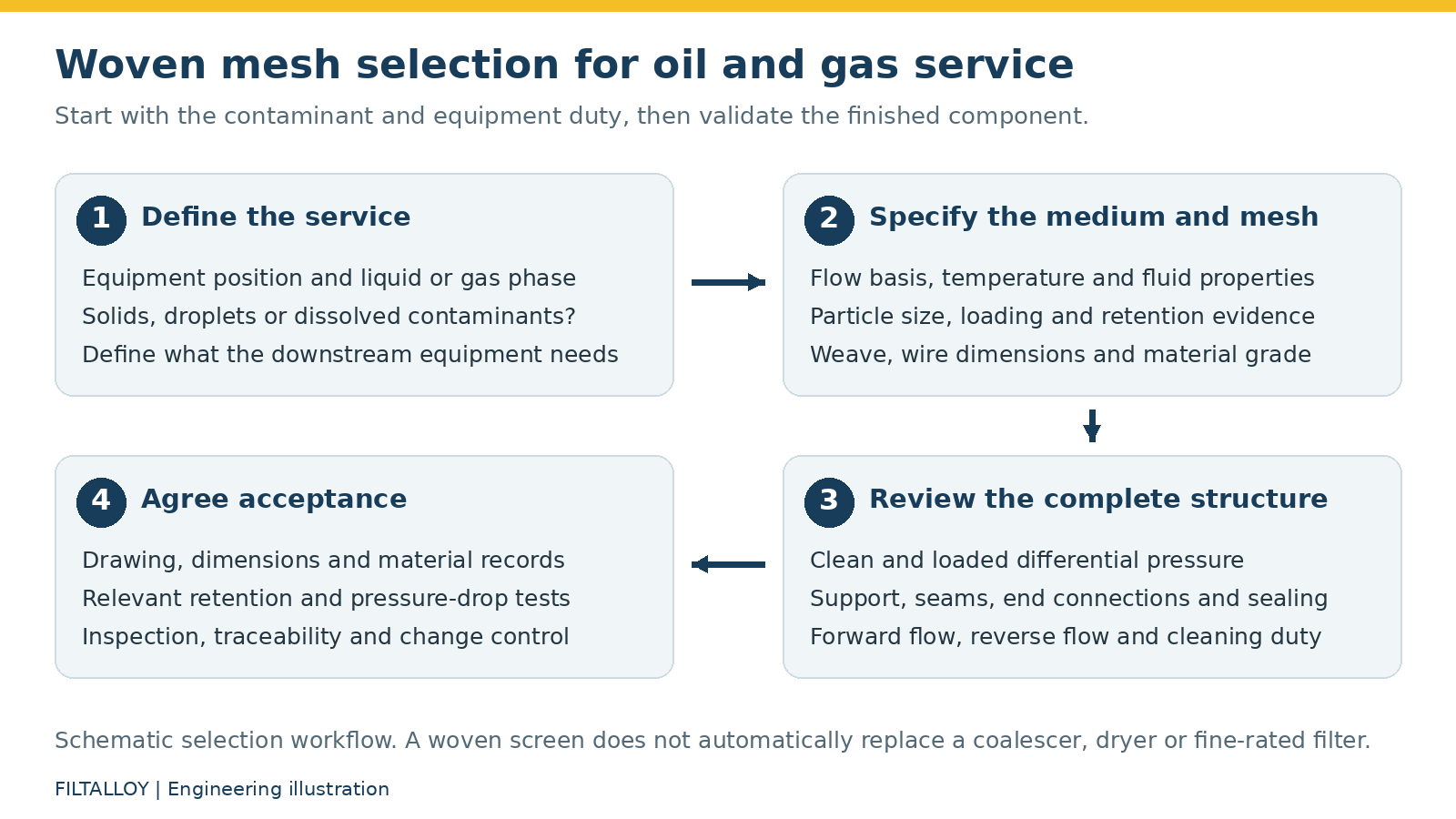
Identify what must be removed and what the downstream equipment needs before choosing a weave. “Oil and gas” describes an industry, rather than one filtration condition.
| Proposed duty | Mesh-related question | Information needed |
|---|---|---|
| Liquid-line or pump-inlet particle screening | Can a supported screen intercept the specified debris without excessive restriction? | Liquid properties, minimum temperature, flow range, inlet-pressure constraints and particle loading |
| Lubricating or auxiliary oil circuit | Does the complete element meet the equipment’s cleanliness and filtration requirements? | Equipment specification, oil viscosity, retention test evidence, differential pressure and bypass arrangement |
| Gas-line particle protection | Is the proposed medium and support appropriate for the actual gas flow and contamination? | Gas composition, pressure, temperature, actual or reference flow basis, solids and possible liquid carryover |
| Liquid-droplet or oil-mist removal | Is a separate demisting or coalescing function required? | Droplet characteristics, loading, drainage and separation performance required by the process designer |
A particle screen does not automatically remove dissolved contaminants, water vapour or fine dispersed droplets. When liquid separation is part of the duty, define that requirement separately. A wire mesh demister pad is a different component from a flat woven particle screen; the terms should not be interchanged on a drawing.
2. Specify the mesh and retention requirement
Mesh count alone is not a complete filtration specification. For square-aperture cloth, the opening depends on both mesh count and wire diameter. A different wire diameter at the same count changes the opening and open area. Use our mesh count, wire diameter and micron-opening guide when checking those relationships.
For square mesh, state the weave, warp and weft count where relevant, wire diameter, aperture and agreed tolerances. For Dutch weave, specify its construction, wire dimensions and the basis of the stated filtration rating. The square-opening conversion cannot be applied directly to Dutch filter cloth. See the plain, twill and reverse Dutch weave guide for the structural differences.
Also define the retention evidence you need. A geometric aperture, a nominal micron description and a particle-removal result describe different things. Ask which test method, fluid, particle distribution, flow rate and acceptance criterion support a proposed rating. Do not convert a dimensional inspection result into an absolute removal claim.
3. Separate line pressure from differential pressure
The housing’s pressure rating does not establish the filter element’s resistance to a pressure difference. The pressure difference across the filter assembly is the upstream pressure minus the downstream pressure, measured under the stated conditions.
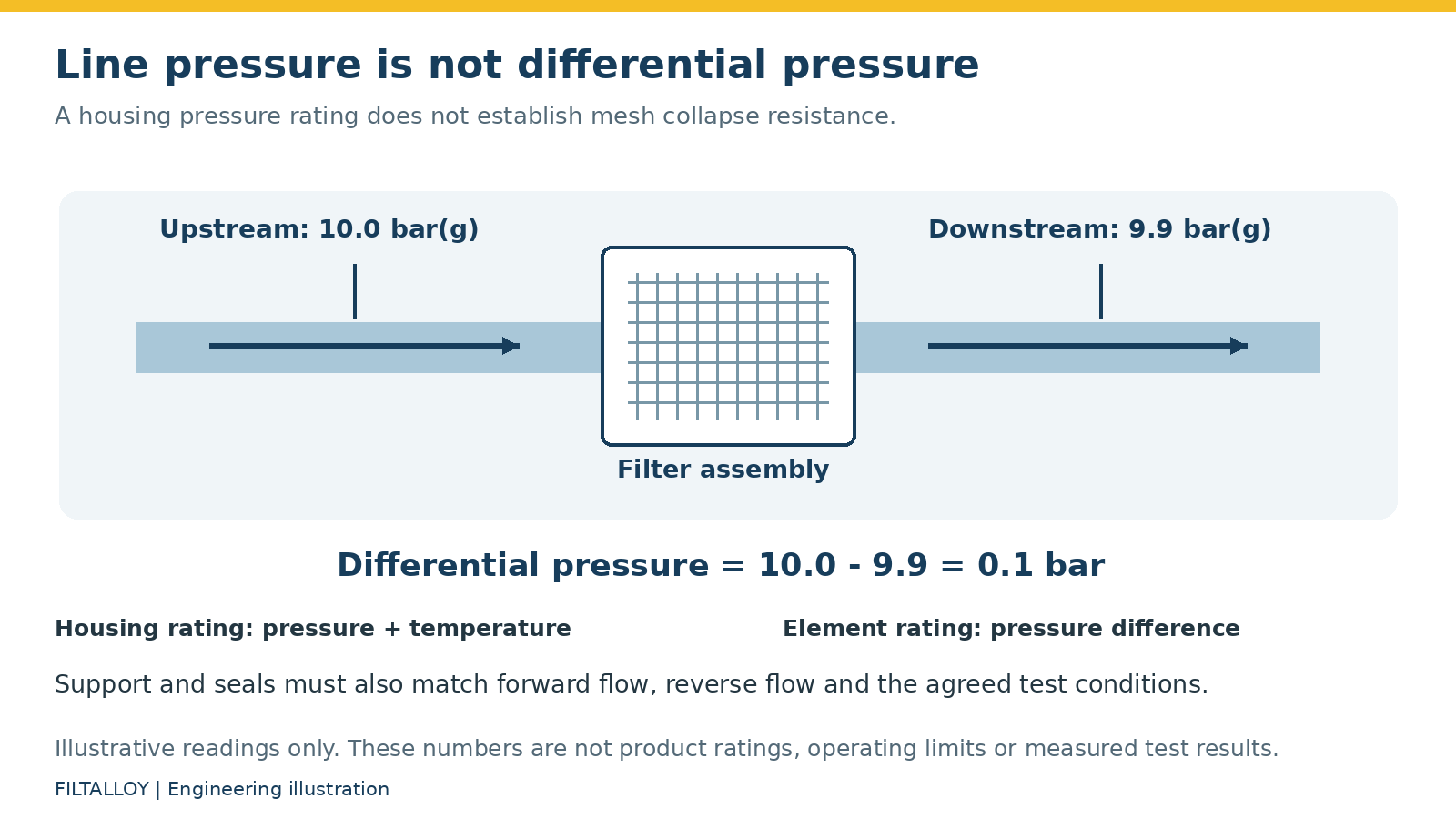
Review clean pressure drop and the permitted loaded-element differential separately. For an oil circuit, include the cold-start or other highest-viscosity condition as well as normal running. For gas service, identify whether the flow is stated at reference conditions or at the local operating pressure and temperature; the same numerical volume-flow value can represent different operating conditions.
During the design review, record forward flow, reverse flow, pulsation and any cleaning pressure difference. A supported element designed for one flow direction must not be assumed suitable for reversal. Where a bypass exists, its function and setting belong in the equipment design; they are not established by the mesh supplier choosing a weave.
A pressure-drop curve for the complete element is more useful than a generic claim of “high flow.” State the test fluid, temperature, flow basis and configuration. Media-only data will not capture restrictions from supports, connections or the housing.
4. Review support, seams and sealing
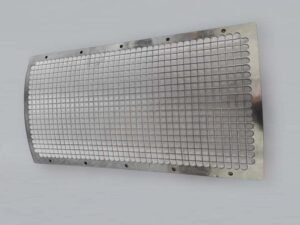
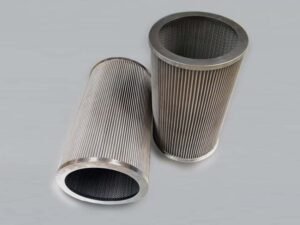
Our fabricated wire mesh filter elements page covers the finished component rather than the operating specification. Review it with the wire mesh pressure-drop guide when defining support, active area and the assembly test required for the duty.
Particle retention depends on the flow passing through the intended filtering surface. An appropriate mesh can still give an unsatisfactory assembly if an edge, seam or end connection permits bypass.
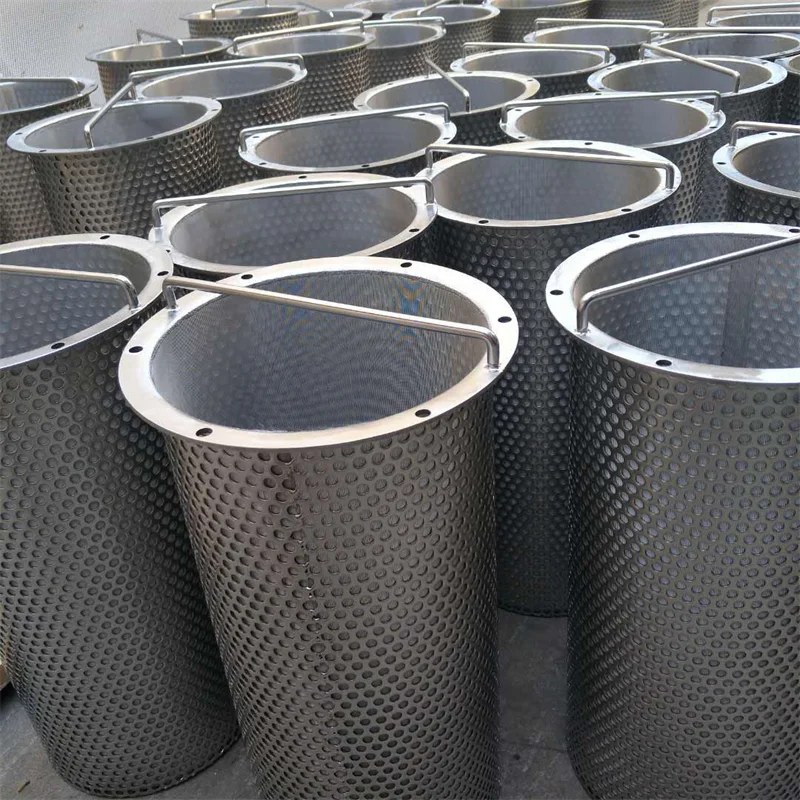
For a cylindrical component, the drawing should identify the filtering layer, support layer, longitudinal seam, end connections and sealing faces. Specify inside-to-outside or outside-to-inside flow. The supporting structure must suit the loading direction, and its openings and contact areas must be considered when evaluating usable flow area.
In our manufacturing review, we separate the mesh specification from the formed-part specification. Diameter, length, roundness, seam construction, end-face geometry and the installation interface are checked against the agreed drawing. We also distinguish an unfinished mesh cylinder from an assembled element with end fittings and seals.
For fine retention or more demanding structural requirements, consider whether a different construction is needed. A sintered mesh element and a supported single-layer woven screen are distinct constructions. Their suitability must be compared using the actual duty and evidence for the finished part.
5. Choose materials for the complete service
Select a material grade using the fluid composition, temperature, contaminants and cleaning conditions together. “Stainless steel” is not enough information for material approval.
List the proposed mesh, support, end-fitting and weld materials. Include water content, salts, corrosive constituents and any cleaning chemical in the project review. Wet-gas or sour-service requirements need the project’s material qualification process; a mesh grade name alone does not demonstrate compliance.
Where a customer supplies an approved material specification, we manufacture to the agreed requirement and document scope. If the grade is still undecided, the process or equipment engineer should resolve compatibility before fabrication. Do not assume that selecting a finer weave or a more substantial support will correct an unsuitable material choice.
6. Agree inspection and performance evidence
Separate dimensional conformity, material traceability and filtration performance in the acceptance plan. Each answers a different question.
- Material and identity: agreed grades, batch identification and the required material documentation.
- Mesh dimensions: weave, wire dimensions, openings or the relevant Dutch-weave specification, together with the agreed sampling and tolerances.
- Fabrication: finished dimensions, seams, attachment of supports, sealing surfaces and cleanliness requirements.
- Performance: applicable particle-retention and pressure-drop evidence, plus any specified structural or integrity test for the finished element.
ISO 9044:2016 concerns industrial square-aperture woven cloth for screening. Its use for filtration needs attention to the standard’s scope and any additional purchaser–supplier requirements. It is not a substitute for testing a finished oil or gas filter.
ISO 16889:2022 addresses multi-pass performance testing of hydraulic filter elements, including particulate removal, contaminant capacity and differential-pressure characteristics. An unspecified “micron rating” does not establish that an element was tested by this method, and the method should not be assigned automatically to every gas or process screen.
For projects that invoke API Standard 614, confirm the specified edition and the equipment-level requirements with the responsible engineer. Supplying a woven component does not, by itself, establish conformity of the oil system or filter assembly to that standard.
7. Prepare a useful manufacturing enquiry
| Provide | Include these details |
|---|---|
| Duty and equipment position | What is protected, what must be removed, and where the component fits |
| Fluid and operating conditions | Composition, liquid/gas phase, temperature range, pressure and oil viscosity where relevant |
| Flow and contamination | Normal/maximum flow with its measurement basis, particle description and expected loading |
| Filtration requirement | Mesh specification or required retention result, with its test and acceptance basis |
| Pressure difference | Clean pressure-drop target, permitted loaded-element differential, direction and reverse-flow duty |
| Manufacturing information | Drawing or sample, material grades, dimensions, supports, seams, connections and seals |
| Delivery and acceptance | Quantity, documentation, inspection, cleaning/packaging requirements and required validation |
For a new project, send the operating requirements for discussion. For drawing-based manufacture, send the controlled drawing and acceptance specification. For replacement from a physical sample, include the operating history and known requirements: measuring an old part cannot establish every original performance rating.
Frequently asked questions
Can a woven wire mesh filter remove water from oil?
Do not assume this from the mesh opening or material. Solid-particle screening and separating water droplets are different duties. If water removal is required, specify its form and the required separation result so that an appropriate process can be evaluated.
Does a higher mesh count always improve the filter?
No. It changes the geometry only in combination with wire diameter and weave. The selection also has to satisfy the available pressure drop, contamination load, support and actual retention requirement.
Can the same mesh element be used for oil and gas?
Only after the complete duty is reviewed. Fluid properties, gas-flow basis, liquid carryover, materials, loading direction and sealing may differ even when the outside dimensions are identical.
Can a cleaned element be returned to service based on appearance?
Appearance alone is insufficient. The equipment’s procedure should define the required inspection and acceptance after cleaning, including damage, sealing and any relevant flow or integrity checks. Cleaning does not establish an unlimited reuse life.
Conclusion: specify a duty, then verify the component
A useful specification for woven wire mesh for oil and gas filtration brings together the contaminant, fluid conditions, retention requirement, pressure difference, supporting structure and installation interface. Agree how those requirements will be verified before manufacture.
Review our wire mesh specification guide for the wider parameter checklist, or explore the woven mesh product range. To discuss an actual part, send operating requirements, a drawing or sample details.
Jack Sun works in metal wire mesh weaving and industrial filter-element manufacturing. Filtalloy is based in Anping, Hengshui, Hebei, China, a centre of wire mesh manufacturing. About Filtalloy.