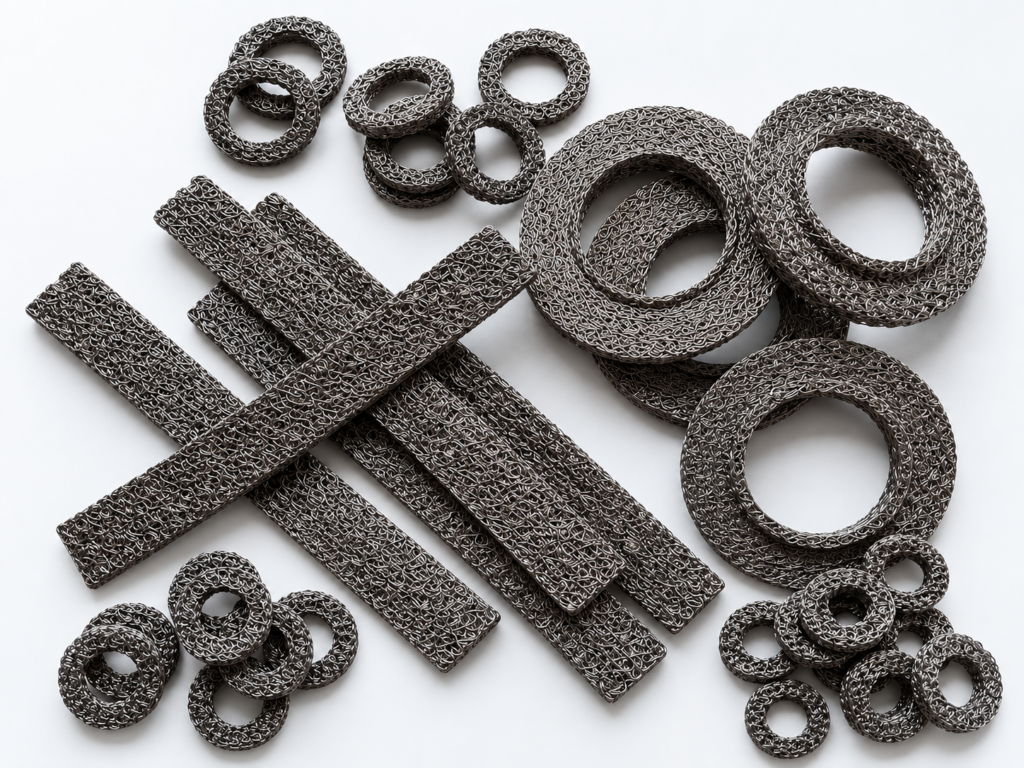
A metal cushion damper is a porous elastic metal component formed by preforming and compressing wire mesh. In compressed knitted mesh versions, wire bending, contact, sliding and friction produce nonlinear force–displacement behavior and hysteretic energy dissipation.
A wire mesh ring may fit the space left by a rubber pad and still respond very differently to vibration. Its mechanical behavior depends on much more than its outside dimensions.
This guide follows the manufacturing route from operating conditions and mechanical loads to material, wire diameter, preform weight, die compression and verification. Its focus is compressed knitted mesh dampers; other entangled-wire and woven structures need their own specifications.
By Jack Sun. Our company is based in Anping County, Hengshui, Hebei, China, a center of the wire mesh industry. Jack Sun has long worked in wire mesh weaving and industrial filter manufacturing. This guide explains how manufacturing and purchasing requirements connect; product performance must be verified for the intended conditions.
1. Metal Cushions and Rubber Isolators
Rubber isolators are established solutions for many ordinary temperatures, loads and excitation ranges. High temperatures, oil, fuel, vacuum or thermal cycling can change the suitability of a specific elastomer formulation.
A metal wire mesh structure can be evaluated when those conditions limit an elastomer. It avoids polymer aging, but still needs assessment of wear, fatigue, oxidation, corrosion and permanent deformation. Metal construction alone does not prove longer life or higher isolation efficiency.
| Factor | Metal cushion | Rubber isolator |
|---|---|---|
| Main dissipation mechanism | Wire contacts, sliding and friction | Polymer viscoelasticity |
| Temperature and fluids | Check exact alloy, environment and duration | Check elastomer formulation and duration |
| Vacuum | Check cleanliness, outgassing and installation | Check compound suitability and outgassing |
| Cost and service life | Compare specification, quantity and validation | Compare compound, specification and validation |
2. From Knitted Wire to a Damper
Continuous wire is knitted into mesh, then rolled, folded, layered or preformed and compressed in a die. The initially flexible mesh becomes a porous component with defined geometry, wire mass and recovery behavior.
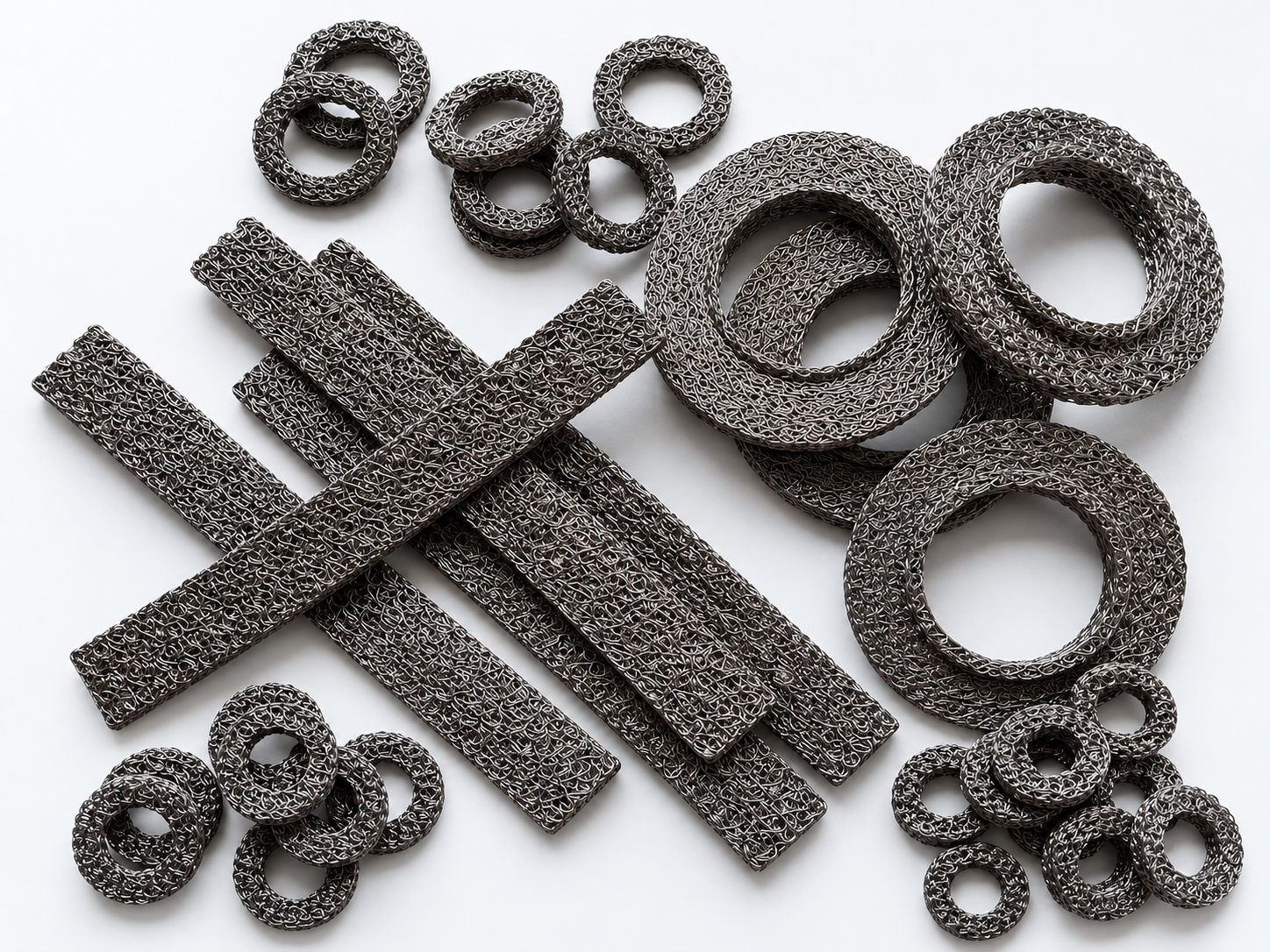
Common shapes include rings, cylinders, rectangular blocks, strips, sleeves and custom forms. The same raw knitted mesh can produce different mechanical parts when preforming direction, layering and die compression change.
3. How Frictional Damping Works
Cyclic loading bends wires, changes contacts and produces small relative slips. Loading and unloading follow different force–displacement paths. The area within that hysteresis loop represents energy dissipated over the cycle.
Damping is not the same as vibration isolation. Dissipating more energy does not guarantee less transmitted vibration at every frequency. System mass, equivalent stiffness, natural frequency, excitation, damping, load and mounting arrangement act together.
Surface texture can show structural differences, but it cannot establish a damping grade. Knitted-loop products and spiral-wire entangled metal rubber have different manufacturing routes; similar-looking surfaces do not make them interchangeable.
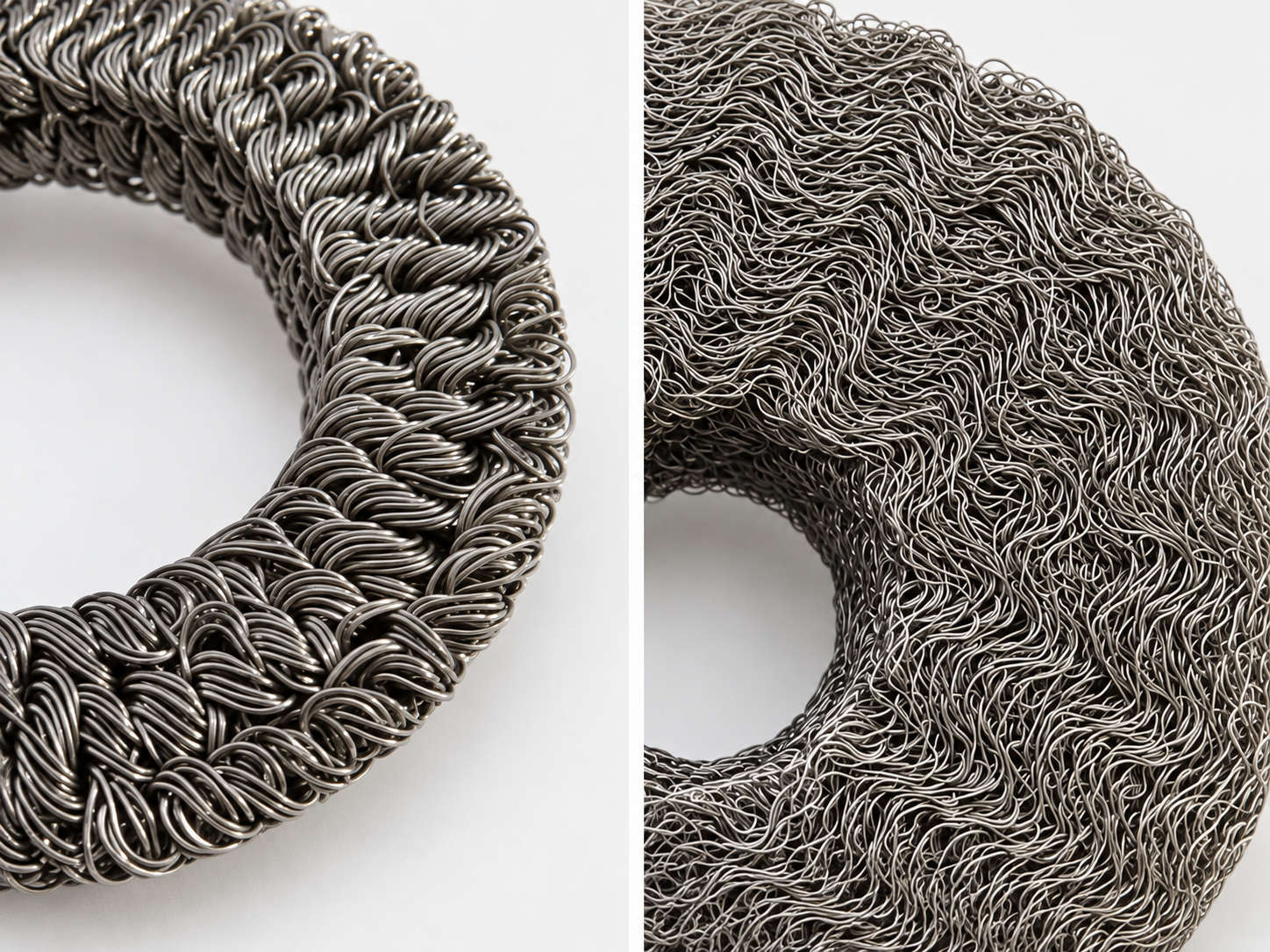
4. Wire Diameter, Density and Compression
Wire diameter
Wire diameter changes bending stiffness, contact behavior and the amount of wire within a volume. Thicker wire does not automatically improve damping; judge it with load, allowable displacement and geometry.
Bulk and relative density
Bulk density is ρb=m/V, for example in g/cm³. For a single-metal structure without fillers, relative density is ρb/ρs, a dimensionless ratio. Record whether V is the free or installed volume and use compatible units. Higher density is not a universal performance target.
Use the knitted mesh density and porosity calculator to check mass and volume arithmetic for a defined component state. Keep free and installed dimensions separate; the result is not a stiffness, damping or load-capacity prediction.
Manufacturing and installation compression
A manufacturing compression ratio must state its definition and initial preform condition, for example initial height divided by formed height. Installation compression can be defined as (free height − installed height)/free height × 100%. These are different quantities.
5. Preload, Load and Excitation Frequency
Precompression is displacement, specified in mm or a percentage with a stated reference. Preload is force, specified in N. They are linked by the force–displacement curve at a defined condition and cannot substitute for each other.
Provide the actual load at each support, number of supports, center of gravity, load direction, eccentric loading and expected shocks. Insufficient or excessive compression may place the part outside its intended working range.
Shaft frequency in Hz is n/60 for speed n in rpm. Actual excitation can also include harmonics, gear-mesh frequencies and impacts. Supply the main frequency components, amplitude, direction and permissible movement; shaft speed alone is incomplete.
6. Shapes and Installation Requirements
| Shape | Key information |
|---|---|
| Ring | OD, ID, free/installed height, wire mass and axial/radial compression |
| Block or strip | Length, width, height, weight and compression direction |
| Sleeve or custom form | Drawing or 3D model, mating-part dimensions and installation photos |
Ring-shaped parts may be evaluated around bolts, shafts, piping supports or stops. Blocks and strips may suit bases, channels or housing interfaces. Suitability depends on load paths and testing rather than shape alone.
7. Material and High-Temperature Selection
304 and 316L stainless steels are common candidates. In some chloride-containing environments 316L can offer advantages over 304, but chloride corrosion resistance is not the same property as high-temperature oxidation resistance.
Evaluate the exact alloy against continuous and peak temperatures, atmosphere, chemical exposure, load, cycles and exposure duration. Engine, exhaust, furnace or hot-piping locations describe demanding conditions; they do not establish a single temperature rating for every wire mesh damper.
Compare alternatives under the same load, temperature, excitation frequency/amplitude, allowed displacement and service-life criteria.
8. Manufacturing and Batch Consistency
Control wire grade, diameter and surface condition before knitting. Then control mesh structure and width, preform weight, rolling/layering direction, die dimensions, forming height and springback.
The manufacturing task is to convert the customer’s required geometry and response into a stable combination of these variables. Producing one suitable sample is different from keeping a production batch consistent.
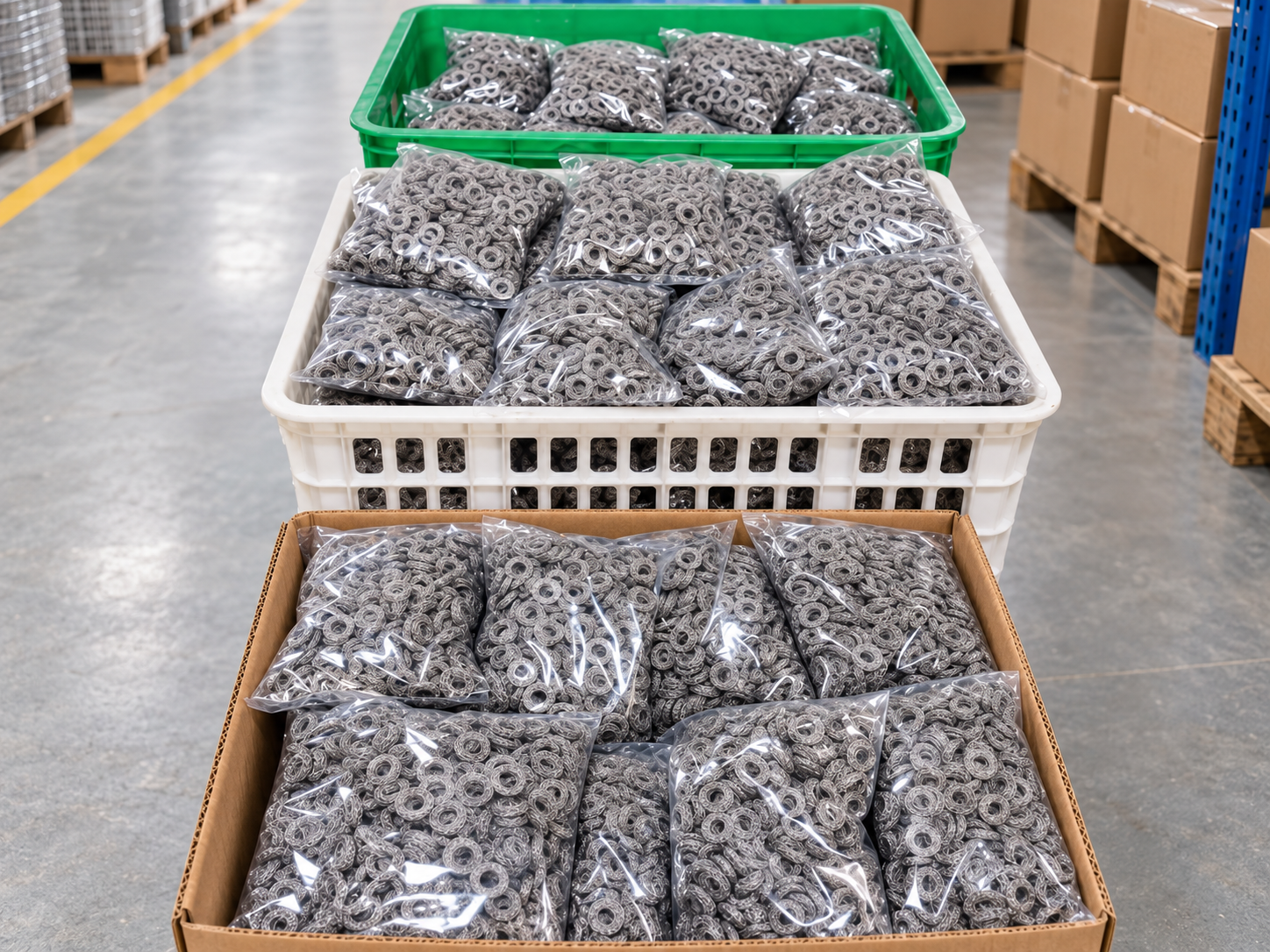
Routine checks include dimensions, unit weight, surface integrity, obvious deformation and packaging quantity. Additional mechanical checks can include compression at a specified load, recovery and cyclic force–displacement behavior, when agreed.
9. Mechanical Verification
Static or quasi-static curves help compare stiffness and hysteresis, but cannot replace dynamic testing for an isolation claim. Define preload, excitation amplitude, frequency range, direction, temperature and measurement locations, then verify vibration transmissibility.
The required validation and acceptance criteria should be agreed between buyer and supplier; the customer or a third party can perform tests. This guide does not imply that the factory owns every type of dynamic test equipment.
After validation, freeze material, wire diameter, mesh structure, preform weight, forming dimensions and inspection conditions for repeat production.
10. From Operating Conditions to a Specification
- Environment: continuous/peak temperature, fluids, corrosion, vacuum and thermal cycles.
- Mechanics: per-support loads, shock, excitation spectrum, direction, available stroke and preload.
- Product: material, wire diameter, geometry, weight/density and installed compression.
- Manufacturing: knitting, preform weight and direction, die and formed height, springback.
- Verification: dimensions, weight, compression curves, cyclic behavior and dynamic tests as required.
An old part helps identify dimensions and structure, but may have permanent compression, wear or internal wire rearrangement. Send the mating housing and actual installation dimensions when possible.
11. Common Mistakes and FAQ
Is a high-density metal cushion always better?
No. Density changes contacts, stiffness and hysteresis. Specify the working load and displacement and verify the response.
Can I order by photograph?
A photo helps identify a product type. It cannot reliably establish alloy, wire diameter, mass, density, stiffness or load capacity.
Can a metal cushion be used at high temperature?
It can be a candidate, but a permissible temperature needs exact material and service conditions. There is no universal limit based on mesh appearance.
Do identical dimensions mean identical performance?
No. Wire diameter, mass, mesh structure, forming direction and installation state can differ.
Is it better than rubber?
Compare tested candidates under the same conditions. Environment and system response determine suitability.
12. Conclusion and Technical References
A metal cushion damper should be specified as a functional component with a defined installed state, rather than only as a metal ring. Match the environment, loads and excitation to the material and internal structure, then confirm the intended response.
See compressed knitted components for product forms. Contribution to the Characterization of Vibration Isolators Based on Metal Mesh discusses knitted mesh isolators and the limits of quasi-static characterization. Studies of annular periodic metal rubber and multilayer plain-woven mesh isolators concern adjacent structures; their experimental results are not universal product ratings.
Discuss Your Wire Mesh Damper Requirements
- Application-based customization: provide operating conditions, installation space and functional targets to establish an initial specification and prototype.
- Drawing-based customization: provide materials, dimensions, tolerances, connections and agreed acceptance requirements.
- Sample-based customization: provide the existing part and mating components; evaluate wear, contamination and permanent deformation before confirming a replacement.