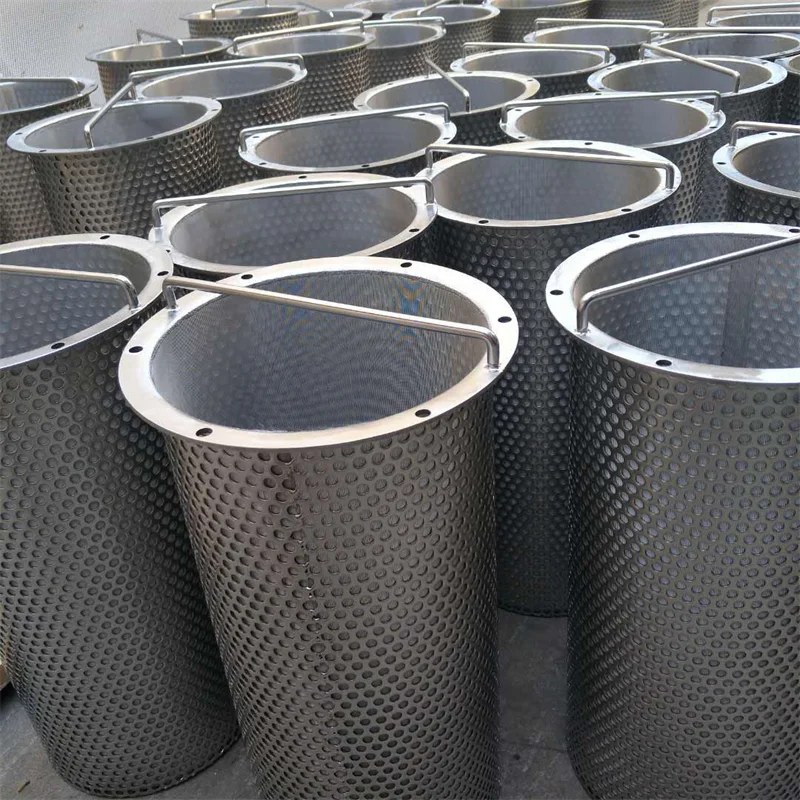
Quick definition: Woven wire mesh can retain suspended particles in chemical process fluids or support another filtration medium. Selection requires fluid compatibility, the retention target, flow, allowable differential pressure and the finished component structure. An alloy name and mesh count alone usually do not define a complete purchase specification.
This guide addresses mechanical particle filtration. Ordinary metal mesh does not remove dissolved salts, ions or molecules simply through its openings, and it does not automatically provide adsorption, decolorization or chemical reaction functions. Those tasks require a separate separation mechanism and treatment unit.
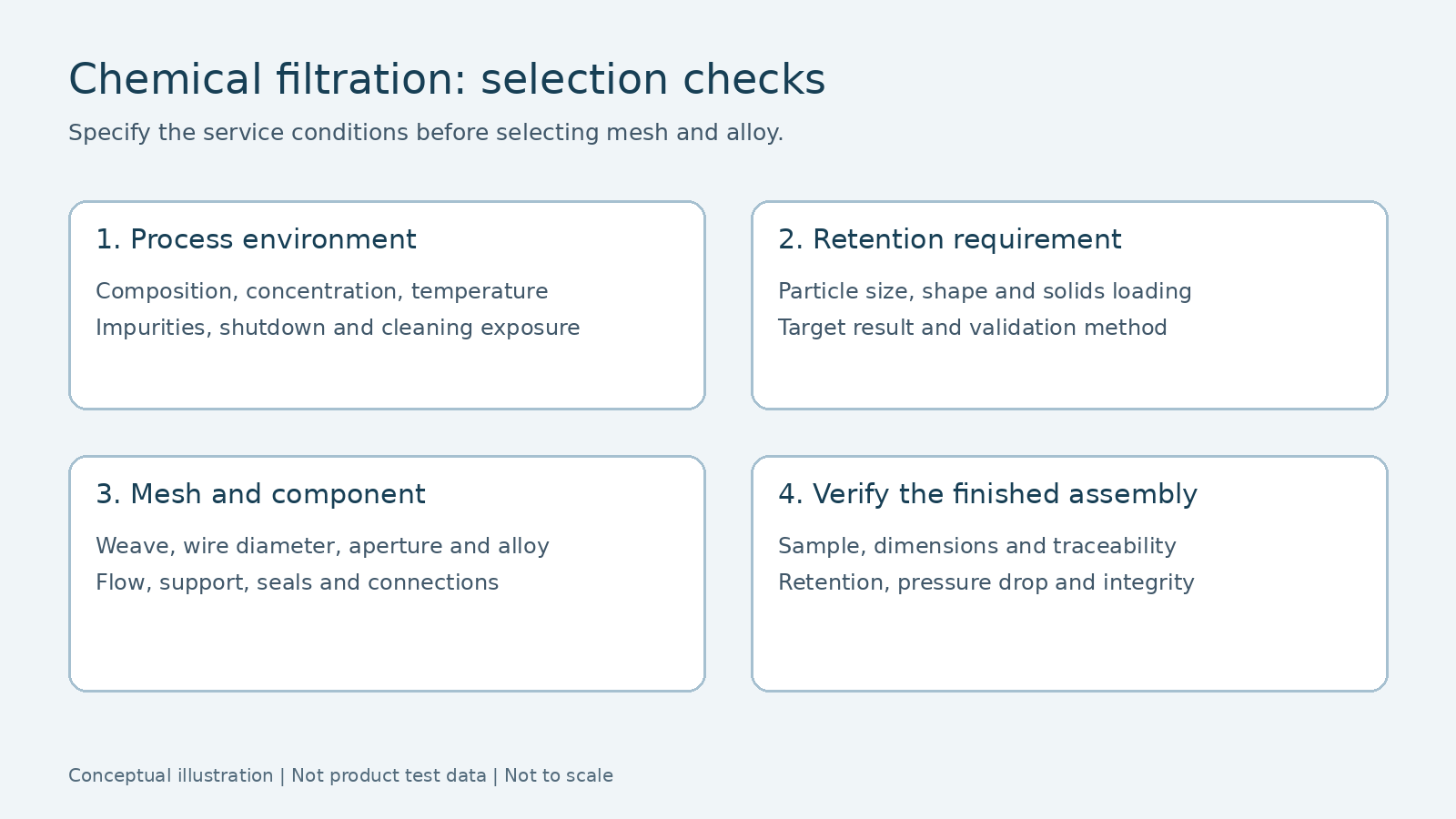
For purchasing teams, the starting point is a specification that the manufacturer can make and both parties can verify. Equipment engineers should also define how the retention layer, support and installation seals work together. Choosing the finest available mesh before defining these conditions can leave essential requirements unresolved.
Contents
- Define the task and equipment location
- Check material compatibility
- Specify square mesh or Dutch weave
- Review flow, pressure drop and support
- Include cleaning conditions
- Verify samples and production deliveries
- Prepare purchasing information
- Frequently asked questions
Define the Filtration Task and Equipment Location
Write down what the mesh must retain and where it will be installed. Pump protection, process-liquid filtration and valuable-particle recovery can require different acceptance criteria even when the same mesh material is being considered.
| Task | Information to provide | Result to verify |
|---|---|---|
| Equipment protection | Foreign material and the equipment’s acceptable particle range | Retention and required flow |
| Process-liquid filtration | Particle shape, size distribution and solids content | Outlet particle requirements and pressure-drop behavior |
| Valuable-particle recovery | Particle fragility, recovery requirements and discharge method | Recovery and unloading feasibility |
These are selection scenarios, not a claim that one mesh meets every requirement. Particles may be flakes, needles, agglomerates or deformable solids. Comparing an average particle size with an opening number cannot establish the final retention result.
For example, “filter resin particles” still leaves questions: are these intact beads or broken fines, what is their size range, which liquid carries them, is limited fine-particle passage acceptable, and could cleaning break them further? This is an information-preparation example, not a factory case study or performance guarantee.
Check the Complete Material-Compatibility Environment
Document the complete fluid before screening alloys. “Acid resistant” and “alkali resistant” do not adequately describe whether an alloy is suitable for a particular process.
| Condition | Record | Reason |
|---|---|---|
| Composition | Main constituents, concentration range and water content | A mixture cannot automatically use single-chemical compatibility data |
| Temperature | Normal temperature, peaks and duration | Room-temperature evidence cannot be extrapolated directly |
| Impurities and exposure | Chlorides, oxidizing impurities, aeration or stagnation | These conditions can change corrosion behavior |
| Cleaning | Agent, concentration, temperature, exposure time and frequency | The component also contacts the cleaning environment |
The Nickel Institute’s The nickel advantage explains that acid corrosion depends on concentration, temperature, aeration, impurities and flow. Design, welding, fabrication and cleaning exposure also matter. Review operating, shutdown and cleaning conditions together.
304 and 316L Are Not a Universal Ranking
316L may be a candidate for many projects, but its name does not establish suitability for every chemical. The Nickel Institute discusses environments where 316L improves on 304L and some strongly oxidizing acid conditions where 304L may be preferable. The comparison is environment-specific.
For fine wire, our engineering review must also consider how metal loss affects wire diameter, joints and openings. Data for plate or pipe may help screen materials, but thick-wall equipment experience cannot directly establish the service life of fine mesh or a welded filter component.
Specify the Actual Special-Alloy Grade
If ordinary stainless steel is unsuitable, evaluate nickel-based or other alloys using a specific grade. Hastelloy and Inconel names cover multiple alloys; a series name is not a complete material specification. Official sulphuric-acid and nitric-acid selection guides can help narrow candidates. Actual process-fluid, joint and cleaning validation remains necessary.
Review every wetted part: mesh, support, end fittings, welds and equipment seals. Confirming only the filter-layer alloy does not complete compatibility assessment of the installed assembly.
Specify Square Woven Mesh and Dutch Weave Differently
State the weave before discussing an opening or filtration rating. For square woven mesh, record mesh count, wire diameter and clear opening together, with the inspection method and agreed tolerances. The same mesh count can produce different openings when wire diameter changes.
For Dutch weave filter cloth, record warp and weft counts, both wire diameters, the specific weave and the filtration-rating definition and test basis. Its flow passages cannot be treated as visible square openings or converted using an ordinary square-mesh formula.
When a specification uses nominal or absolute filtration rating, ask what was tested, how particle size was defined, what method and acceptance rule were used, and which conditions apply. Equal micron labels from different methods do not establish equal retention. Our filtration rating and efficiency guide explains this distinction; the Wire Mesh Size Calculator handles preliminary geometric calculations.
Separate mesh-media requirements from finished-element performance. A compliant mesh cannot establish assembly retention if welds, connections or seals allow bypass.
Review Flow, Pressure Drop and Support Together
The wire mesh pressure-drop guide explains why geometry alone cannot establish a component’s pressure loss. Where Dutch cloth is proposed, use the Dutch weave comparison to define both wire directions and the agreed filtration test basis.
Discuss flow and differential pressure with fluid state, effective filtration area and finished geometry. Open-area percentage alone cannot determine filter-element pressure drop or an allowable pressure rating.
Provide flow and viscosity at operating temperature, normal and terminal differential pressure, flow direction and possible pressure pulses. Record system operating pressure separately from the pressure difference across the filter.
The fine layer provides retention; the support helps it withstand the specified load. Support span, direction, fittings and cleaning loads affect the required structure. Material name and mesh count cannot alone establish the differential pressure a mesh panel can withstand.
Distinguish rolls, cut pieces, cylinders and assemblies. Cut mesh requires dimensions, edge restraint and loose-wire requirements. Cylinders require longitudinal seams, end connections, roundness and support. Assemblies additionally require sealing fit and installation direction. These are review items, not assumptions about design loads that the customer has not supplied.
For multiple layers, list each material and specification, the order and the joining method. More layers can change resistance, overall thickness and cleaning access; they do not automatically mean higher efficiency or longer service life.
Include Cleaning Conditions During Selection
Select candidate cleaning methods early and validate their effectiveness. A metal structure that can be cleaned does not necessarily recover its original performance after every cycle.
First distinguish surface cake, particles embedded in passages, and adherent or solidified contamination. Then assess solvent, ultrasonic or other methods against contamination, material compatibility, component joints and residue requirements.
Backwashing introduces a reverse load. Support designed only for forward filtration does not establish suitability for reverse cleaning. Separately review backwash flow, differential pressure, support direction and connection strength.
After cleaning, inspect the mesh, edges, welds, dimensions and connections, then verify flow or retention under agreed conditions. Easier fluid passage only shows that resistance changed: enlarged openings, broken mesh or bypass must also be excluded. The process owner should define drainage, rinsing, acceptable residues and validation methods where purity matters.
Agree Sample and Production Acceptance Criteria
Define acceptance before producing samples. Mesh specifications, finished structure and testing boundaries should correspond to subsequent production deliveries.
| Level | Possible agreed checks | Does not alone prove |
|---|---|---|
| Material and traceability | Grade, documentation and batch identity | Long-term life in the actual fluid |
| Mesh and dimensions | Weave, wire size, pore structure, dimensions and edges | Assembly retention and sealing |
| Finished structure | Layers, welds, connections, support and integrity | Pressure capability in unspecified service |
| Application validation | Retention and pressure drop with representative fluid | Results for another fluid or load |
The public scope of ISO 9044:2016 concerns industrial square woven wire cloth, primarily for screening. Its applicability outside screening is limited, and further requirements can be agreed between buyer and seller. Compliance alone therefore does not confirm chemical resistance, filtration efficiency or finished-element pressure capability. Dutch weave and assembled filters need separately agreed applicable specifications and tests.
Prepare a Traceable Purchasing Record
For a new project, provide fluid, retention target, flow and installation space. For a drawing-based replacement, provide drawing revision, materials, layers, fittings and acceptance requirements. For sample reconstruction, supply the old part and operating information, identifying worn or deformed features.
Combine equipment location, fluid and temperature, particle target, flow, viscosity, pressures, mesh and finished form, dimensions, seals, direction, cleaning and acceptance into one record. Mark unresolved items “to be confirmed.” This is more useful for tracking than “make to standard practice.” See the complete wire mesh specification guide for general parameter documentation.
Frequently Asked Questions
Can pH alone determine the alloy?
No. Also provide composition, concentration, impurities and temperature. Similar pH values do not imply similar corrosion behavior for a metal.
Can an old sample define a new element?
It helps reconstruct the structure, but corrosion, wear and deformation may have changed the original dimensions. Separate its present condition from the design requirement and compare drawings or operating records.
Does increasing mesh count improve the complete process?
Not necessarily. Review wire diameter, weave, particles, flow, blockage and support. Confirm the retention target under agreed operating conditions.
Selection Summary
Define the filtration task and complete contact environment, then select material, mesh specification and finished structure. Verify the sample under agreed conditions. The resulting record guides manufacturing and supports traceability when delivery or operating results differ.
Author: Jack Sun has long-term experience in woven metal mesh and industrial filter-element manufacturing. Filtalloy is based in Anping, Hengshui, Hebei, China, a center of wire-mesh manufacturing. Capabilities and customization are described on our woven mesh product pages; performance depends on the confirmed material, structure and service conditions.
Related reading: Woven Wire Mesh Applications · Chemical Industry Filtration