Woven wire mesh quality control is the planned verification of material identity, cloth construction and delivery requirements throughout production. It connects the approved specification with incoming wire, loom setup, in-process checks, fabrication and final release. A visual check at dispatch is only one part of that process.
Two rolls can carry the same mesh-count label while differing in wire diameter, aperture, weave or documentation. A useful control plan therefore defines what is checked, how the result is recorded, which material the record covers and who resolves a departure from the requirement.
This guide explains how to organize that plan for a purchase order. It complements our defect identification and inspection guide, which covers observations and measurement records, and our defect causes and prevention article, which covers investigation after an anomaly is found.
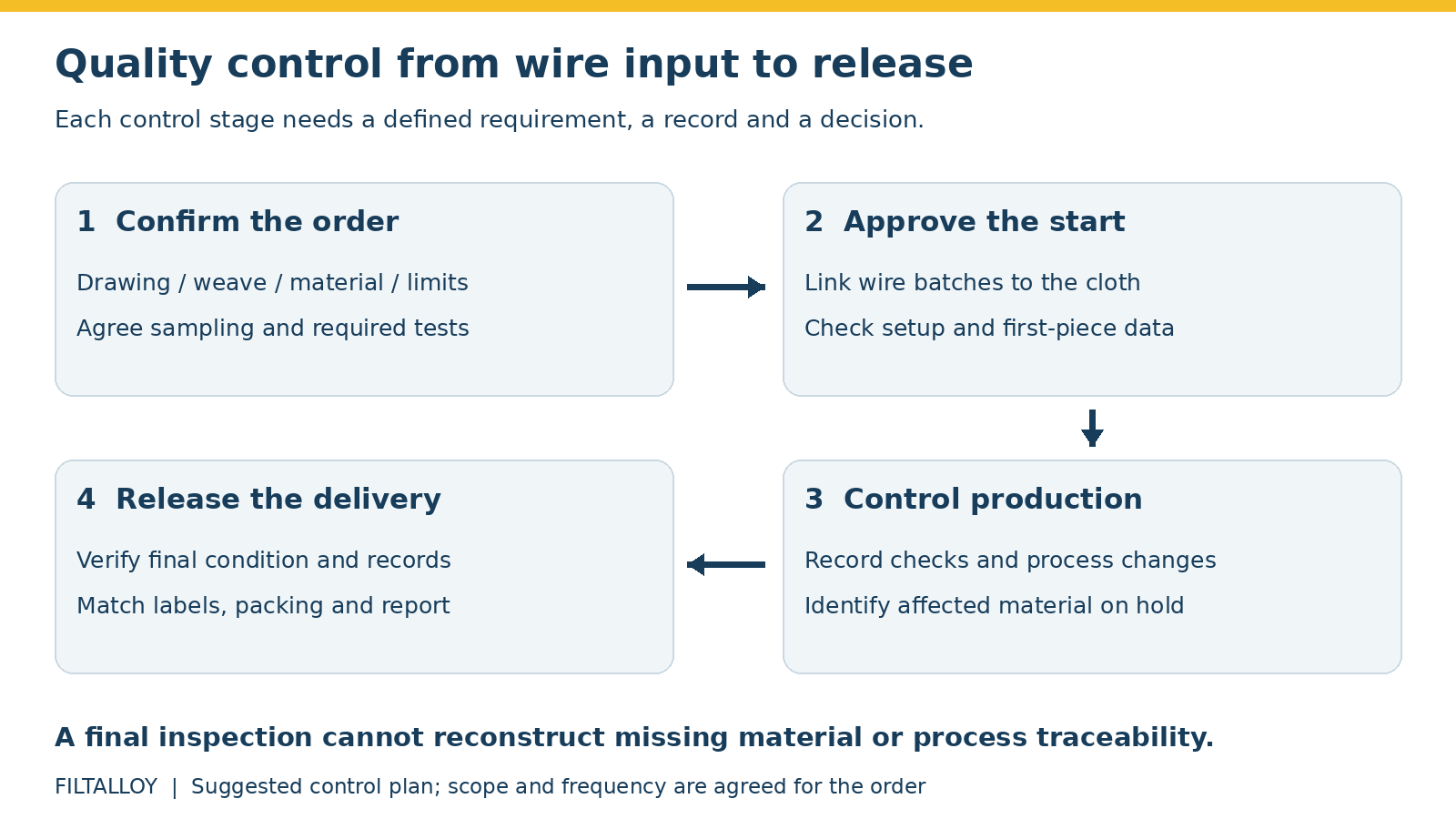
1. Define the order-specific control plan
Start with the product and its function, then decide what evidence is needed. Square-aperture screening cloth, Dutch filter cloth and a welded filter component do not have identical inspection requirements. A standard title or a generic “QC passed” statement is insufficient.
| Control-plan field | What to define |
|---|---|
| Product and revision | Purchase order, approved drawing, weave, material and current specification revision |
| Characteristics | Wire dimensions, aperture or filter-cloth designation, roll or part dimensions, edge and surface condition |
| Method and coverage | Instrument or test, sample condition, locations, frequency and the population represented |
| Acceptance basis | Agreed limits, applicable standard and edition, and any approved alternative requirement |
| Decision and records | Release responsibility, hold identification, disposition route and report content |
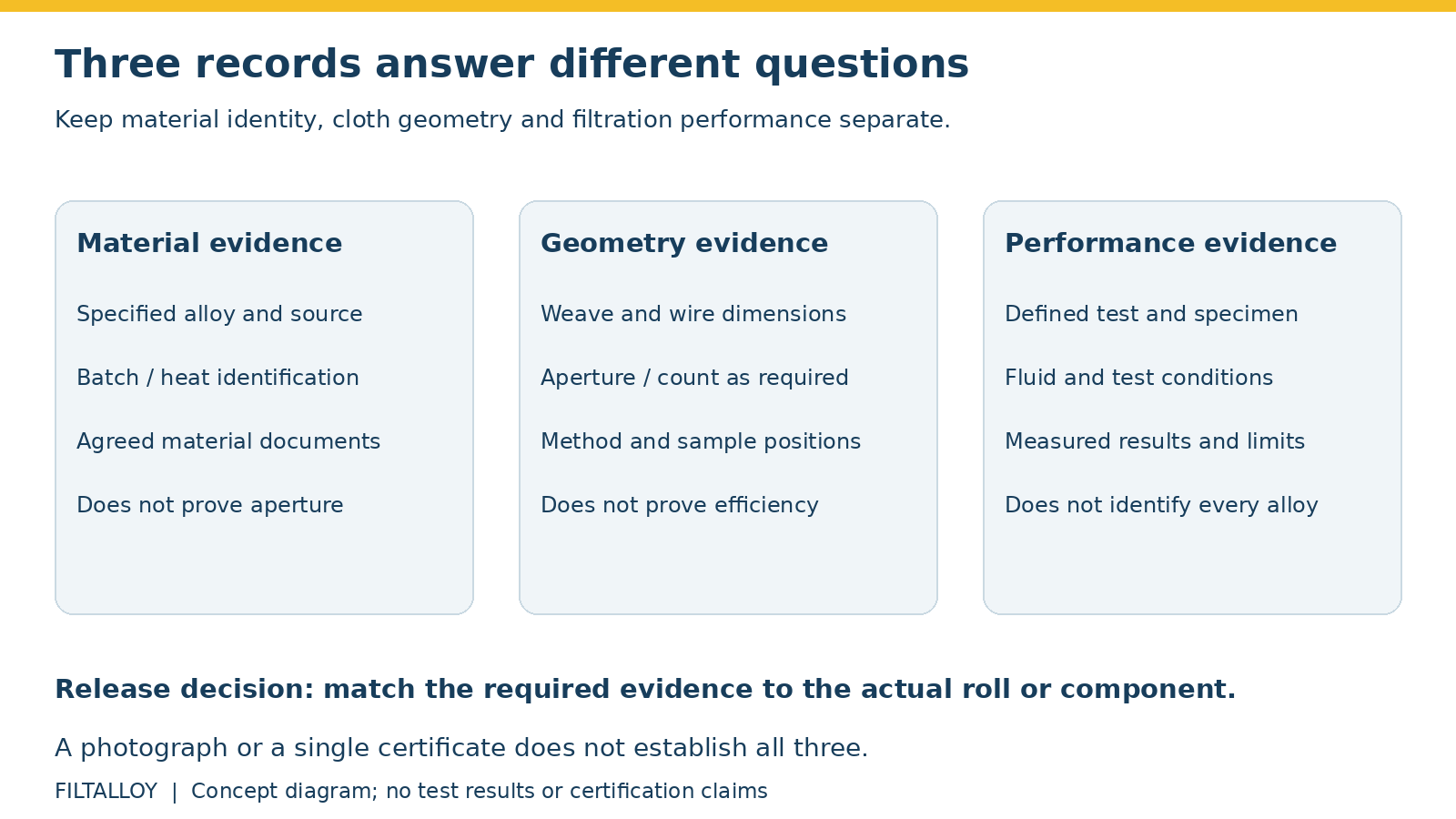
Distinguish a required characteristic from the method used to verify it. “316L” is a material requirement; a material document and any specified identity test are evidence. “0.20 mm aperture” is a geometric requirement; the agreed measurement method supplies the result. A filtration-efficiency requirement needs its own appropriate performance evidence.
Define any customer witness or hold point before production. A witness point allows an agreed opportunity to observe; a hold point requires the specified release before work proceeds. Use those terms only as defined in the project agreement.
2. Keep incoming wire and cloth traceable
At receipt, check identification against the intended material and order requirements. The documentation scope may include the specified grade, source batch or heat reference, wire dimensions and any agreed material properties. Specify the certificate type and supporting tests rather than assuming that every document contains the same information.
Carry the identity forward when wire is allocated, woven, split or cut. The traceability record should let a reviewer connect the finished roll or part to the applicable input records. Where warp and weft come from different batches, or several wire supplies are used, record the relationship at the level required by the order.
A practical identification chain can be:
Incoming wire identification → production allocation → cloth roll ID → cut-piece or component ID → delivery record.
When a roll is divided, preserve its relationship to the parent roll and the relevant inspection coverage. A new label alone does not create traceability. Conversely, material traceability does not prove that every opening in the roll meets its tolerance.
Record any uncertainty before using the material. If the connection between a certificate and a spool is lost, visual similarity, magnetism or a matching mesh count cannot reconstruct that missing connection.
3. Approve setup and the first piece
The start-up check should confirm that the planned cloth is actually being produced. Compare the weave, warp/weft specification, wire dimensions, opening or relevant filter-cloth designation, width and visible condition with the approved requirement.
Keep a dated result linked to the roll and setup. Where a reference sample is retained, identify what it represents: appearance and structure, for example, rather than every dimensional or performance requirement.
First-piece approval supports starting production; it is not evidence for the whole roll. The control plan still needs checks during production, especially after a relevant interruption, wire change or setup adjustment. Define which events trigger a renewed check.
Review any subsequent processing at this stage as well. A cloth that will be cut into discs or formed into a cylinder needs an agreed edge and fabrication requirement. Confirming only the loom output can leave the finished-part requirement unresolved.
4. Control production and changes
In-process records should show the production interval covered, the characteristic checked and the result. Their value comes from being linked to identifiable material, rather than a list of measurements with no roll position or time reference.
- Scheduled checks: follow the agreed coverage for dimensions and visible condition.
- Event checks: address defined changes such as restarts, material substitutions or setup adjustments.
- Stage checks: compare relevant characteristics before and after cutting, forming, welding or cleaning.
- Exception handling: identify affected material, record the observation and obtain the required disposition.
If a check finds a departure, the last recorded conforming result may help bound the investigation, but it does not automatically prove that all intervening material conforms. Review the event, inspection coverage and material history to determine the affected interval.
Keep held material identifiable until its disposition is resolved. Options may include additional inspection, approved rework, selection or rejection, according to the agreement. After rework, verify the relevant characteristics again and retain the connection to the original record.
For potential causes of repeated breaks, spacing changes or fabrication damage, use the manufacturing defect prevention guide. This control plan defines where evidence is collected and decisions are recorded.
5. Choose measurements that answer the requirement
For the practical measurement sequence, see how to measure mesh count, single-wire diameter and clear aperture. This control plan defines the agreed method, coverage and acceptance decision; the measurement guide explains endpoints, individual-wire contact and the record to retain.
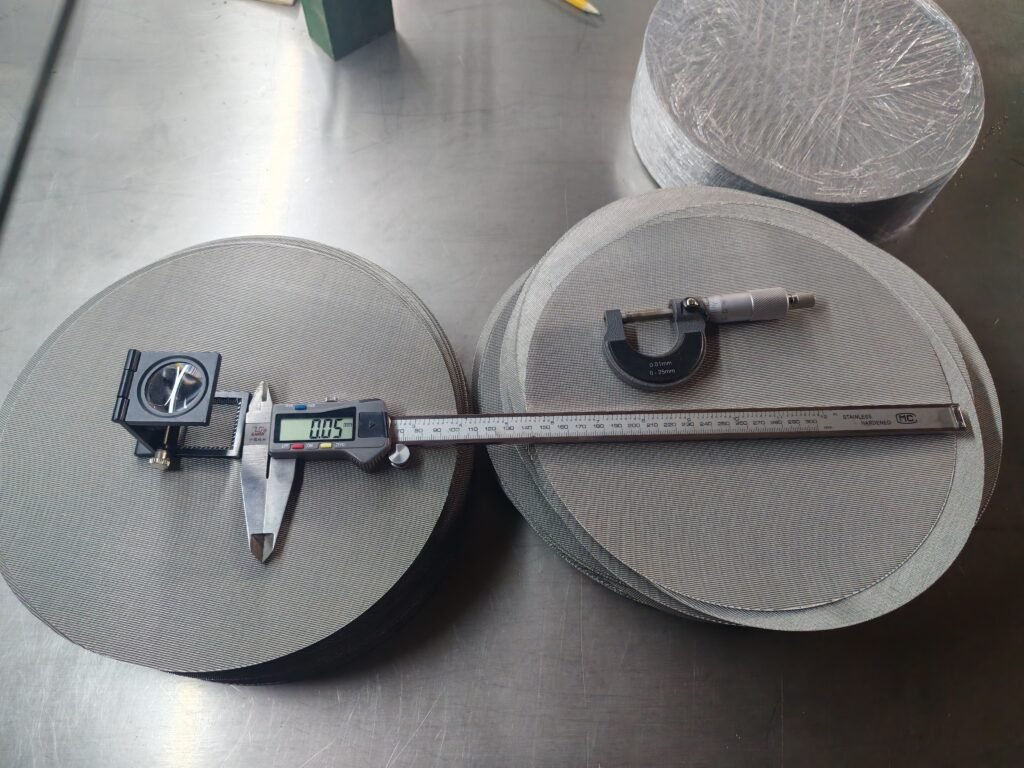
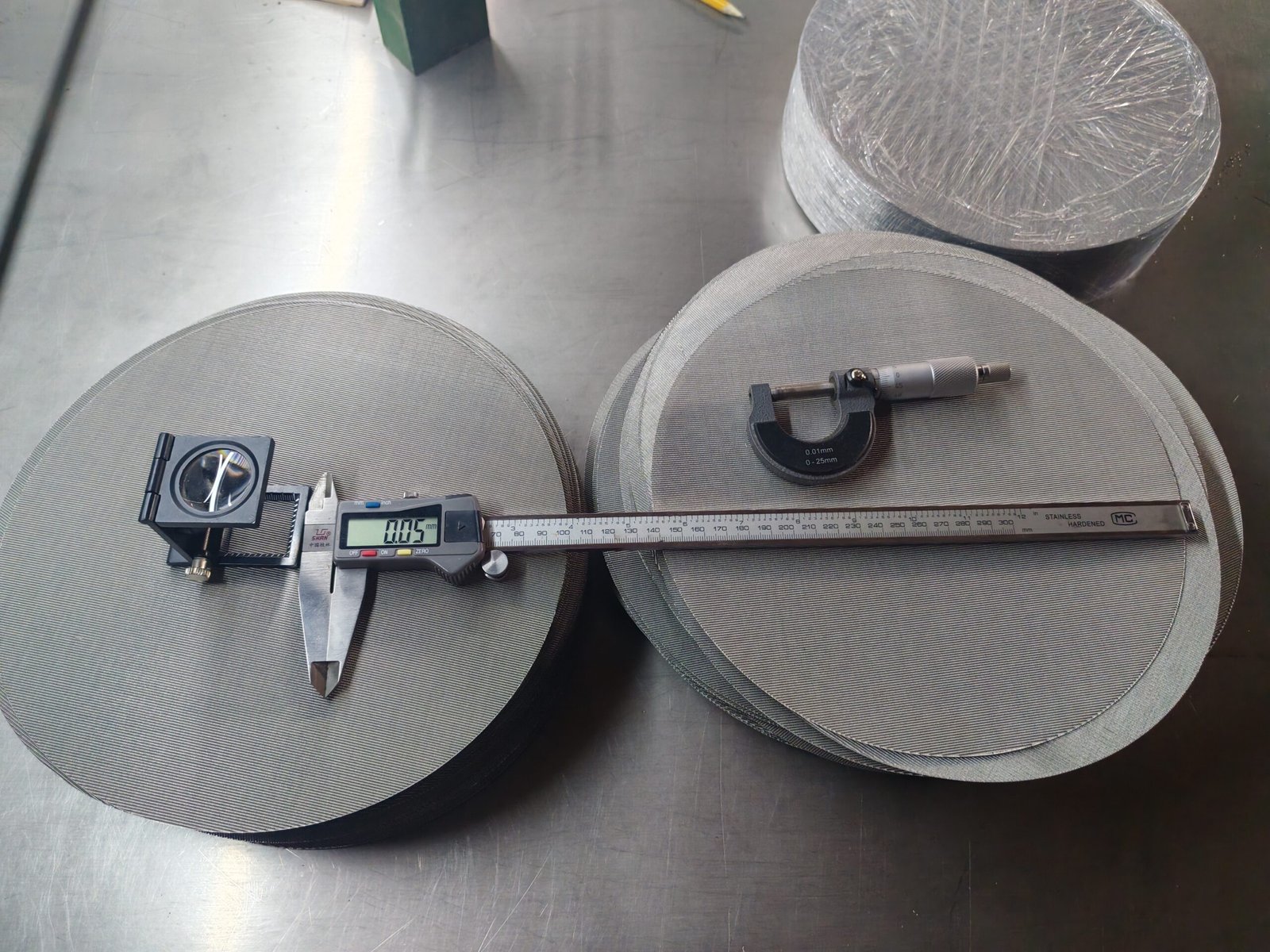
Match the method to the feature, scale and tolerance. A caliper suitable for a disc’s outside diameter is not automatically suitable for a fine aperture. The number of displayed decimal places does not establish measurement capability.
| Requirement | Method considerations | Keep in the record |
|---|---|---|
| Square aperture and count | Appropriate optical or dimensional method; defined direction, sample restraint and counting convention | Locations, individual results, units and applicable local or statistical limits |
| Wire diameter | Suitable contact or optical method; consider access, contact force and the distinction between incoming and woven wire | Direction, measurement position, instrument and method |
| Roll width or finished dimensions | Support and lay the material as specified; distinguish active cloth dimensions from overall part dimensions | Sample condition, datum, result and drawing revision |
| Visible condition and edges | Agreed lighting, viewing or magnification and defined critical regions | Location map, extent, photographs and acceptance basis |
| Filter-cloth or element performance | Test appropriate to the specified retention, flow or integrity requirement | Specimen, method, conditions, results and the scope of the conclusion |
Define sampling before inspection. The plan should state the lot or roll population, locations and quantity, handling of local extremes, and decision rule. There is no single sample count in this article that establishes acceptance for every cloth. An average aperture should not conceal a local condition that has a separate limit.
NIST’s guidance on metrological traceability relates traceability to a documented calibration chain with measurement uncertainty. In practical terms, instrument identification and a calibration record are part of the evidence; suitability for the actual measurement also needs review. A label alone does not establish that a method can resolve a close tolerance.
Confirm the standard’s scope before applying its requirements. ASTM’s E29.01 standards listing distinguishes E2016 for industrial woven cloth, E2814 for industrial woven filter cloth and E3278 for bubble-point testing of woven filter cloth. Their titles are not interchangeable test instructions. Agree the applicable edition and method; this guide does not reproduce tolerance tables.
A bubble-point result is method-dependent and does not, by itself, replace a specified particle-efficiency test for a complete filter. Keep cloth geometry, pore characterization and finished-element performance as separate requirements where the project needs them.
6. Release the finished roll or component
Match the release plan to the delivered form: woven wire mesh rolls require roll identity and cloth checks, while fabricated wire mesh filter elements also need agreed checks for the edges, seams, connections and supports introduced during fabrication.
Final release should bring the required evidence together for the actual delivery. Confirm product identity, quantity, dimensions, visible condition and any specified processing or performance results. Resolve open deviations and approved concessions before stating conformity to the agreed scope.
For cut or formed parts, check the features introduced after weaving: edges, seams, interfaces, supports and final dimensions. A conforming parent roll does not automatically establish the conformity of every fabricated component.
Check labels and packaging against the records. The label should identify the delivered item sufficiently to retrieve its specification and inspection evidence. Protect the material against the handling and transport conditions agreed for the order, including any relevant deformation, abrasion or cleanliness risks.
Do not describe a sampled inspection as 100% inspection. If a full-length visual examination was required and performed, state its actual method and limits. That statement still does not mean every aperture, alloy constituent or filtration characteristic was individually tested.
7. Agree a useful delivery document pack
The document pack should be proportionate to the order and available by agreement. A concise report tied to the correct material is more useful than unrelated certificates.
| Document group | Useful content |
|---|---|
| Order identity | Order and item reference, drawing/specification revision, quantity and roll or part IDs |
| Material evidence | Agreed material documents and the link to the delivered items |
| Inspection results | Characteristics, limits, methods, sampling coverage, units and recorded results |
| Additional tests | Required test reports with specimen identity and conditions; clearly distinguish coupon from complete-element results |
| Disposition and release | Approved deviations or rework, verification status and the responsible release record |
Before placing an order, send the intended service and the required document scope with the drawing. The wire mesh specification guide helps organize those details. Where the flow requirement matters, use the open-area and pressure-drop guide to define the relevant geometry and operating conditions.
Frequently asked questions
Does a material certificate prove the mesh openings are correct?
No. It supports the material information within its stated scope. Cloth geometry needs the relevant inspection results linked to the delivered material.
Is first-piece approval enough for a full roll?
No. It confirms the checked start-up sample. Continued production and relevant changes need the coverage defined in the control plan.
Can one inspection method cover square and Dutch weave?
Some tools may be useful for both, but their structures and requirements differ. Use the appropriate specification and method instead of assigning a square-aperture criterion to every filter cloth.
Should every delivery have the same tests?
The required tests depend on the product, function and order. Agree them before production, including whether evidence concerns raw wire, cloth, a coupon or the finished component.
Summary
A useful quality-control plan links the approved order to identifiable material, start-up approval, production checks and final release. Specify the measurements, coverage and document scope in advance, then keep the records connected to the delivered roll or part. This makes an acceptance decision reviewable without claiming more than the evidence establishes.