By Jack Sun · Updated October 22, 2026
Sintered metal fiber felt can be used for polymer melt filtration, but an improvement in a particular defect needs to be connected to contamination, melt condition and the complete element. A finer micron label is not a universal solution for gels, black specks or fish-eye defects.
For a drawing-based order, begin with media, layer arrangement, dimensions and connections. Where the aim is improved performance, connect the specific problem with the existing construction before choosing a different grade.
This article concerns fiber felt in that role. Woven-mesh layer order and screen-pack manufacture are covered separately.
Hard particles and gels raise different questions
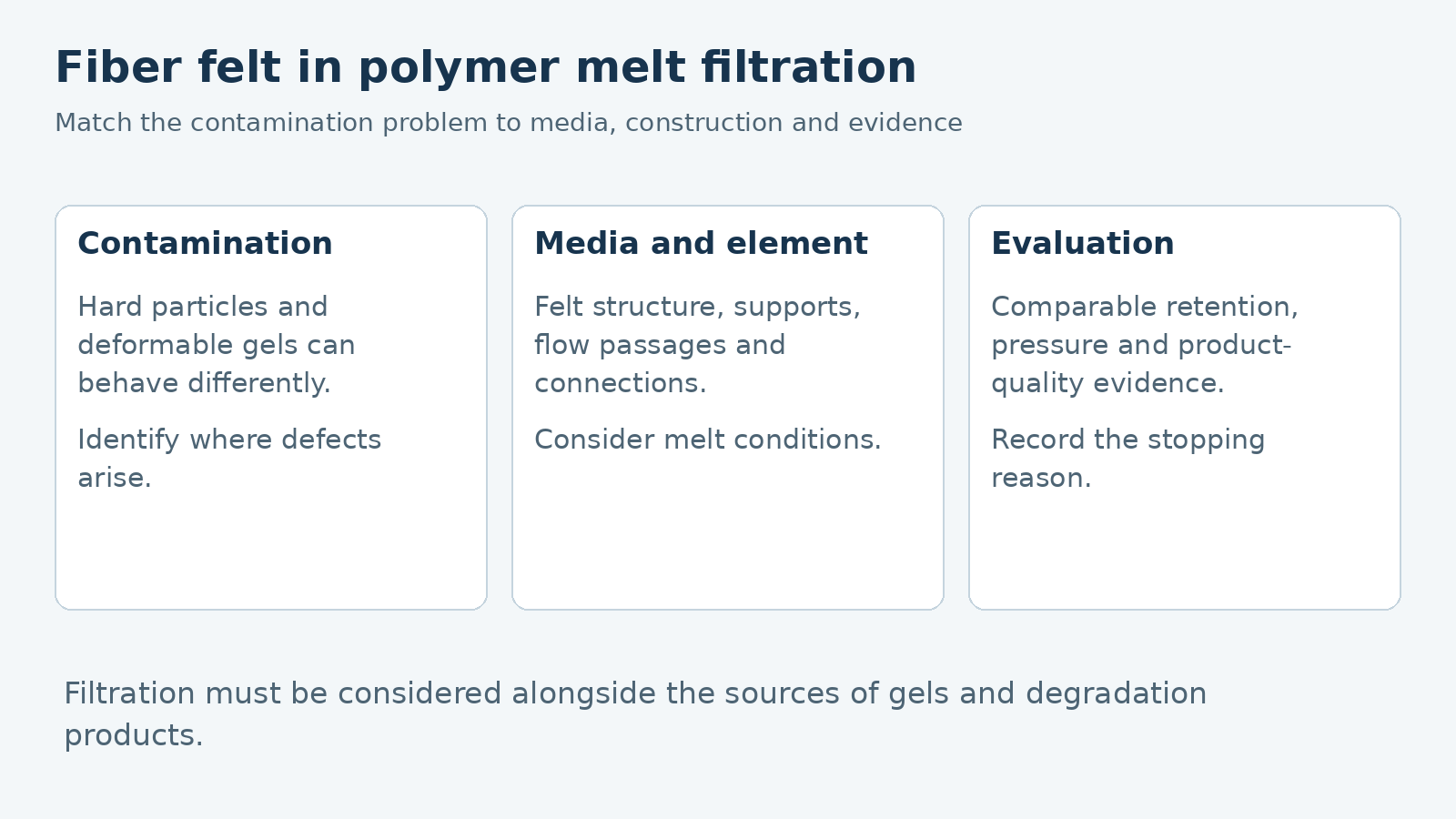
Contamination may be foreign matter or related to the polymer’s own condition. Hard particles and deformable gels need not behave alike when they approach a porous medium.
Bekaert’s gel-removal article distinguishes hard and soft gels and discusses raw material, mixing and overheating among possible sources. [1] The useful starting point is to understand contamination and where it forms. Its broad promotional comparisons should not be treated as proof that one medium is best in every case.
Soft material can deform under flow and pressure. A rating obtained using a defined hard-particle challenge cannot by itself guarantee the same result for every gel.
Similar visible product defects can also have different origins. If gel or degradation products form downstream of the filter, satisfactory upstream retention may not eliminate the final defect. Filtration and process investigation need to work together.
Why consider a metal-fiber structure?
Connected metal fibers form a pore network that can provide three-dimensional paths through the medium. Retention behavior depends on the fibers, layup and resulting pore structure.
Pall’s polyester-fiber production information illustrates a specific metal-fiber medium and candle construction for gel-control duties. [2] It establishes an application example, not a rule that every felt outperforms woven mesh or a test result for our products.
A media comparison needs a common task: what contamination is being controlled, how results are evaluated and what clean and loaded resistance is acceptable? An existing woven-mesh design that meets the requirements does not need changing solely because another material is available.
If felt replaces another medium, keep filtration and support layers distinct. The new medium does not automatically inherit every performance characteristic of the old assembly. Supports, connections and flow direction still need to correspond.
See sintered mesh versus fiber felt for structural comparison, and woven wire mesh in polymer melt filtration for the woven-media task.
Considering pressure drop, passages and residence together
The element must combine the required contamination control with acceptable flow resistance. A finer structure needs evaluation against the actual material, temperature and throughput.
High viscosity does not necessarily make a room-temperature water curve usable through a simple viscosity multiplier. If the melt is non-Newtonian, viscosity also depends on shear conditions, and linear scaling assumptions need reassessment.
Temperature is not merely a way to lower viscosity. The process window, residence and thermal stability also matter. Mott’s melt-spin-pack paper links contamination control with residence considerations. [3] That historical discussion provides task context, rather than current design values for a particular project.
Passages determine how melt reaches and leaves the element. More area alone does not establish an optimized system. Restricted passages, uneven distribution or stagnant regions can prevent the added area from delivering the intended benefit.
Keep the original operating and flow-path definitions when comparing a revision, and identify what changed. This helps interpret both pressure behavior and final-product results.
From sheet media to a melt-filter element
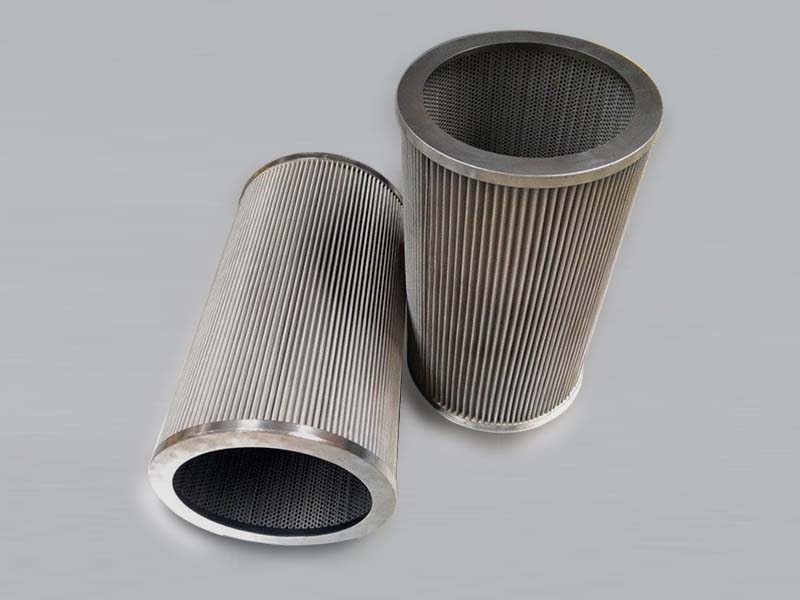
Felt can be supplied as sheet media or used in appropriate cylindrical, pleated and other element constructions. Each form has a spatial and flow-path task beyond simply changing the appearance of a sheet.
Porvair’s polymer candle information includes cylindrical and pleated constructions and connects outer guards with reverse cleaning. [4] It illustrates why operating structure and cleaning loads belong in the element design. Its details are not universal specifications for our products.
| Part | Task | Manufacturing information |
|---|---|---|
| Felt filtration layer | Required retention and flow behavior | Alloy, rating definition, thickness and layup |
| Supports and passages | Maintain construction and carry melt | Position, direction, obstruction and fit |
| Connections and sealed edges | Complete the filtration boundary | Dimensions, joining and sealing requirements |
| Protection and cleaning-related parts | Suit handling and agreed cleaning | Removability, reverse support and compatibility |
For manufacture to a drawing, first check whether these details are clear. A used sample can recover observable geometry, but its original alloy, rating and clean performance need other evidence.
Available forms are described on our polymer melt filter elements and polymer leaf disc filter pages. Screen-pack support and layer order are explained in the extruder screen-pack guide.
Evaluating whether a change worked
Evaluation should return to the original objective. If the goal is fewer defects of a particular type, retain a comparable defect definition and sampling method rather than looking only at pressure drop.
For a longer operating interval, record why each interval ended. Reaching a pressure limit, failing product quality and a scheduled shutdown are different endpoints and should not be combined into one unexplained service-life figure.
If resin batch, temperature, output and process arrangements change at the same time, not all differences can be attributed to the filter. Where practical, keep comparisons close and record unavoidable changes.
Prototype work can proceed in stages: installation and connections first, then unresolved retention and flow questions, followed by cleaning-state evaluation where reuse is intended. An ordinary drawing-based order need not repeat a full research program, but sample approval should identify what was actually established.
Cleaning and reuse in melt service
A residue-removal procedure must suit media, supports, connections and contamination. A metal element cannot automatically be assigned any thermal or chemical method.
Reuse also needs separate consideration of residue, structure and flow. Low pressure drop after a single cleaning does not prove that gel control, connection integrity and long-term performance have all recovered.
Retain cleaning and reuse evidence separately from the original material data. See sintered fiber felt cleaning and reuse for that decision sequence.
Frequently asked questions
Will finer felt eliminate every fish-eye defect?
No such guarantee follows from grade alone. Defects can have different origins and soft gels can deform. Consider contamination identity, filter location and process conditions together.
Does lower pressure drop mean poorer filtration?
Pressure drop alone cannot establish that conclusion. Media, area, passages, temperature and bypass can affect the result. Assess it alongside particle or final-product evidence.
Must a drawing-based order include complete process data?
Manufacture can start from a drawing and agreed requirements. Additional information is needed where a performance judgment or design change actually depends on it.
Can felt directly replace an equal-size woven-mesh element?
Equal dimensions establish only part of the fit. Media, support, direction, connections and the required retention and flow behavior still need checking.
Connecting the medium with the problem
Felt’s value in melt service is established through contamination, construction and operating conditions. A drawing, existing specification and a clear description of the problem help identify what should change and how the result will be assessed.
Technical sources
- Bekaert, How to remove gels from a polymer. Gel categories and possible origins; broad superiority claims are not adopted.
- Pall, Filtration in Polyester Fiber Production. A manufacturer-specific application example.
- Langley and Khalaf, Mott Porous Metal Media for Polymer Melt Spin Pack Filtration, 1998. Historical technical context, not a 2026 product specification.
- Porvair, Candle Filters for the Polymer Melt Industry. Element forms and guard-function example.
About the author: Jack Sun has long worked in metal wire mesh weaving and industrial filter-element manufacturing. Filtalloy is based in Anping, Hengshui, Hebei, China, known for wire mesh manufacturing.