By Jack Sun · Updated October 22, 2026
Effective cleaning starts with the foulant, its location and attachment, and the methods permitted by the filter’s materials and construction. A pressure-drop rise can look similar while loose particles, oily residue and polymer deposits require different treatment.
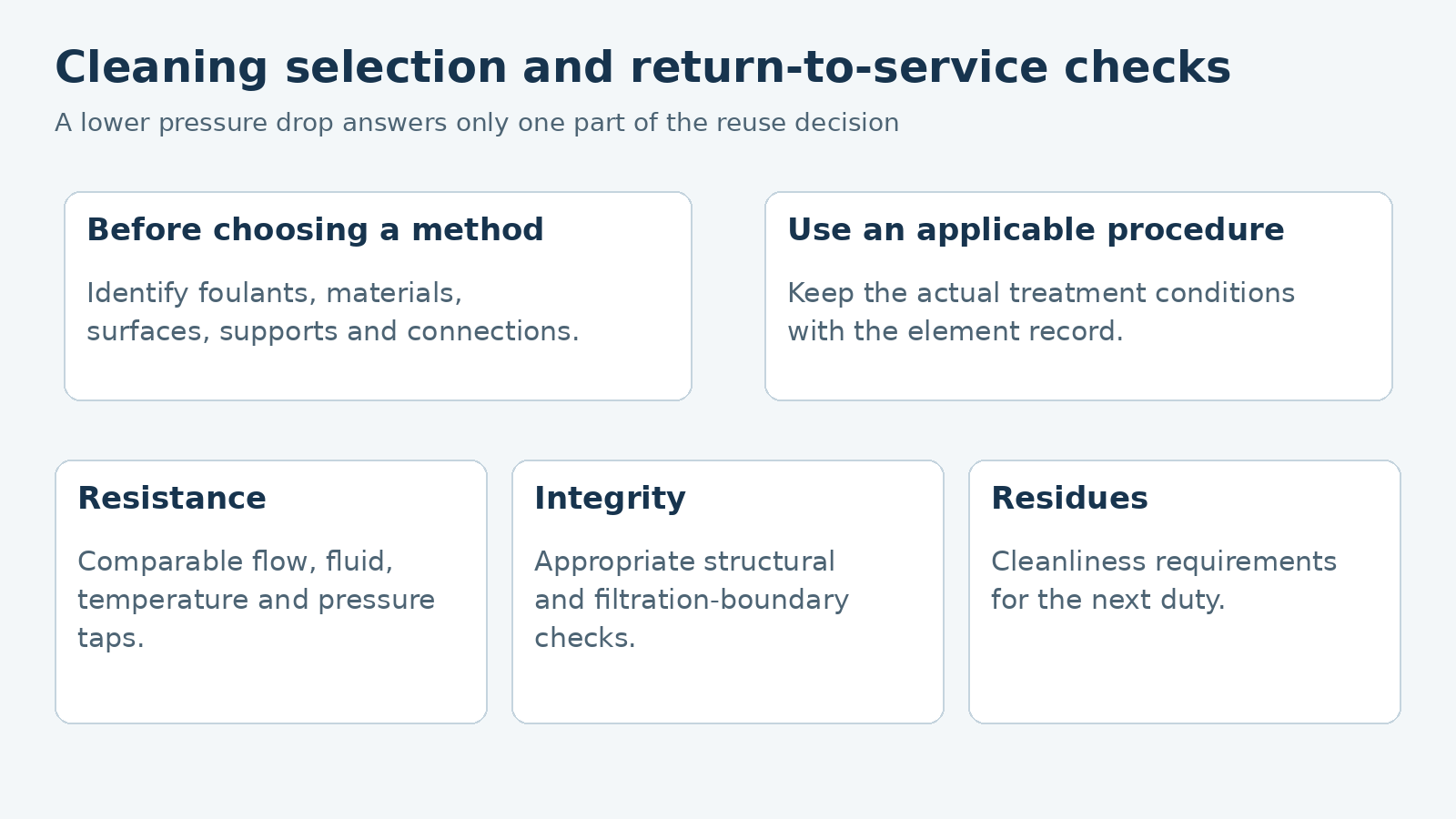
The objective extends beyond restored flow. A cleaned element still needs the integrity, residual-contamination control and structural condition required for its next duty.
This guide connects method selection with the checks needed for reuse. Procedure temperatures, chemical concentrations and reverse pressures must belong to the actual application and assembly.
Establishing a comparable starting condition
A pressure-drop rise can indicate resistance change, but does not establish blockage on its own. Flow, temperature, viscosity, valve position and pressure-tap changes can also affect the reading.
Where conditions are comparable, connect the present result with a clean reference. Identify the element and its fluid and contamination history. A “normal pressure drop” from another element is not automatically a valid baseline.
Missing initial records do not prevent an investigation, but the gap should remain visible rather than being filled with an invented value. The metal filter troubleshooting guide helps establish that comparison.
Connecting foulants with cleaning methods
A method must release contamination and provide a way for it to leave the media. Surface versus internal location, and loose versus adherent deposits, influence that process.
Mott’s porous-metal cleaning document discusses foulant types and methods including reverse flushing, soaking, circulation, ultrasonic treatment and furnace cleaning. [1] Its operating conditions are not a universal fiber-felt recipe. The useful relationship is to identify contamination before selecting treatment.
| Condition | Direction to investigate | Boundary to confirm |
|---|---|---|
| Loose surface particles | Suitable backwashing or blowback | Reverse load and removal path |
| Oily or soluble residues | Compatible soaking, flushing or circulation | Material compatibility and rinsing |
| Adherent internal deposits | A validated combination of methods | Access, residues and structural effects |
| Polymer or carbonized deposits | An application-specific procedure | Thermal or chemical conditions and connections |
This table offers discussion points, not automatic method assignments. Mixed contamination may need more than one step, and one treatment can change what the next step encounters.
Backwashing and blowback
Reverse flow can help remove suitable deposits, but a support arranged for normal flow may not work the same way under reverse load.
Allowable reverse differential pressure must therefore refer to the particular element, direction, temperature and support design. Supply-air pressure is not necessarily the instantaneous differential across the medium. Another manufacturer’s limit cannot be assigned to every Filtalloy assembly.
Soaking, circulation and auxiliary treatment
Released or dissolved material still needs to be removed from the element and cleaning liquid. Recirculating particles back into the medium can defeat the intended removal.
Ultrasonic or other auxiliary treatments need validation for the material and assembly. Greater treatment intensity is not proof of a better result; assessment should consider both removal and element condition.
Dry pulse cleaning and offline washing answer different questions
In a dust filter, online pulse or reverse-gas cleaning aims to release a deposit while the element remains part of the gas-cleaning system. Offline soaking or washing addresses a removed element and adds liquid compatibility, residue, drying and reinstallation questions. A successful liquid-washing result does not by itself establish repeated pulse-cleaning behavior.
For cyclic gas cleaning, compare the resistance remaining after successive cleaning events with the operating flow and gas state, and retain outlet-particle observations during stable operation and cleaning transitions. Keep gas-supply settings separate from the actual load across the medium. The element, supports, end joints and seals belong to the assessment.
A test-method name also needs its scope checked. The public abstract of VDI 3926 Part 1 identifies dry-operating cleanable filters and restricts that part to textile media. It should not be presented as automatic certification of a sintered-metal element. A proposed method for metal media needs an explicit applicability review.
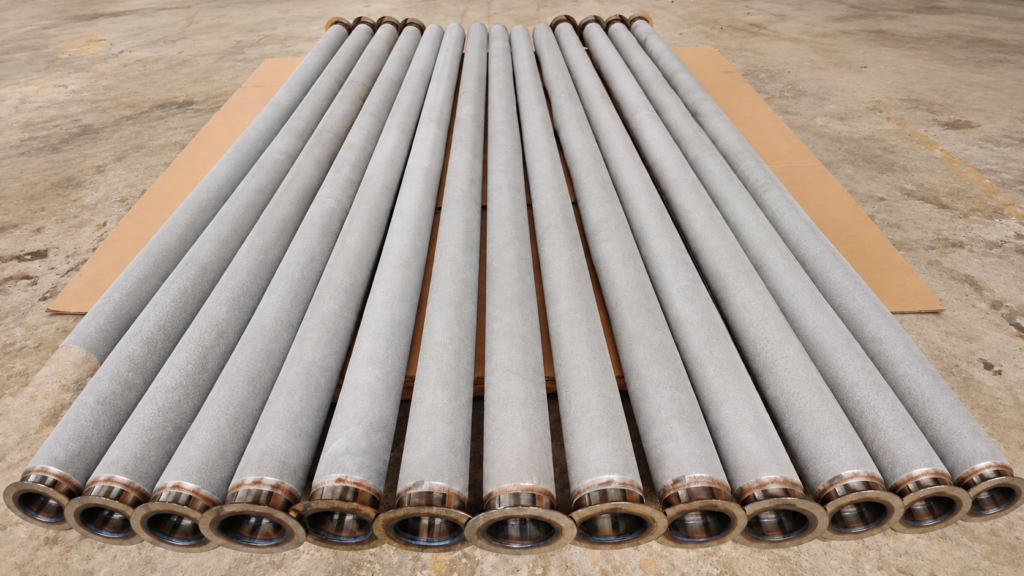
For the supplied construction see hot gas filter elements; for dust, condensation and equipment considerations see biomass flue gas filtration. No universal pulse pressure, duration or cleaning interval is assigned here.
Materials, surfaces and connections
An element may combine felt, support mesh, a core, welds, end fittings and seals made from different materials.
A method considered for a bare sheet may be unsuitable for its assembled cartridge. Chemical or thermal selection must consider the whole assembly rather than a general description such as “stainless steel.”
Coated titanium felt, uncoated titanium felt and other alloy felts should not share an unvalidated procedure. A surface may perform a particular application or contact function. A brighter appearance does not establish that the function has been preserved.
For equipment with an established procedure, begin with that procedure and the element requirements. Changing chemistry, temperature, duration or flow direction is a process change requiring its effects to be considered.
What to check after cleaning
Three questions need separate evidence: has resistance recovered, is the filtering boundary intact, and are residues controlled for the next use?
Resistance recovery needs the same actual flow, comparable fluid and temperature, and consistent pressure taps. Wetting, drying and conditioning should also be identified. Otherwise a lower value may reflect test differences.
Integrity and structure need appropriate inspection or testing. Appearance can reveal obvious deformation and connection damage, but cannot replace every leakage or retention assessment. A bubble-point or leakage result needs its own method and acceptance basis; it should not be expanded into a guarantee of efficiency at every particle size.
Residues and cleanliness depend on the next duty. Cleaning liquid, released material and original contamination may require corresponding observations or measurements. See metal fiber felt shedding and cleanliness for those distinctions.
Our cleaning pressure-drop recovery calculator calculates the fraction of measured pressure-rise removed under its stated comparison. It does not certify integrity or restore a declared service life.
A post-cleaning value substantially below the original reference deserves attention. It may reflect fluid or measurement differences, but bypass or structural change may also need investigation. “Lower” should not automatically be recorded as “cleaner.”
Keeping a reusable cleaning record
A useful record connects the before, treatment and after conditions to the same element.
| Stage | Information to retain |
|---|---|
| Before cleaning | Element identity, exposure, symptoms and reference |
| Treatment | Procedure revision and actual conditions |
| After cleaning | Resistance, structural or integrity results, residues and disposition |
| Return to service | Date, subsequent performance and next stopping reason |
Repeated, comparable results can support a maintenance plan. One successful recovery cannot establish unlimited cleaning cycles or a fixed lifetime.
Drawings, used elements and previous cleaning records can all start the discussion. Where exposure history is incomplete, record the uncertainty and decide what further identification or sampling is needed.
Recording the reason for return to service
Keep three outcomes visible: the resistance comparison, the condition of the filtering and sealing boundary, and the residue assessment for the next duty. Record an unresolved result as an open item rather than combining it into a single “cleaning passed” label.
If particles or leakage remain unexplained, connect the record to shedding and delivery cleanliness and the metal filter troubleshooting guide. The purpose is to resolve the missing evidence, not to recover the lowest pressure reading at the expense of the required retention or sealing.
Frequently asked questions
Can every fiber felt be furnace-cleaned?
An all-metal description is insufficient. Media, surface, connections, seals, contamination and the applicable procedure all need consideration. There is no universal furnace temperature.
Is a visibly clean element ready to reinstall?
Appearance is one part of the assessment. Resistance, integrity and residue requirements for the next use still matter.
Why can pressure drop rise quickly again after washing?
Incomplete removal is one possible cause, but contamination input, operating conditions and other flow-path changes can contribute. Align flow, temperature, contamination and test conditions before narrowing the cause.
Must every possible test be repeated after every clean?
Check content and frequency can reflect project risk and existing validation. The evidence retained must be sufficient for the reuse decision being made.
From treatment to a reuse decision
Identify contamination and construction, select an applicable method, and review resistance, integrity and residues after treatment. This makes the return-to-service decision explainable.
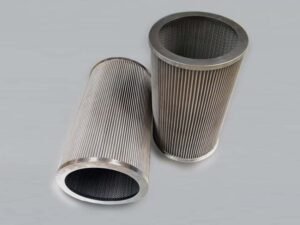
Supply configurations are shown on the fiber felt and pleated metal filter pages. For melt-service considerations, see fiber felt in polymer melt filtration.
Technical sources
- Mott, Cleaning of Porous Metal Products, April 2024. Cleaning and evaluation framework; its numerical settings and thresholds are not adopted here.
- Bekaert Filtration FAQ. Source of the cleaning-and-reuse question, without adopting unconditional claims about retained performance or shedding.
- Porvair, Candle Filters for the Polymer Melt Industry. A product example connecting guard construction and reverse cleaning.
About the author: Jack Sun has long worked in metal wire mesh weaving and industrial filter-element manufacturing. Filtalloy is based in Anping, Hengshui, Hebei, China, known for wire mesh manufacturing.