Quick answer: Delivery cleanliness describes residual contamination in a specified product state. Shedding concerns material released from the filter under defined conditions. A downstream particle result can help investigate either question, but its source and test conditions determine what you can conclude.
If particles appear downstream after a new cartridge is installed, you may want to know whether they came from the felt. If you are preparing a purchase specification, the question may be how to describe “clean on delivery” or “non-shedding” in a way both parties can verify.
The useful starting point is the question behind the particle result. This guide connects possible sources, sample condition, report interpretation and delivery requirements, so you can identify the evidence needed for your project.
1. Particle sources and the questions they raise
Particles found after a filter can raise three different questions. Establishing which one you are investigating helps determine the sampling and analysis needed.
| Question | What is being assessed? | Evidence to discuss |
|---|---|---|
| Delivery residue | Contamination carried by the product in its defined delivery state | Sample condition, assessed surfaces or passages, sampling and analysis |
| Material release | Particles originating from the medium or other filter components under stated conditions | Operating stage, loading conditions and evidence of particle origin |
| Penetration or bypass | Upstream particles reaching the downstream side | Upstream and downstream observations, sampling conditions and possible flow paths |
These sources can coexist. An elongated particle is a useful observation about shape; identifying it as a fiber from the felt may require morphology, composition or comparison with relevant components. A total particle count provides another part of the evidence, but does not identify each particle’s origin.
The distinction is especially useful when reviewing a report. A delivery-residue result describes the inspected product state. An operating-release evaluation addresses behavior under its stated conditions. A retention assessment asks how upstream contamination is removed. The report’s objective should make clear which question it was designed to answer.
2. Sintered construction and the finished filter
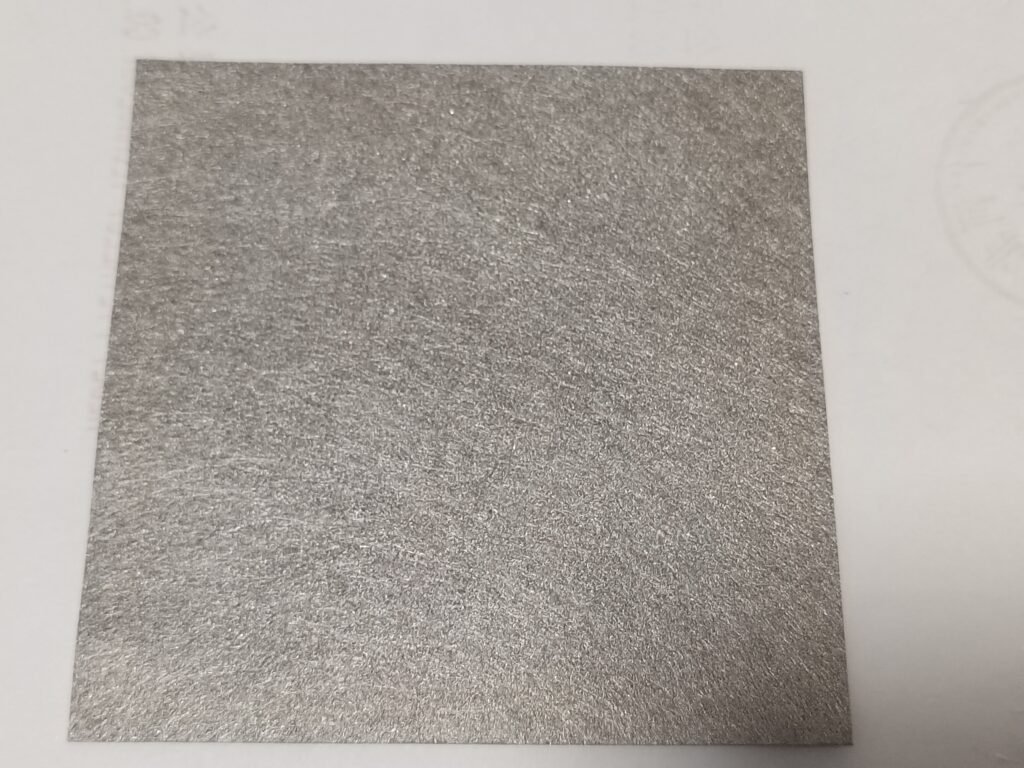
Sintered metal fiber felt has fibers bonded at their contact points. That structure matters when discussing integrity and release. The object used in service, however, also includes the effects of forming and assembly.
A flat medium may subsequently be cut, pleated and joined into a cartridge with supports, end connections and seals. A project concerned about release therefore needs evidence relevant to that finished construction, rather than relying only on the material name.
When you see “non-shedding” in product literature, useful details are the product being described, its preparation, the evaluation conditions and the detection scope. For example, Bekaert’s hydraulic-media literature discusses shedding in relation to its own bonded fiber medium. Such statements describe that manufacturer’s product; evidence for a different supplier or assembly needs its own basis.
Binder-free media also leave other parts of the assembly to consider. Supports, joints, seals and attached residue can all belong in the review, even when the concern began with the fiber felt itself. Our mesh support guide explains the relationship between the medium, adjacent mesh and cartridge structure.
3. Delivery cleanliness and sample condition
The condition of the sample is part of the result. Manufacturing completion, final cleaning, packing, transport, opening and pre-installation treatment are different stages.
Suppose a report evaluates a cartridge after an additional laboratory rinse. That can be useful for its stated purpose, but it answers a different question from an inspection of the product immediately after its final packaging is opened. This is an illustrative comparison of sample states, not a Filtalloy test result.
For an arrival-condition requirement, the record can identify the final packaging, receipt condition, opening time and any treatment before inspection. For an assembly, it can also state whether the assessed areas include the internal passages, external surfaces, ends, fittings and supports.
Visual inspection provides information about visible debris, staining, damage and other abnormalities within its observation scope. A quantitative particle requirement additionally needs a defined sampling method, analysis and reporting basis. Oil films, chemical residues and microbial requirements call for their own assessments where relevant.
ISO 16232:2018 addresses methods and documentation for particulate cleanliness of relevant road-vehicle components and systems. Its public scope does not set component-specific cleanliness limits and excludes film contamination and operating-fluid characterization. A project can assess whether that scope fits its needs before selecting the method and acceptance criteria.
4. What a particle report can tell you
A report becomes easier to interpret when the result stays connected to the sample and method. The following fields help you see both its value and the questions it leaves open.
| Report detail | What it helps establish | Useful clarification |
|---|---|---|
| Product identity and state | Which specimen and preparation the result describes | Media or full cartridge; as received, rinsed, used or cleaned |
| Sampling and analysis | How the observation was obtained | Assessed area or passage, sample basis and method |
| Background or blank | Contributions from the evaluation process | Fluid, container, fixtures and handling controls |
| Detection and size definitions | What the method can detect and how it classifies observations | Detection range and metrics for elongated particles |
| Particle characteristics | Count, shape or composition, depending on the analysis | Which observations support a possible origin |
| Acceptance criteria | How the result is judged | Agreed limit, reporting basis and response to nonconformity |
Background deserves attention because the fluid, containers, connections and handling can contribute particles. A useful discussion with the laboratory is what the method reports without the test product. If that background is high or unstable, result validity needs review before making an acceptance decision. Any correction follows the chosen method; there is no single subtraction rule for every evaluation.
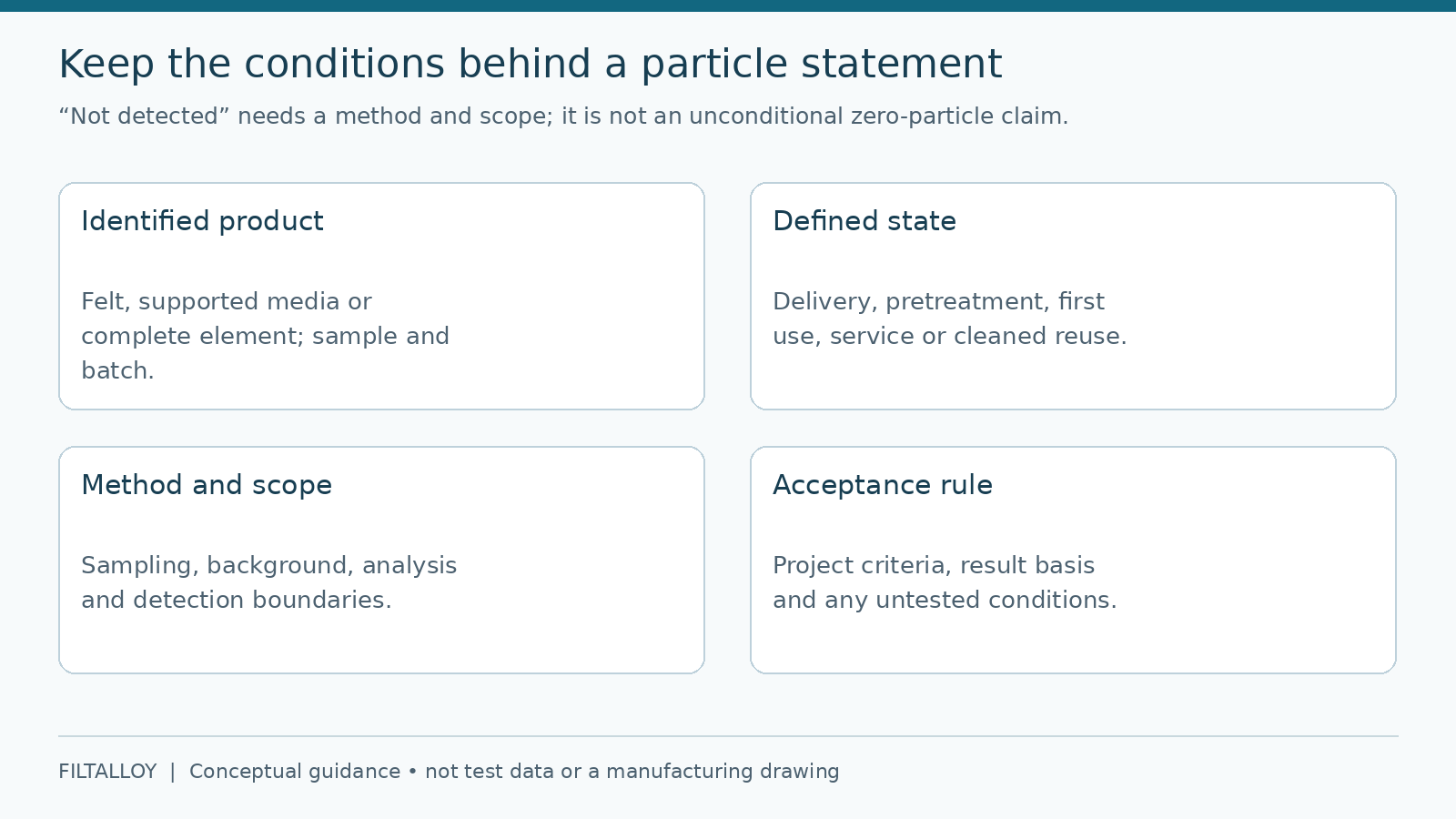
Detection capability and acceptance are also separate. “Not detected” describes a result within a method’s scope. Keeping that scope with the result is more informative than shortening it to “zero particles.”
Count, shape and composition provide different clues. In particular, a size metric used for an elongated object may differ from its physical length or diameter. A composition matching the cartridge metal can help an investigation, but similar alloys elsewhere in the system may provide other possible sources. Reports should distinguish observations, possible explanations and confirmed findings.
5. Release during startup, operation and cleaning
An operating-release evaluation needs a defined service stage. First use, established operation and reuse after cleaning may pose different questions.
The plan can record fluid, temperature, flow, differential-pressure direction, duration and fluctuations, together with sample pretreatment. Where backwashing or cyclic operation matters, those stages need to be identified in the evaluation scope.
For example, a startup observation and a stable-running observation can be kept as separate records. This preserves the timing needed to investigate initial residue and continuing release, rather than assigning every particle to the same mechanism.
The required conditions come from the application and agreed method. The article does not assign a universal rinse time, cycle count or test pressure. Those values need a basis in the actual product and intended evaluation.
6. Evidence when particles appear downstream
The most useful early record connects the observation to what happened around it: replacement, unpacking, installation, startup, switching or cleaning. Timing helps identify which comparisons may be informative.
- Observation record: time, location, product and sample identity, original counts, photographs and operating records.
- Sampling comparison: whether positions, volumes, containers and analysis methods are comparable.
- Possible sources: upstream contamination, penetration or bypass, delivery residue and release from relevant components.
- Further examination: suitable microscopy, composition analysis or component comparison, as determined with qualified personnel.
Before disassembly, photographs and records of the assembled state help distinguish service observations from changes introduced during handling. Preserving collected particles, where appropriate to the method, can support later analysis.
If the source remains uncertain, the report can state what has been observed and what still needs checking. This is more useful than assigning the particles to the felt simply because they look fibrous, or excluding it without evidence. The metal filter troubleshooting guide provides related checks for sampling, upstream sources, seals and bypass paths.
Preserving the evidence around a cleaning event
If a downstream particle result changes after cleaning, keep the last pre-clean observation, the treatment record, the first startup observation and a later comparable running observation distinct. A rinse may remove delivery residue; treatment or handling can also introduce material; changes in a seal or joint can create a different path for upstream particles.
Compare the fluid and sampling background as well as the element. Where collected particles can be retained under the chosen method, their shape and composition may help identify an origin. Neither one increased count nor matching alloy composition alone establishes felt shedding.
Use fiber felt cleaning and reuse for the reuse decision and the metal filter troubleshooting guide for pressure, bypass and installation checks. This page addresses particle origin and the defined cleanliness state.
7. From packaging to acceptance requirements
If the requirement concerns the product on arrival, the agreement needs to extend beyond the end of cleaning. Protected openings and surfaces, packaging integrity, batch identification, opening conditions and receipt inspection help define that delivery state.
Packaging choices need a purpose and compatibility review. The number of layers alone does not establish a cleanliness grade, and a packaging photograph records visible condition rather than the particle content of every delivered product.
You can organize the technical requirement into three groups:
- Object and state: bare felt, supported medium or complete cartridge; assessed regions; cleaning, packaging and opening state.
- Evaluation: particle characteristics, size definitions, sampling, analysis, background controls and the operating stages covered.
- Decision and records: acceptance basis, reporting, batch and design traceability, retained evidence and the response to an unacceptable result.
If installation includes additional treatment, its responsibilities can be recorded separately from the supplier’s delivery condition. A requirement such as “zero shedding” can then be discussed in terms of a defined object, method, conditions and decision rule. A demanding requirement still needs a consistent way to assess it.
Frequently asked questions
Does a filtration-efficiency report establish that the filter does not shed?
Its objective and method need checking. A retention evaluation and a release evaluation address different questions. The efficiency report is relevant only to the extent that its method also covers the stated release requirement.
Can two particle reports be compared directly?
Comparison needs compatible product states, sampling bases, size definitions and methods. When those differ, the differences should remain visible rather than ranking the products by their counts alone.
Does a metal particle with matching composition prove it came from the felt?
Matching composition is a clue. Other components may use a similar alloy, so morphology, sampling location, timing and component comparisons may be needed to establish origin.
Does “not detected” mean no particles of any size are present?
It describes the result within the stated method and detection scope. Smaller particles or other contamination categories outside that scope require separate consideration.
Does every industrial filter need ISO 16232?
The application and method scope determine whether it is appropriate. Its name alone does not define the project’s cleanliness limit or demonstrate long-term absence of release.
Conclusion
Delivery cleanliness, operating release and particle retention are connected through the same filter, but each has its own question and evidence. Keeping the product state, method and acceptance basis with every result makes those connections easier to review.
If your project has strict downstream particle requirements, you can share the application, particle concern and existing acceptance requirements with Filtalloy. The discussion can identify the construction involved, available evidence and any evaluation still needed. Available supply forms are described on our sintered metal fiber felt product page.
Technical context
The ISO link above provides public scope information, rather than a reproduction of the paid standard’s procedures. The Bekaert link provides manufacturer-specific background. The report fields and investigation questions here are an engineering review framework; they do not assert that Filtalloy has a certified cleanliness grade, a zero-shedding product or a particular in-house release test.