Quick answer: A pleated fiber felt filter validation plan connects each open requirement to an identified specimen, evaluation method, conditions and acceptance criteria. Media samples, formed specimens and complete cartridges answer different questions; the plan brings their results together for a defined design revision.
If your felt sample already has test data, you may be wondering what remains to be checked after it becomes a pleated cartridge. Or you may be keeping the same medium while changing the pleats, supports or end connection. Which earlier results are still useful, and what does the next prototype need to establish?
Those questions give the plan its focus. Rather than starting with every possible test, you can connect the available evidence to the unresolved design and service requirements. This guide follows that process from sample definition to production handover.
1. Validation objectives and available evidence
The purpose of the prototype determines what it needs to demonstrate. A first use of fiber felt may raise questions about the medium and contaminants. A revised pleat arrangement may focus attention on forming and flow passages. A replacement cartridge may introduce additional fit and sealing questions.
A useful project record groups the open issues as media, construction and service questions. For each issue, it identifies the relevant requirement, evidence already available, missing information and proposed evaluation.
For example, a prototype made only for installation assessment can provide a clear fit conclusion. The record can state which interfaces were checked and which questions remain for the performance evaluation. That is more useful to the next reviewer than a general “sample approved” label.
Existing evidence can reduce unnecessary work when its conditions and design remain applicable. The plan’s job is to make that relationship visible, while keeping unresolved requirements in view.
2. Sample identity and design revisions
A result needs an identifiable object. “316L pleated fiber felt cartridge” may describe several developing configurations, rather than a single design.
The sample record can include the prototype number, drawing revision, media identity and batch, layer structure, supports, connections, seals and completion date. Photos, dimensions and test results can then refer to the same specimen.
This becomes especially helpful when several versions are being developed together. If one sample has a different support or connection, its record shows the change instead of leaving the reviewer to infer it from photographs.
Detailed manufacturing information can remain within the agreed disclosure boundary. The people making, inspecting and evaluating the sample still need a consistent definition. Changes made during evaluation become part of its history and inform the review of earlier results.
3. Media, forming and complete-cartridge evaluation
The evaluation object changes as the product takes shape. The following stages help connect the questions without requiring every project to repeat the same sequence.
| Object | Questions it can address | Connection to the next stage |
|---|---|---|
| Flat media specimen | Agreed material information, dimensions, layer construction and relevant media performance | A traceable baseline for forming and assembly |
| Local forming specimen, where useful | Pleat roots, tips, cut edges, layer positions and feasibility of the proposed geometry | Evidence about the forming questions before or alongside complete-cartridge work |
| Complete prototype | Construction, installation, sealing and the agreed assembly-performance requirements | Evidence for the identified cartridge revision under stated conditions |
| Defined service or cleaned state | Behavior during the intended duty or after the specified cleaning procedure | Evidence for the operating stages actually covered |
At the media stage, the record distinguishes bare felt from mesh-supported composite material. Each result retains its specimen, method and conditions. For interpretation of individual parameters, see our fiber felt specifications and test data guide.
A forming specimen is useful when it resolves an actual uncertainty. An established construction may already have relevant evidence; a new medium or layer arrangement may justify closer examination. Observations of pleat roots, tips and layer position help locate questions that need further investigation.
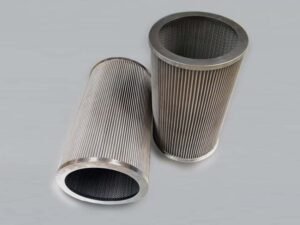
The complete cartridge adds interfaces and flow paths. Its evaluation therefore connects the media results to supports, joints, fittings, seals and installation. Available supply configurations are described on our pleated metal filter cartridge page and sintered metal fiber felt page.
| Assembly question | Conditions to define | Useful record |
|---|---|---|
| Does the build match the drawing? | Media, pleats, supports, connections and seals | Revision-linked construction inspection |
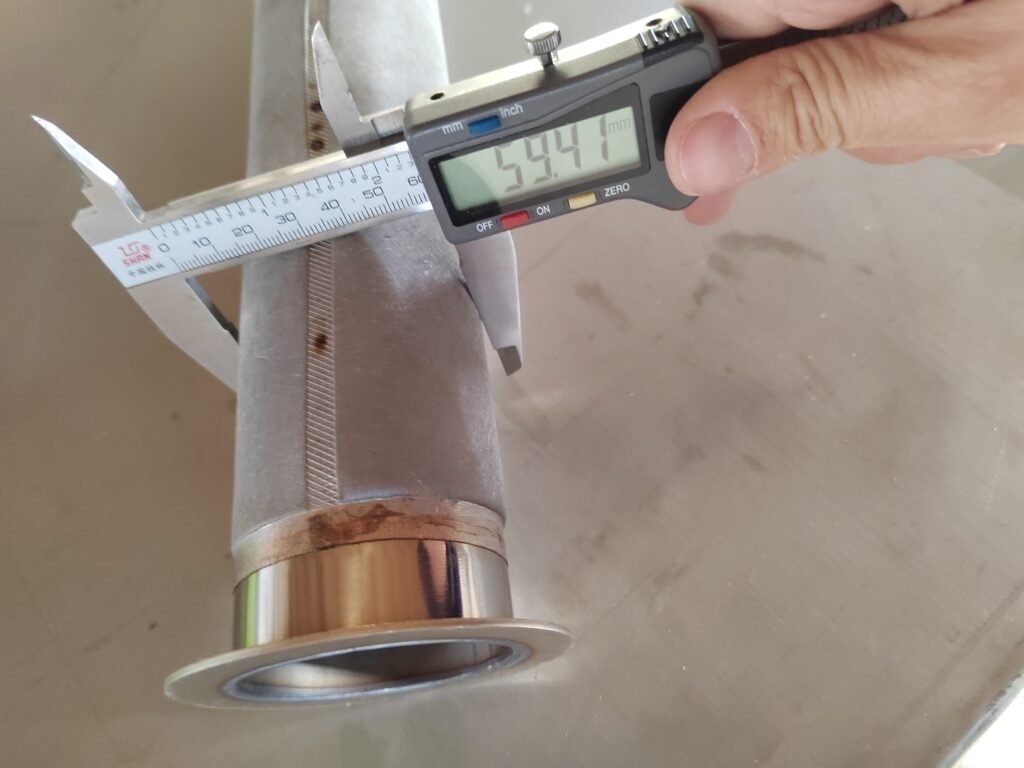
| Does it fit the equipment? | Mating surfaces, location, sealing engagement and space | Installation assessment and open issues |
| Does flow behavior meet the target? | Fluid, temperature, flow, measurement points and configuration | Flow and pressure-loss results |
| Does retention meet the requirement? | Challenge material, method, sampling and acceptance definition | Requirement-linked performance result |
| Does the structure meet the agreed duty? | Load direction, temperature, loading method and criteria | Condition-specific structural evidence |
| Can a cleaned element return to service? | Cleaning procedure and required checks | Comparable before-and-after evidence |
The relevant items, responsible parties and methods can be agreed for the project. Pressure or destructive-loading evaluations require a suitable facility and technically defined procedure; the table is a planning aid rather than operating instructions.
Separating fit, seal and joint evidence
An interface change can be reviewed through three distinct questions: does the element seat and locate correctly, does the intended seal prevent bypass, and does the joint remain acceptable for the specified loading and cleaning? Passing the installation check answers the first question, without automatically answering the other two.
| Changed detail | Evidence to reconsider | Useful retained reference |
|---|---|---|
| Thread, flange, shoulder or groove | Mating dimensions, seating and seal engagement | Equipment interface and drawing revision |
| Media-to-end joint or seam | Applicable joint, leak or integrity assessment | Test boundary, method and acceptance basis |
| Support end or reverse-cleaning duty | Load path and relevant directional structural evidence | Complete assembly and stated loading conditions |
A report should name which boundary was tested. A test of one joint is not automatically a full housing test, and a housing test does not identify a media retention grade. Existing drawings can define most of this work; additional evaluations should resolve actual open requirements. See mesh support and loading directions and finished-cartridge connections for the corresponding construction details.
4. Sample allocation and test sequence
What happens to a specimen in one evaluation can affect the next. Fit checks, contaminant testing, structural evaluation and teardown can require different sample states.
Before allocating specimens, the technical team can identify which activities may contaminate, alter, consume or damage them. That helps avoid discovering that the only available cartridge has already been sectioned when an installation assessment is still outstanding.
Where the same specimen is used at several stages, recording its state before each stage preserves the history. A loaded or cleaned specimen is then described as such, rather than being grouped with unused material.
Sample quantities depend on the purpose, variability, method and project requirements. Development screening, design validation and production acceptance need their own allocation decisions. Retained specimens or controls can be useful when their identity and storage arrangements support later comparisons.
5. A meaningful comparison between designs
Consider a development example in which the medium is unchanged but the pleat arrangement is revised. The question is how the revised construction behaves. It helps to record which inputs remain fixed and which have changed.
A comparison can bring together its purpose, media identity, sample state, geometry, fluid, temperature, flow, measurement boundaries, results and remaining questions. If support or connection details also change, those differences belong in the record.
The result describes the complete tested construction. Where several inputs differ, the report can identify the overall difference without assigning all of it to the pleats or the felt. This example illustrates the planning logic; it is not a Filtalloy test case or performance claim.
Geometric calculations remain useful for checking design inputs. The filter area calculator can help review unfolded area, while measured flow behavior needs its own conditions and evidence. A calculated area and a tested flow result answer different questions.
6. Acceptance criteria and result review
Acceptance criteria give the result a decision context. They can be linked to agreed equipment requirements, an applicable standard or a technical agreement before the evaluation begins.
Some criteria are numerical; others describe observable conditions. For an appearance check, identifying the regions and unacceptable conditions helps different reviewers apply the same rule. “Good appearance” alone leaves more room for disagreement.
If the purpose is to explore behavior and help define the next revision, the activity can be identified as exploratory. Its findings remain useful, with the final acceptance decision scheduled for the requirements that are still open.
When a result is unacceptable, retaining the original observation helps separate measurement issues, sample problems, manufacturing deviations and design questions. The response can then be recorded as further investigation, repeat evaluation, rework or a design change, with a reason for the decision.
7. Evidence after a design change
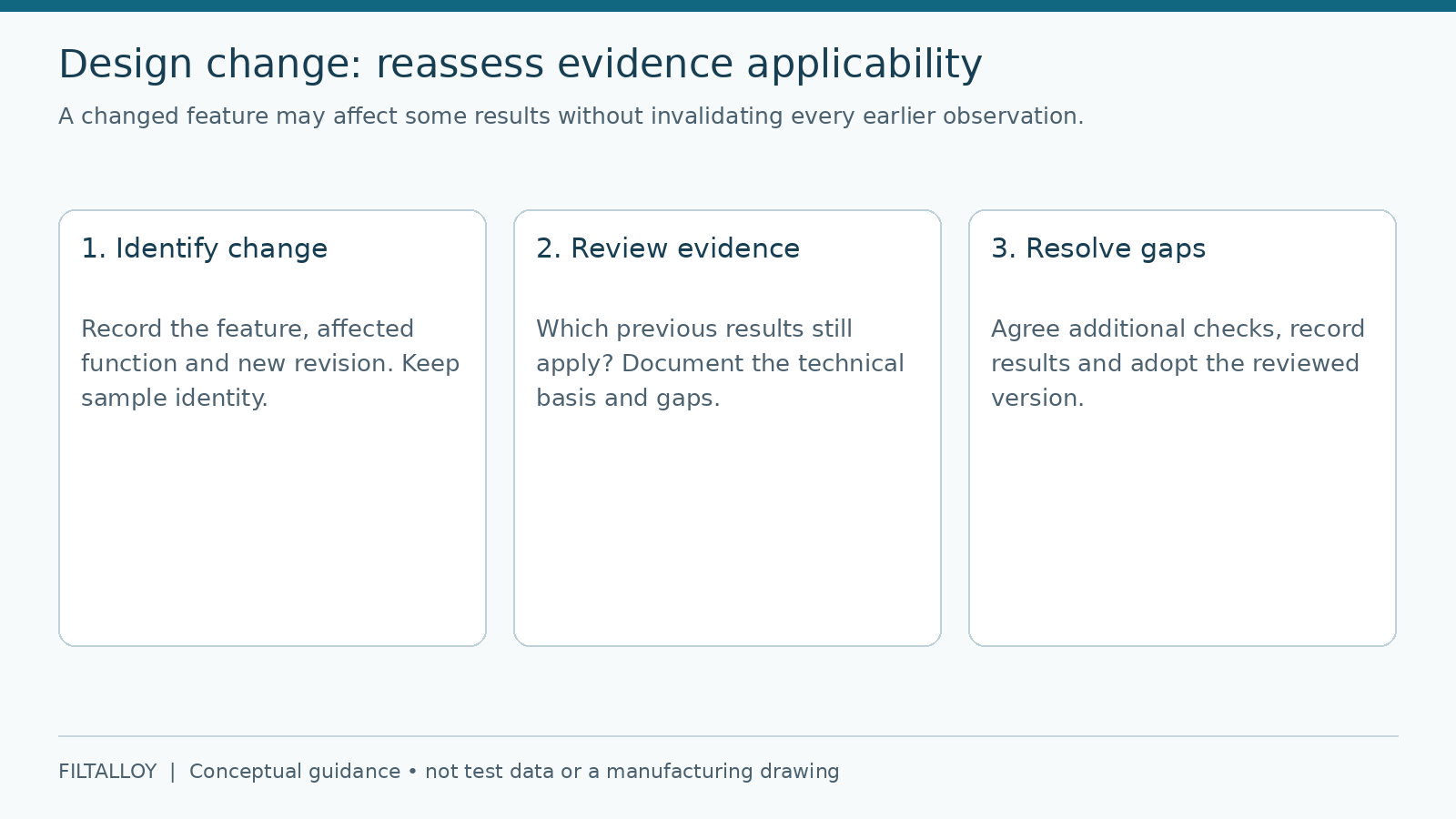
A change review connects the altered feature to the requirements it may affect. This helps determine which earlier evidence remains applicable and where additional work is needed.
For example, unchanged external dimensions may leave some installation evidence useful after a media change, while flow and retention evidence need reassessment. A connection change directs attention to the associated fit and sealing. The project’s technical team determines the actual scope.
A concise change record can state what changed, potentially affected functions, applicable earlier evidence, additional checks and the adopted revision. That gives “some results retained” a traceable basis and keeps it distinct from a claim of fully validated equivalence.
8. From the approved prototype to production
The handover connects the adopted design to the documents and checks used in production. It can include the final drawing and configuration, acceptance criteria, prototype records, resolution of outstanding issues, batch identification, reporting and the process for later changes.
Production inspection needs an agreed scope: which checks apply to individual units, which use sampling and what records accompany delivery. Prototype evidence supports the defined design decision; batch consistency requires the corresponding production controls and records.
If a field trial is included, its operating conditions, observations and endpoint can be agreed beforehand. The useful record explains the duty experienced and the functions assessed, rather than reporting elapsed time alone.
The final conclusion can identify the revision, requirements met, supporting records, applicable conditions and any remaining actions. For replacement dimensions and fittings, our cartridge measurement guide provides related information.
Frequently asked questions
Does every project need a separate forming specimen?
Its value depends on the uncertainty it resolves. Relevant evidence from an established construction may already be available. New media, layers or pleat geometry may justify a local forming evaluation.
Can one prototype be used for every check?
That depends on how each activity changes the specimen. A plan can allocate samples and sequence the checks so contamination, loading or teardown does not invalidate the state needed for a later evaluation.
Can an equal-size fiber felt cartridge replace a woven-mesh cartridge directly?
Matching dimensions addresses only part of the question. A media change needs a review of filtration, flow, support, connections and cleaning requirements, followed by the relevant evidence assessment.
Does pressure-drop recovery establish that a cleaned cartridge can be reused?
It provides information about resistance recovery under comparable conditions. The plan also needs the required structural, integrity and retention checks for the intended return to service.
Does this plan provide standard certification?
It is a project-planning framework. Applicable standards, methods and any certification requirements need to be determined separately for the actual project.
Conclusion
A useful validation plan makes the next decision clear: what remains uncertain, which specimen can address it, what conditions apply and how the result will be assessed. Traceable versions connect media, forming, assembly and service evidence throughout development.
You can share your drawing, existing data and unresolved questions with Filtalloy to discuss the next prototype and the evidence needed. The validation scope follows those questions, rather than a fixed test package for every filter.
Reference context
Porvair’s pleated fiber cartridge data sheet illustrates separate configuration fields for media, fittings, seals and guards. Its brand-specific performance values are not used here. The staged evaluation and change-review framework in this article is engineering planning guidance, rather than a procedure prescribed by that data sheet or a record of completed Filtalloy tests.