By Jack Sun · Updated October 22, 2026
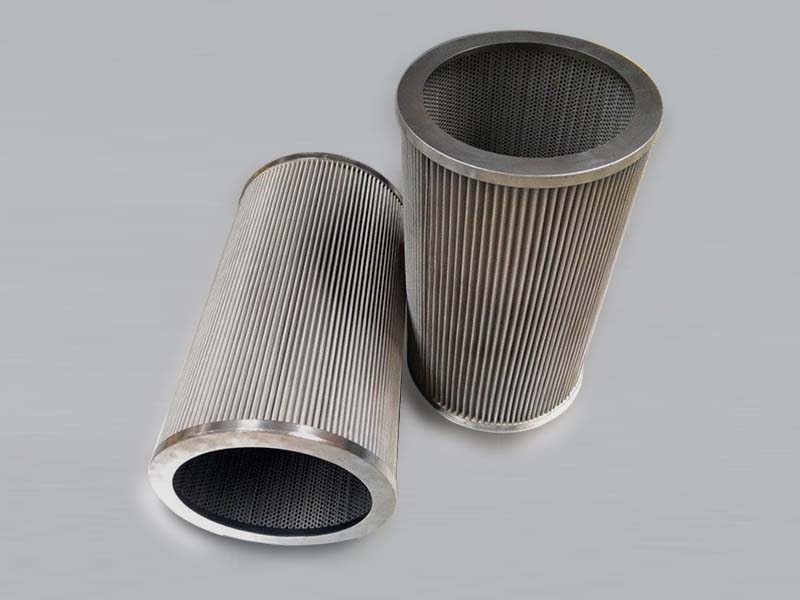
Adding pleats within a fixed cartridge envelope can increase developed media area, but pleat count alone cannot establish a better filter. Flow passages, supports, edge seals and the pleat profile determine how that area can participate in filtration.
The useful design question is whether the extra area remains accessible under the intended flow, loading and cleaning conditions. That connection needs geometry and evidence from the completed structure.
Developed area and effective area
Developed area describes the media dimensions when laid flat. Regions occupied by seals, welds or obstructions may not remain available for filtration, and flow across the remaining pleated surface may be uneven.
There are two related tasks: deduct clearly inactive regions, then assess how the available surface is used in the actual flow arrangement. Dimensions can help with the first; flow or complete-element evaluation may be needed for the second.
There is no universal area-utilization factor for every pleated cartridge. Multiplying all developed areas by an arbitrary fixed percentage hides construction differences.
For example, two cartridges may use the same developed media length, but one has wider edge seals and the other tighter pleat roots. Their unavailable areas and flow passages can differ despite similar nominal area. This is a design illustration, not a Filtalloy test result.
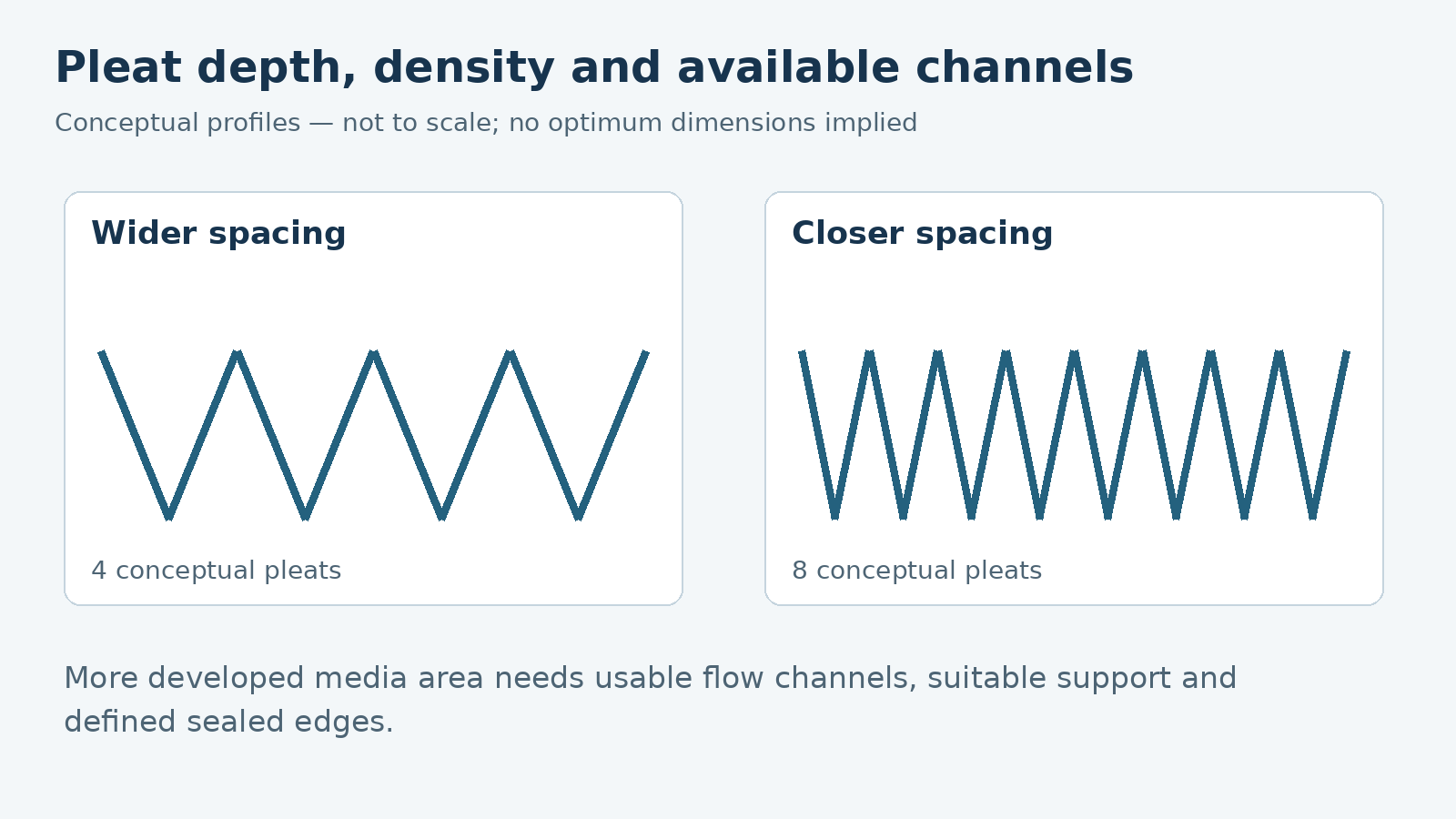
What pleat depth and density change
Pleat depth describes the geometric distance between a peak and valley. Pleat density also needs a defined counting reference. A cylindrical cartridge has different inner and outer circumferences; “pleats per centimetre” can be ambiguous without a stated location.
Increasing depth
Deeper pleats can accommodate more media within the available envelope. They also change the paths by which fluid enters and leaves the pleat channels. The resulting benefit depends on channel opening, support and fluid behavior.
The root and tip need room for real media thickness and adjacent layers. A zero-thickness sharp line on a drawing does not establish a manufacturable fold. Experience with one construction provides a starting point, rather than proving that every thickness and layer arrangement can use the same tooling.
Increasing density
More pleats around the same circumference may narrow the gaps between adjacent surfaces. Close approach or contact can change local flow and loading.
Research on low-height pleated fibrous filters considers geometry, flow and media permeability together. [1] Its materials and geometry are not our metal cartridges, so its optimum dimensions should not be copied into production. The relevant lesson is that a useful geometry depends on operating conditions.
Pall’s metal-fiber polymer-filter information also treats pleat form, surface area and flow distribution as related design features. [2] That is a specific product example, not evidence that one pleat shape suits every fluid.
| Change | Possible benefit | Associated check |
|---|---|---|
| More pleats | Greater developed area | Channel gap, contact and distribution |
| Deeper pleats | More media in an envelope | Flow path, root space and forming |
| Additional support | Shape and spacing control | Obstruction, contact and resistance |
| Wider edge seals | Connection and sealing allowance | Available length and active area |
Matching flow direction and support
Outside-in and inside-out flow create different loading and support relationships. Normal filtration and reverse cleaning should also be identified separately.
Adjacent mesh, a center tube and an outer guard occupy different positions and have different tasks. They should remain separately defined when assessing a replacement or design change.
A support-mesh change can alter total layer thickness, root clearance, assembly dimensions and flow paths even if the felt grade remains unchanged. See whether sintered fiber felt needs mesh support for those component distinctions.
Cleaning adds the question of whether contaminants have a path out of the pleats. More area does not automatically improve cleaning access, and reverse loading is not necessarily equivalent to normal filtration loading. Cleaning direction, connections and supports belong in the same element definition.
Comparing two pleated designs
A comparison needs common conditions. Changing media grade, thickness, pleat count and end construction together can make a measured difference difficult to attribute.
Where practical, hold the medium and interfaces constant while changing a defined group of pleat variables. Record complete dimensions and flow conditions, compare clean-state curves, and add loading, cleaning or structural evaluation when the project requires it.
The comparison must also answer the same question. A replacement with a fixed envelope may be judged at the existing flow and pressure-drop requirement. A new design may compare throughput at a specified pressure drop. Those are different expressions of the design objective.
Initial pressure drop alone does not describe the whole operating cycle. Loading behavior, retention, structural requirements and recovery need appropriate evidence alongside the clean curve.
Use the existing pleated metal filter pressure-drop guide to read measured curves. Use the pleated fiber felt validation plan to organize specimen and assembly checks.
From a drawing to a manufacturable structure
For an existing drawing, begin with its outside diameter, inside diameter, active length, connections and flow direction. Then establish whether the pleats and layer arrangement are defined sufficiently for manufacture and acceptance.
Missing details vary between projects. A clear drawing does not need to be replaced by an unrelated system-design questionnaire. Clarify details that can change the delivered component: whether mesh is included in total thickness, how pleats are counted, the sealed width and the root geometry.
A used sample helps recover observable geometry. It may not establish the original alloy, filtration grade or clean-state performance. Record measurable dimensions first and identify the properties needing other evidence.
We supply pleated metal cartridges and fiber-felt elements to drawings. When geometry changes, sample approval should refer to an identified revision. Conforming flat media alone does not validate every pleated configuration.
Frequently asked questions
Will more pleats make an equal-size cartridge last longer?
Pleat count alone cannot establish that result. Channels, support, contaminants and operating conditions still matter. Durability and cleaning cycles are not simple functions of area.
Does pleating change the filtration rating?
Pleating is a forming operation, not a new rating definition. Formed regions, connections and sealing still need to meet the filtration requirements of the completed element.
Can flat-sheet air data establish the optimum pleat count?
They provide media flow information, but do not contain every cartridge-channel and connection loss. They can support preliminary comparisons, followed by evaluation of the intended construction.
Putting area into the complete structure
Useful pleated design connects media area with channels, support and connections. When considering more or deeper pleats, identify where the added area sits, how fluid reaches it and how contamination leaves during cleaning.
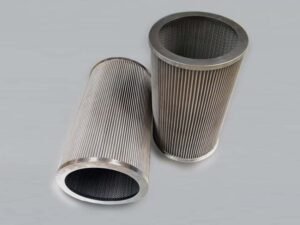
Supply configurations are shown on the pleated metal filter and sintered metal fiber felt pages. For the next operating question, see felt dirt holding capacity and service life.
Technical sources
- Choi et al., Pressure drop and optimization meta-models for arbitrary low-height pleated filter shapes and flowrates, 2021. Research background on coupled geometry, flow and permeability; its optimum dimensions are not metal-cartridge specifications.
- Pall, Ultipleat Plus Fiber Metal Filter. A manufacturer-specific metal-fiber pleat design; its performance claims are not Filtalloy data.
About the author: Jack Sun has long worked in metal wire mesh weaving and industrial filter-element manufacturing. Filtalloy is based in Anping, Hengshui, Hebei, China, known for wire mesh manufacturing.