By Jack Sun · Filtalloy
Choose the shape by tracing the fluid path, then compare exposed porous area, sealing and the space needed for installation and removal.
Flow through discs, cups and cartridges
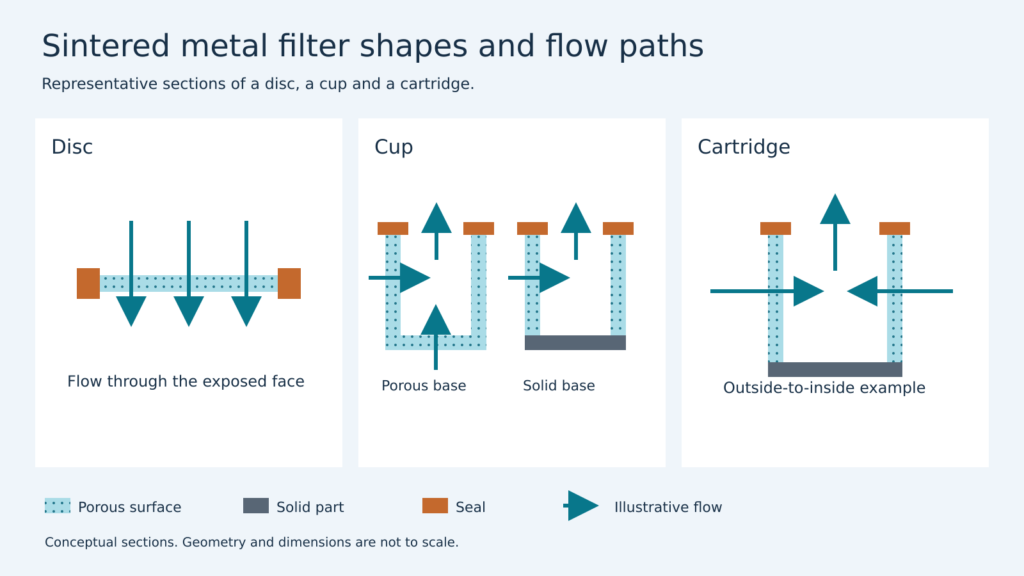
A disc usually passes fluid through the face. A cup may use its sidewall and, where porous and open to flow, its base. A cartridge commonly uses radial flow through the wall. Check which end is open, where the seal separates upstream and downstream, and which direction the support is designed for.
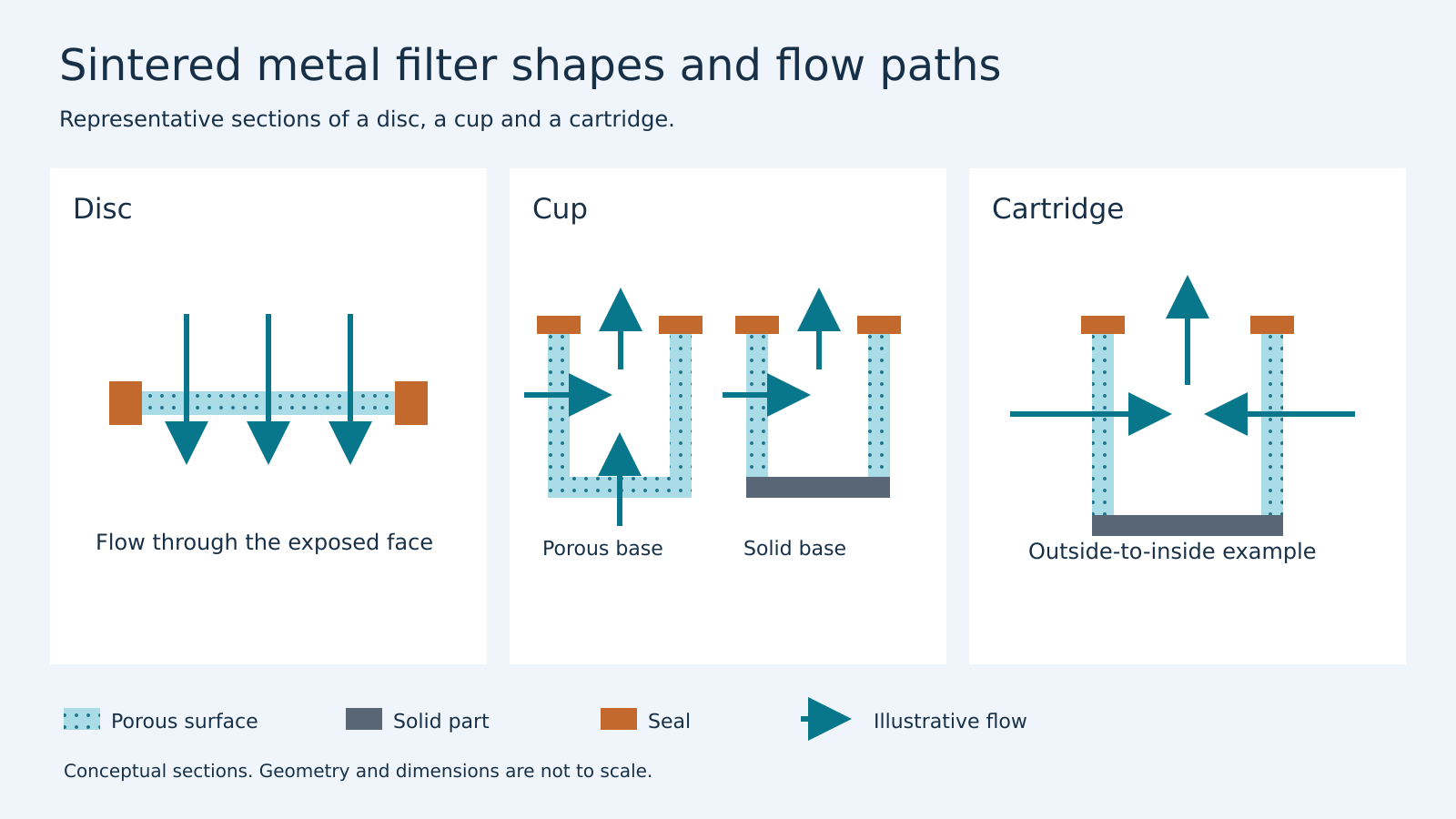
Which area is open to flow?
Use the exposed upstream face as the geometric basis. For a disc, use the diameter left open by the retaining ring. For a cup, inspect the wall and base separately. For a straight cylindrical wall, multiply the upstream circumference by active porous length. Use outside diameter for outside-in flow and inside diameter for inside-out flow. Exclude sealed ends and blocked regions. Filter area calculator
Can a short cartridge replace a disc?
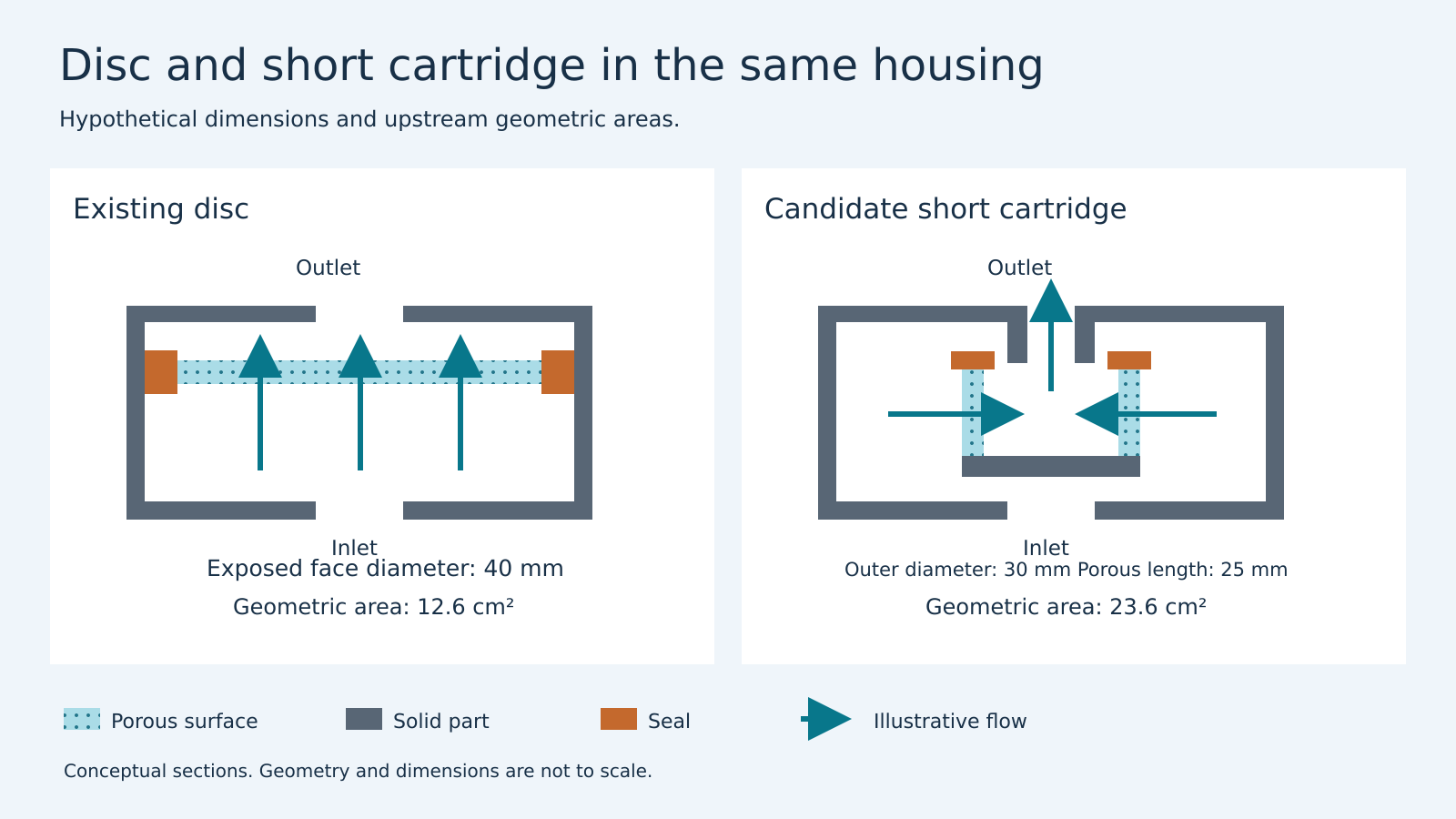
An exposed disc diameter of 40 mm gives about 12.6 cm². An outside-in cartridge 30 mm in diameter with 25 mm of active length gives about 23.6 cm², assuming no other blockage. That is about 1.88 times the geometric area. Check removal clearance, shell gap, sealing, outlet restriction and support, then compare assembly pressure drop at the target flow. These dimensions are illustrative.
Drawings and used samples
Mark the seal, flow direction, porous region, thread or interface and overall dimensions on the drawing. For an old part, photograph the inlet, bottom and mating interface. Use the original specification or testing for material, retention and flow requirements that cannot be established from dimensions.
Frequently asked questions
Does the cup base always filter?
Only when it is porous and has usable flow paths on both sides.
Does a larger area always mean lower pressure drop?
Compare media, wall thickness and assembled flow paths at the target flow.
Powder-sintered porous metal products · How sintered powder filters work
Jack Sun has long worked in metal wire mesh weaving and industrial filter-element manufacturing. Filtalloy is based in Anping, Hengshui, Hebei, China.