By Jack Sun · Filtalloy
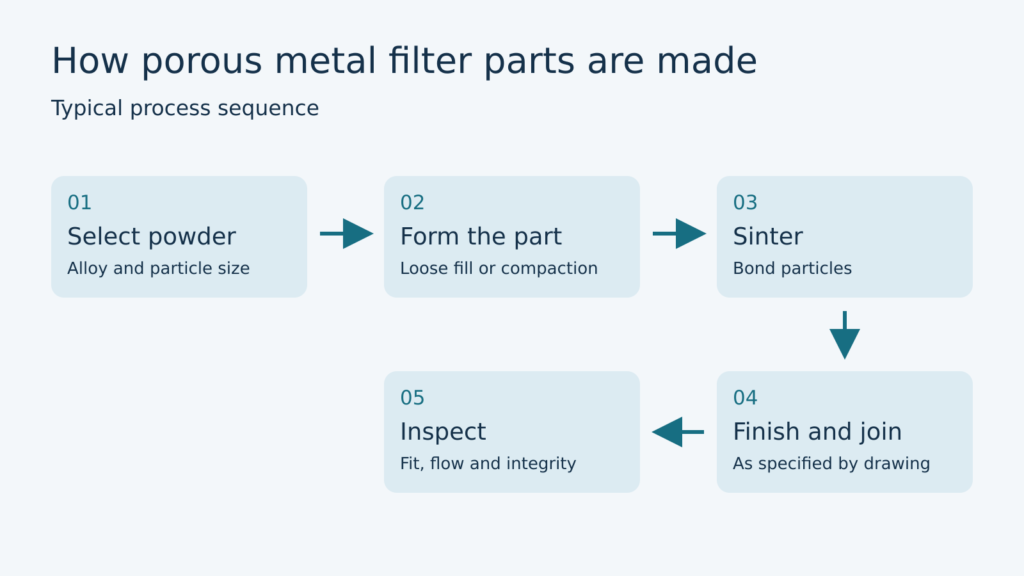
A powder-sintered metal filter starts with metal powder and finishes as a porous part or assembled element. The process has to preserve connected flow paths while meeting dimensions, fitting requirements and the agreed inspection criteria.
Powder and part geometry
Particle size distribution, shape and packing influence the pore network. Powder size alone cannot predict the finished filtration rating. A disc needs controlled thickness and flatness; a thin tube needs consistent wall thickness and enough material at the ends for its connection. Even acceptable inner and outer diameters can hide a locally thin wall, so check wall thickness at the drawing-defined positions where it matters.
Forming and sintering
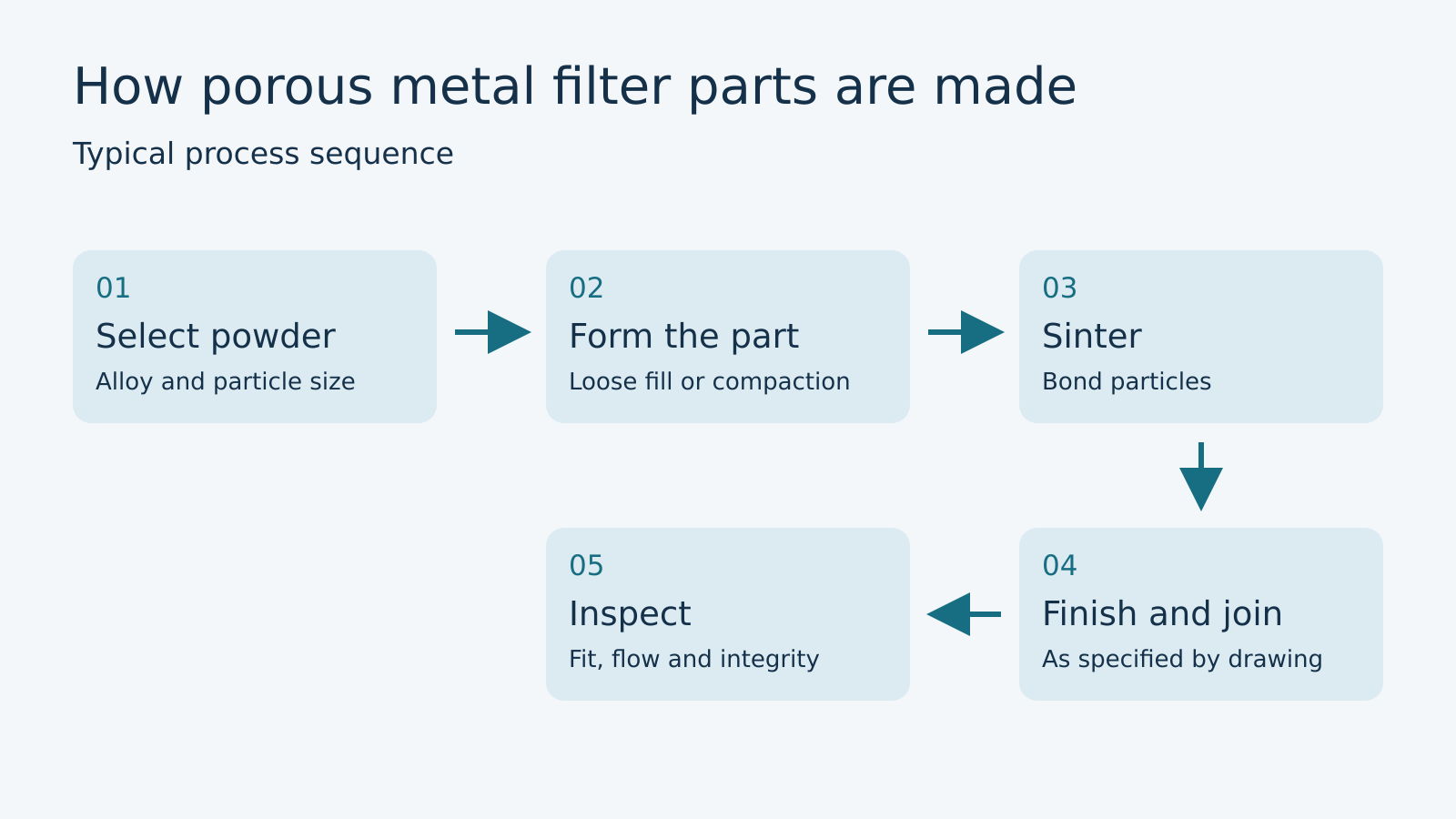
Loose-powder sintering uses a form to hold the powder geometry, while pressing first produces a compact for sintering. Both are general routes. In solid-state sintering, bonds form at particle contacts while interconnected pores remain. Powder distribution, compaction and the sintering cycle affect final dimensions, permeability and strength. Check the first piece after sintering, then repeat the relevant dimensional and flow checks after machining and assembly. Experimental study on sintered 316 stainless steel filters
Machining and joining
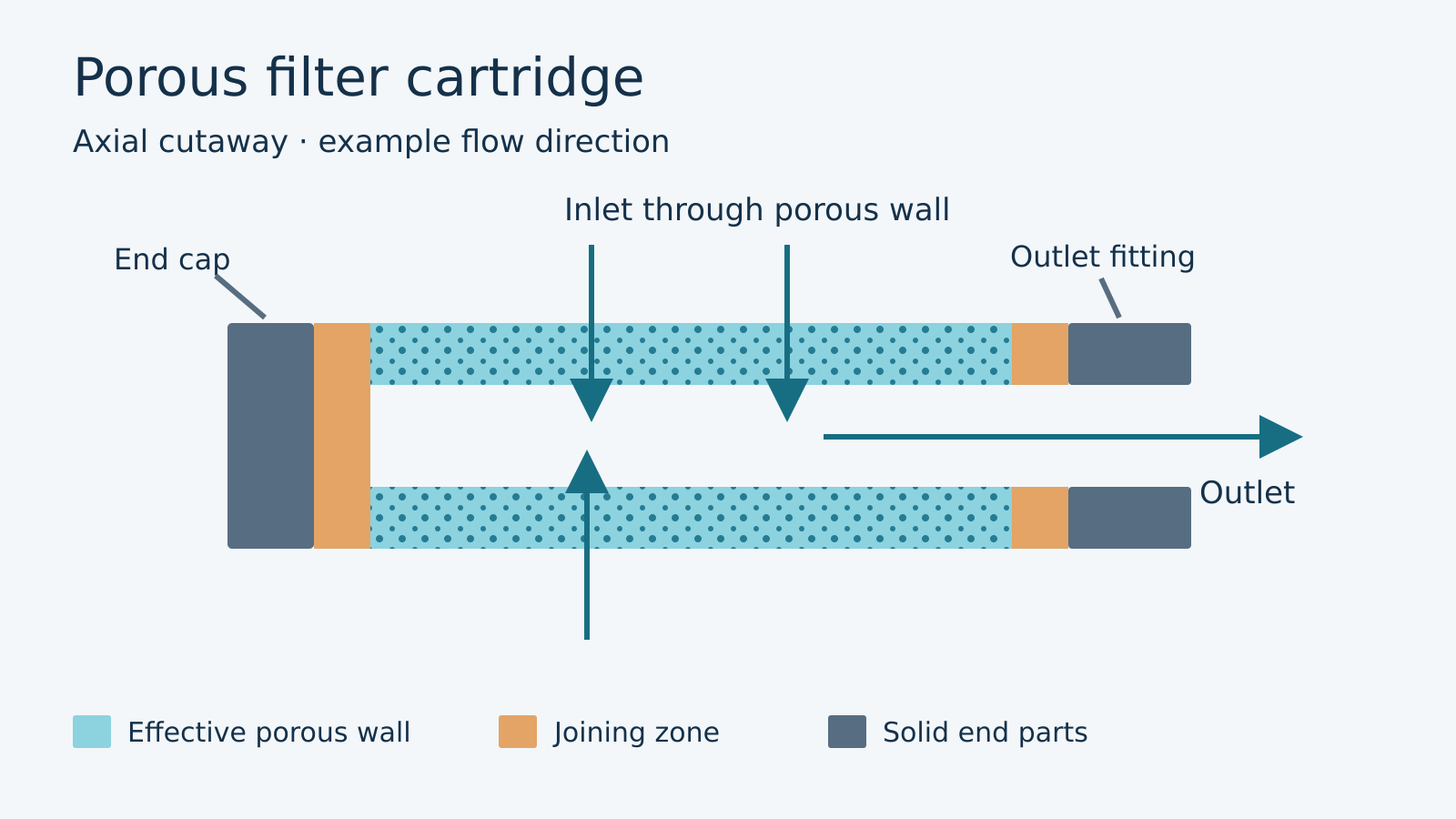
Mark the effective porous zone and the areas permitted for trimming, machining and joining. Machining a locating surface is different from machining an active porous face, where smearing or debris can restrict flow. Inspect the transition between the porous wall and solid fitting for potential bypass paths. Shortening a solid fitting mainly changes fit; removing part of the porous wall can also reduce the active area.
Final inspection
Separate dimensional and visual checks from flow resistance, integrity and particle retention. Record whether flow testing covers a media specimen or the finished element with its fittings. If a coupon passes but an assembly shows high resistance, compare fixture boundaries, exposed area, joint regions and the outlet passage. ISO 4022:2018 addresses fluid permeability of applicable permeable sintered metal materials. ISO 4022:2018
Frequently asked questions
Can the same outside dimensions establish an equivalent replacement?
Check the connection, sealing surface, effective porous length and flow direction, then verify material and performance.
Can a flow test establish filtration rating?
Use a suitable particle challenge and the agreed efficiency or retention criterion to verify that requirement.
Powder-sintered porous metal products · How sintered powder filters work
Jack Sun has long worked in metal wire mesh weaving and industrial filter-element manufacturing. Filtalloy is based in Anping, Hengshui, Hebei, China.