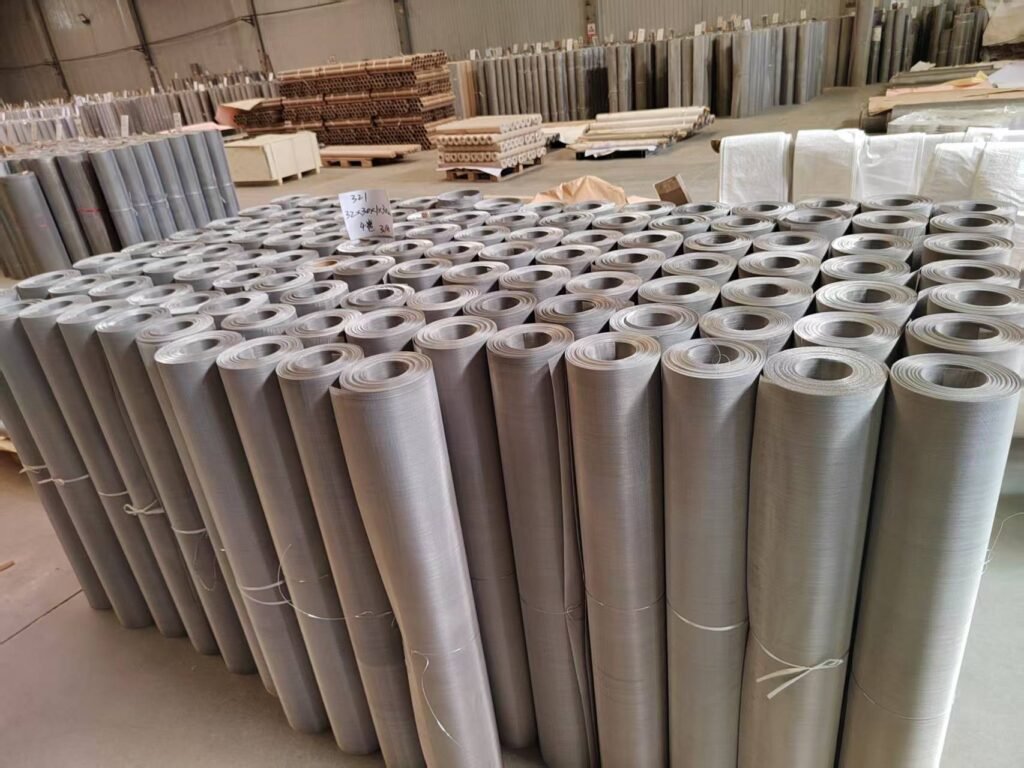
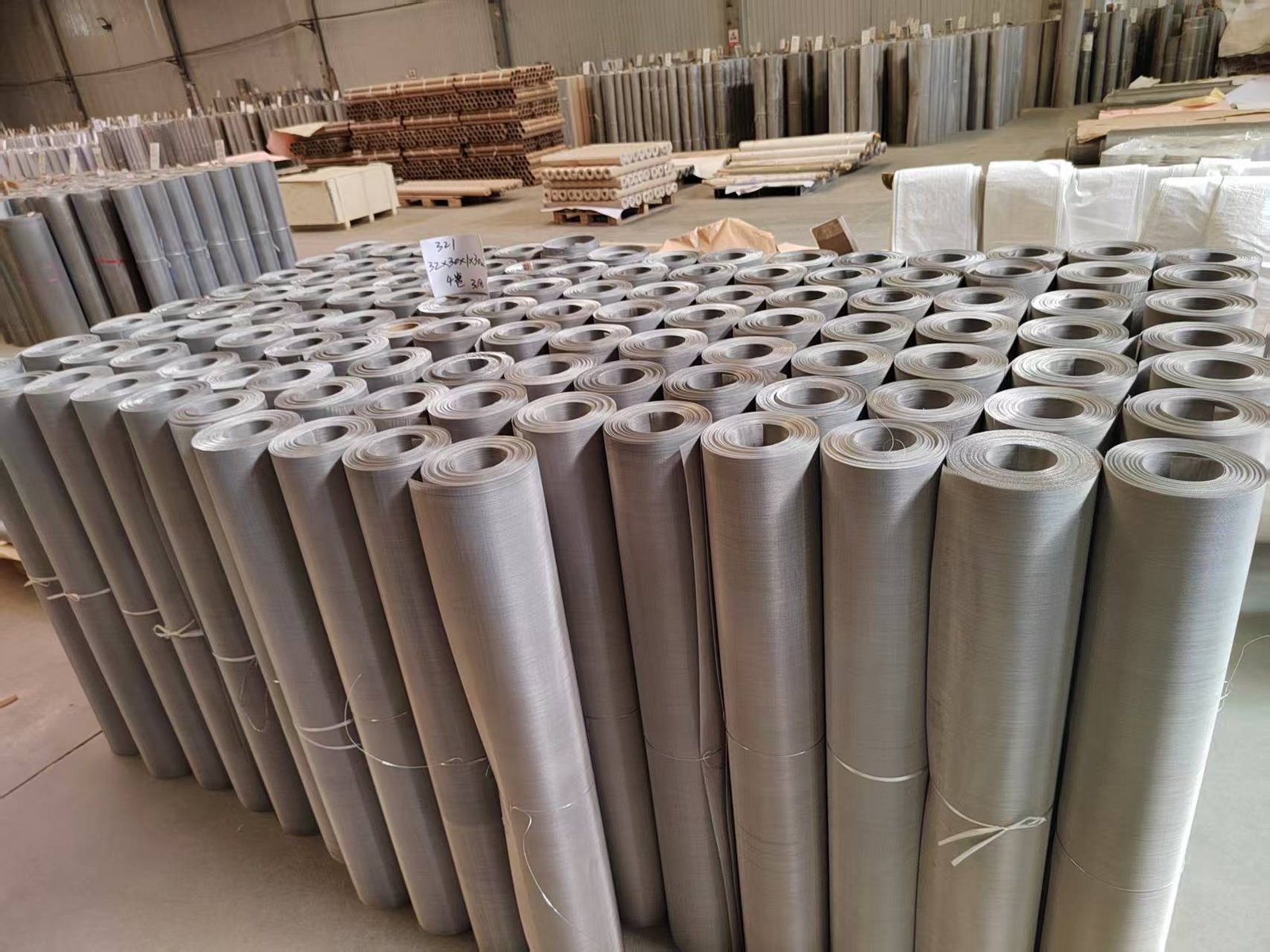
Woven wire mesh, also called wire cloth, is made by interlacing warp and weft wires. It can serve filtration, screening, support, protection and fluid-processing duties. Performance depends on aperture, wire diameter, open area, weave, material and the finished assembly.
Two customers ask for ‘316L, 100 mesh’. One needs low-viscosity liquid prefiltration; the other filters hot polymer melt. Their flow, pressure-drop, cleaning, thermal-cycle and assembly requirements can be very different.
Begin with the medium and equipment, then choose material, weave, aperture and wire diameter. Finally define the sheet, disc, screen pack, cylinder or complete component.
By Jack Sun. Our company is based in Anping County, Hengshui, Hebei, China, a center of the wire mesh industry. Jack Sun has long worked in wire mesh weaving and industrial filter manufacturing. This guide explains how manufacturing and purchasing requirements connect; product performance must be verified for the intended conditions.
1. Woven Mesh and Related Structures
Warp wires run longitudinally and weft or shute wires run across them. Aperture w is the clear distance between neighboring wires; pitch p is their center-to-center distance. For an equal square mesh, p=w+d, where d is wire diameter.
For mesh count M expressed as nominal pitches per linear inch and d in mm, w≈25.4/M−d. For equal square apertures, OA=[w/(w+d)]²×100%. Confirm the counting convention. These relationships do not directly describe Dutch weave, distorted apertures or unlike warp/weft parameters, and do not calculate efficiency.
Welded mesh uses welds at intersections; knitted mesh uses interlocking loops; perforated metal has holes made in sheet. Select the structure by function, stiffness, flow paths and fabrication. Do not transfer performance data between them.
2. From Conditions to a Specification
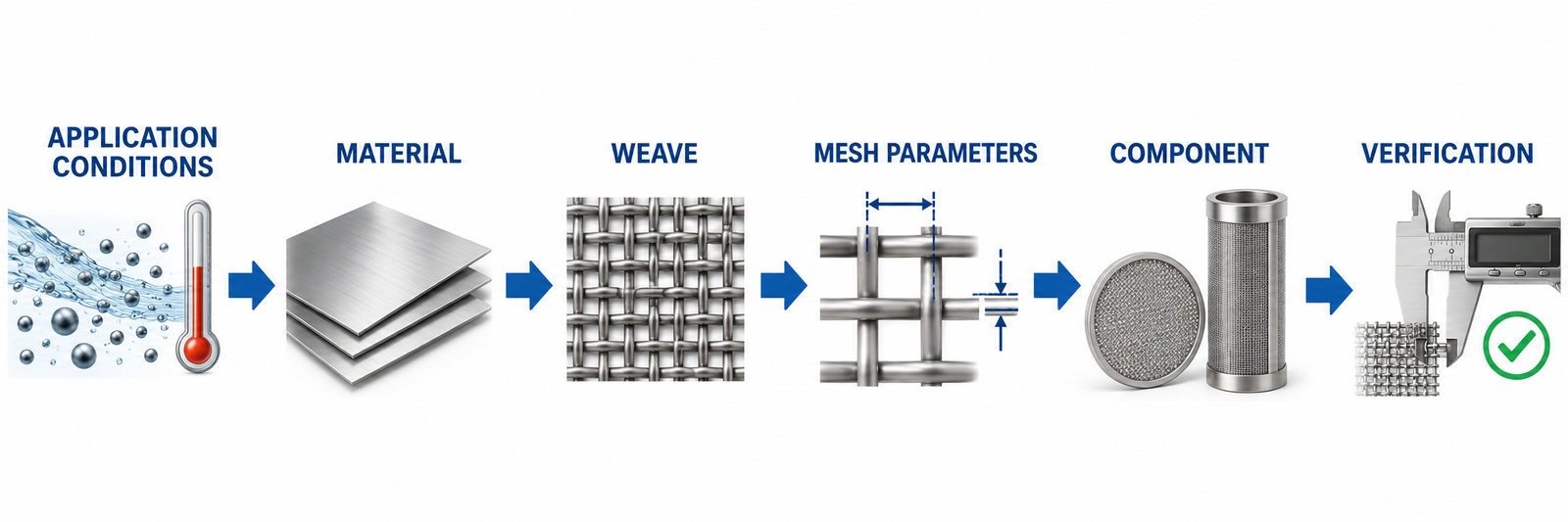
- Medium: liquid, gas, powder, granules or high-viscosity melt, including corrosive constituents.
- Particles: size distribution, shape, hardness and the required separation or protection.
- Operation: temperature, pressure, flow, allowable differential pressure and duty cycle.
- Maintenance: backflushing, ultrasonic, chemical or thermal cleaning, and reuse requirements.
- Form: roll, cut sheet, stamped disc, welded cylinder or multilayer assembly.
- Verification: material, wire diameter, aperture, defects and finished dimensions.
This sequence turns an application request into an executable specification. It helps distinguish a suitable sample from a stable production solution.
3. Industrial Filtration Applications
Liquids and process gases
Wire cloth can provide prefiltration, downstream protection or support layers in a filter. Fine media provide retention while coarse layers or perforated structures provide support. Balance retention, flow area and mechanical stability.
For loading fluids, assess particle embedding, cleaning and allowed pressure rise. Pressure pulses and backflushing also make media-to-frame and support connections important.
Chemical and petrochemical service
Assess acids, alkalis, solvents, chlorides and temperature with concentration and exposure duration. 304 and 316L are candidates rather than universal solutions. Frames, edge treatments, supports and welds must be compatible with the medium.
Polymer melt filtration
Screen packs in extrusion, pelletizing and film production combine fine filtering layers with coarse supports. Melt viscosity, temperature, layer order, seal edges and change intervals affect pressure rise and retention. Deformable gels can pass through openings; geometric aperture is not an absolute boundary for every melt contaminant.
Oil and gas service
Wire cloth can be evaluated for instrument protection, lubrication, pretreatment and sand-control assemblies. Sand control needs formation-particle data, erosion assessment, support and end connections. A general mesh roll specification does not establish a qualified sand-control screen.
4. Screening, Protection and Specialty Uses
Screening depends on aperture distribution, wire diameter, tension, particle shape and moisture. Long particles may pass in favorable orientations; sticky powders can blind openings. Confirm performance with representative material.
Standard test sieves require their own wire cloth and frame requirements. General industrial mesh compliance does not establish test-sieve compliance.
Food and pharmaceutical equipment also require suitable material documents, surface condition, cleaning, hygienic design and market-specific requirements. Stainless steel alone does not establish a food or pharmaceutical grade.
Automotive, aerospace and machinery uses can include intake protection, lubrication filtration, ventilation and electromagnetic shielding. Validate shielding for the complete assembly with frequency range, conductivity, grounding and seams. Flame arrest requires a qualified complete device for the medium and installation; mesh count alone cannot establish flame-arrester performance.
Heavy mining screens with severe impact and abrasion may need thicker wire or purpose-built screening products beyond fine industrial wire cloth.
5. Weave Types and Materials
| Weave | Selection considerations |
|---|---|
| Plain | Alternating over/under interlacing; common square-aperture screening and general filtration. |
| Twill | Commonly two over/two under; can accommodate relatively thicker wire in certain fine-mesh combinations. |
| Dutch | Unlike wire diameters or densities create tighter, tortuous flow paths; use defined specifications and retention tests. |
Weave type does not independently determine filtration rating. Dutch weave cannot use a simple square-aperture formula to establish a micron rating.
Choose 304, 316L or another exact alloy against temperature, corrosion, cleaning and mechanical requirements. 316L can offer advantages in some chloride-containing environments, but does not guarantee suitability for every acid, seawater exposure or high temperature. State the material standard or composition basis.
6. From Rolls to Finished Components
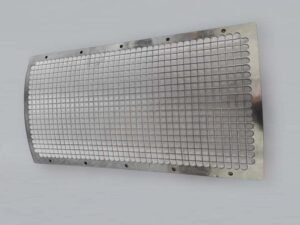
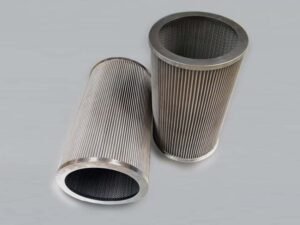
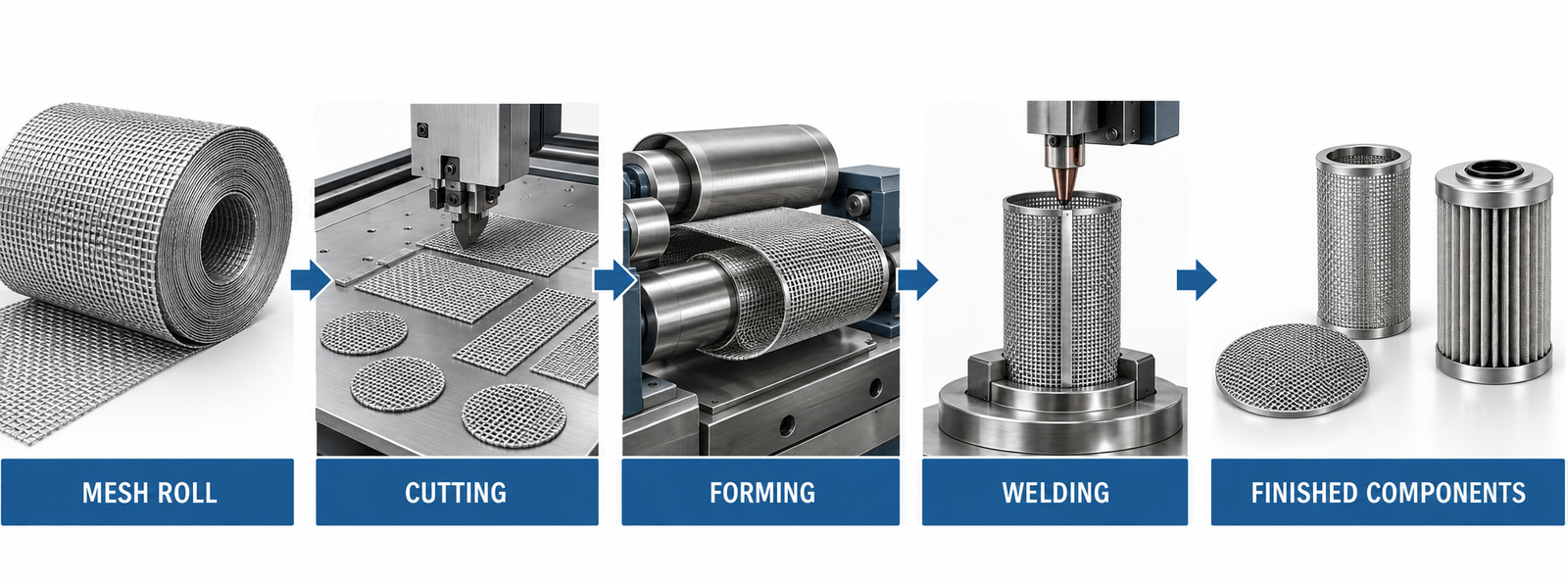
Customers may need slitting, cutting, stamping, forming, welding and edge treatment to produce discs, screen packs, cylinders or framed mesh.
Each step introduces new controls: burrs and dimensions during cutting, loose wires at stamped edges, roundness and seams during forming, strength and heat effects during welding, and layer order in screen packs. Freeze the component drawing and inspection plan before production.
A conforming roll is only one input to a conforming assembly. Evaluate connections, support and sealing in the final operating state.
7. Common Selection Mistakes
| Mistake | Better requirement |
|---|---|
| Only mesh count | Give wire diameter, aperture and weave as well. |
| Smallest possible aperture | Balance contaminants, flow, pressure rise and cleaning. |
| Only media material | Check all wetted parts and joining materials. |
| Ignore finished geometry | Provide drawing, tolerances and connection requirements. |
| No operating validation | Use actual or representative fluid and loading conditions. |
8. Quality Verification and Purchasing Checklist
ISO 9044:2016 concerns technical requirements and tests for industrial square-aperture woven wire cloth. Its scope excludes after-weaving coated cloth, precrimped and welded screens. Non-screening use can require additional agreed requirements. It is not universal certification of Dutch-weave ratings or fabricated filters.
For metal-wire test sieves, confirm the applicable requirements separately, such as ISO 3310-1:2016.
- Exact material and traceable documents.
- Wire diameter, aperture/count and weaving defects.
- Surface contamination, edge condition and overall dimensions.
- Disc diameter, cylinder roundness, length and seams.
- Layer count/order, marking and packaging.
- Measurement methods, sampling and acceptance criteria.
For purchasing, add equipment, medium, particles, flow, temperature, pressure-drop limit, cleaning, quantity and delivery needs. Where information is incomplete, a sample and failure history can establish what still needs confirmation.
9. Frequently Asked Questions
Does a higher mesh count guarantee finer filtration?
No. Wire diameter and weave also matter. The same count can give different apertures and open areas; Dutch-weave behavior cannot be described by square-mesh count alone.
Can I order by a micron value?
Clarify whether it means geometric aperture, required particle retention or a tested rating. These are different specification concepts.
Should I buy rolls or finished components?
Rolls suit buyers with controlled cutting, joining and inspection. Finished components can be more useful when forming, sealing and assembly are the main risks.
What must be fixed after a sample passes?
Freeze material, wire, aperture, weave, final dimensions, inspection methods and packaging identification. Keep the accepted sample or records as the batch reference.
10. Conclusion and References
Reliable woven wire mesh applications connect operating conditions to material, weave, mesh parameters, finished structure and consistent verification. Supplying actual conditions early reduces mismatched specifications and repeat prototyping.
Explore woven wire mesh, extruder screens and fabricated mesh filters. Scope references: ISO 9044:2016 and ISO 3310-1:2016. These references do not establish certification or efficiency for every product.
Discuss Your Woven Mesh and Filter Component Requirements
- Application-based customization: provide operating conditions, installation space and functional targets to establish an initial specification and prototype.
- Drawing-based customization: provide materials, dimensions, tolerances, connections and agreed acceptance requirements.
- Sample-based customization: provide the existing part and mating components; evaluate wear, contamination and permanent deformation before confirming a replacement.
Related Guides
Application-specific guides: chemical process filtration, polymer melt filtration and oil and gas filtration explain the operating information and component checks for each duty.
Engineering and manufacturing questions: compare mesh count and micron openings, Dutch weave structures and open area and pressure drop; then review manufacturing defect prevention and production quality control.