
By Jack Sun · Updated October 22, 2026
Dirt holding capacity describes contaminant capacity under defined test and endpoint conditions. Service life describes how long a filter operates in a particular duty. The two are connected, but they are different quantities.
A value in mg/cm² invites a simple calculation: multiply by area, then divide by daily contaminant load. That can express a mass-balance planning assumption. Its usefulness depends on whether the reference test, contaminants, operating conditions and stopping criterion match the application.
The first question is what the capacity test actually measured, which specimen it represents and why it ended.
Why the test endpoint matters
A capacity result needs its test object, contaminant and endpoint. Two results in mg/cm² can use different feed methods, fluids, face velocities and terminal differential pressures.
Terminal differential pressure identifies an agreed stopping condition. It is different from an element’s structural pressure limit and is not automatically the replacement setting for every installation.
A test allowed to continue to another endpoint may accumulate a different contaminant mass. Align the endpoint when comparing results, and confirm that required particle control is retained during loading.
ISO 16889:2022 places contaminant capacity, particle removal and differential-pressure characteristics within a hydraulic-element multi-pass test framework. [1] Its scope illustrates the connection between capacity and test definition. It does not make that hydraulic procedure directly applicable to every felt, gas filter or polymer melt.
The mass definition also matters. Cumulative injected mass, capacity calculated through a test-system method and directly measured retained mass may have different definitions and corrections. An arbitrary feed record should not be relabelled as actual mass held by the element.
Why porosity and thickness cannot replace a capacity test
Void volume helps describe structure, but does not fully describe where contaminants accumulate or how blockage develops. Particles may form a surface layer or enter the depth, and their size, shape and adhesion can change loading behavior.
Two felts with similar thickness and porosity therefore need not have equal capacity. More void space cannot simply be converted into an equal volume of stored contamination: a limiting condition can occur before every void is filled.
Initial pressure drop is also a different measurement. It describes clean resistance; capacity evaluation must consider what happens as contaminants are introduced.
Pall’s metallic-media guide relates structure and application requirements to media selection. [2] It offers comparison context, not a universal porosity-to-capacity equation or a Filtalloy test table.
Relating flat-media data to element area
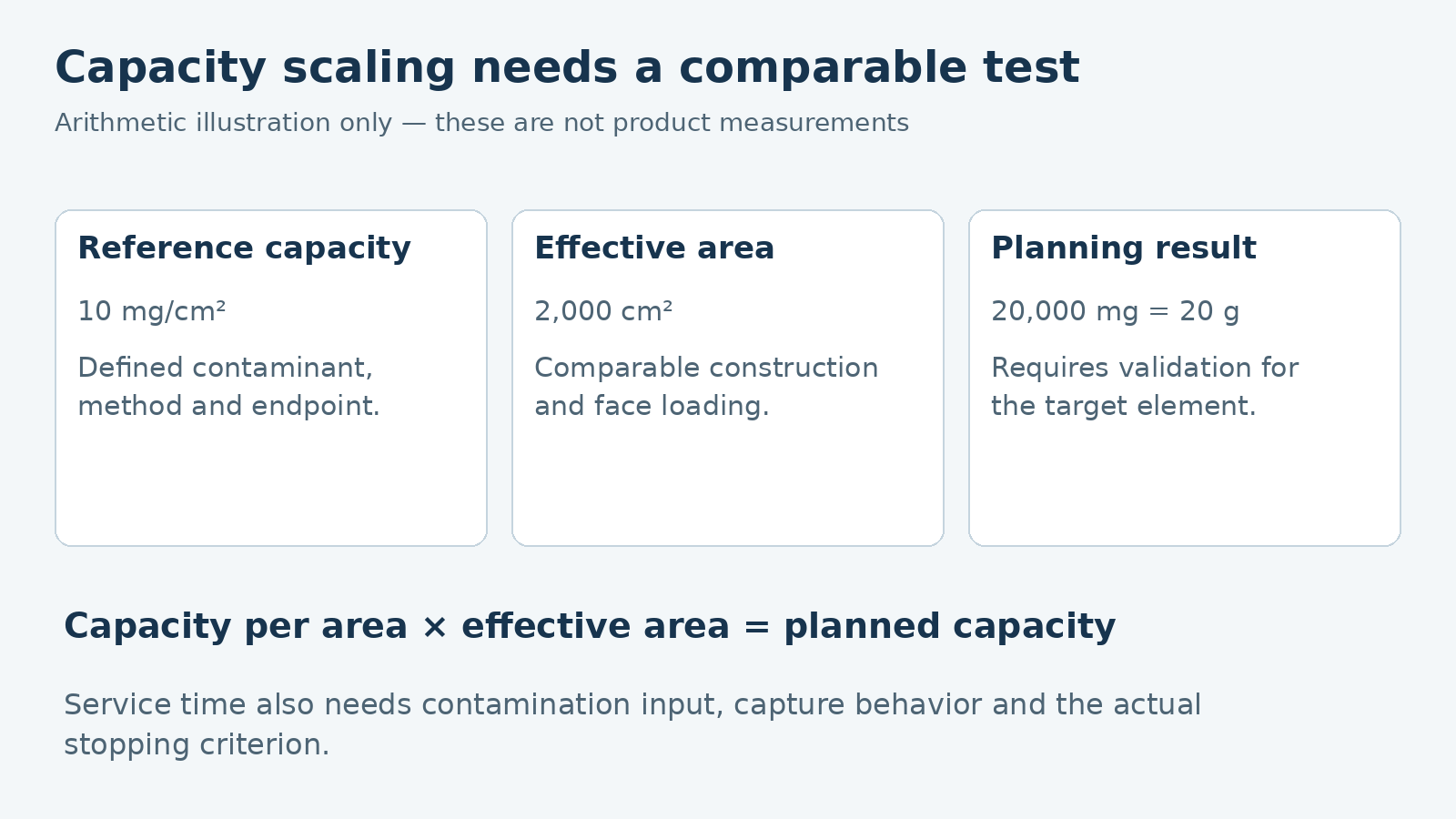
Area scaling can support preliminary planning when the reference and target have comparable material, construction and test conditions, and there is a defensible reason to expect comparable behavior per effective area:
Planned capacity = comparable reference capacity per unit area × target effective area.
For an arithmetic illustration, assume a valid reference result of 10 mg/cm² and a target effective area of 2,000 cm². Their product is 20,000 mg, or 20 g. These are assumed inputs, not Filtalloy measurements or a guaranteed cartridge capacity.
Before applying this relationship, check:
- Media grade, thickness and support construction.
- Contaminant, fluid, temperature and face velocity.
- Endpoint and particle-retention requirements.
- Inactive seals and obstructions, plus acceptable flow distribution.
Changing pleat density, passages or media grade can change the assumptions as well as area. A complete cartridge can load differently from a flat specimen and may need corresponding validation.
Our measured filter holding capacity calculator performs area planning from a comparable measured reference. It cannot generate capacity from the material name or porosity.
Why capacity does not directly give operating days
Operating time also depends on contaminant arrival rate, capture behavior, changing flow and maintenance criteria. Even reliable capacity data do not establish a constant rate of capacity consumption in service.
A mass balance can connect an available capacity with mass retained per unit time, but the latter requires application evidence. Inlet concentration multiplied by volume flow initially describes incoming mass rate. Not all incoming material is necessarily retained with the same efficiency or produces the same blockage.
A filter can also stop being useful for another reason: an operating pressure-drop limit, unacceptable downstream quality, damaged connections or a planned cleaning event may occur before the assumed capacity is reached.
Laboratory capacity is therefore useful for comparison and planning. Operating time should be developed from comparable service records: initial pressure drop, flow, temperature, elapsed time and the actual cleaning or replacement trigger.
If pressure drop becomes abnormal, use the metal filter troubleshooting guide to consider instrumentation, fluid changes, flow and element condition before attributing every rise to insufficient capacity.
Comparing two felt constructions
The objective may be longer operation at equivalent particle control, or more throughput within a fixed envelope. Define that objective before selecting the comparison.
| Evidence | Basis to align or identify | Question it helps answer |
|---|---|---|
| Clean resistance | Fluid, temperature, face velocity and pressure taps | Flow cost at startup |
| Loading curve | Contaminant, feed method and endpoint | Resistance growth during loading |
| Particle removal | Particle-size and measurement definitions | Whether the filtration task is met |
| Post-cleaning condition | Cleaning procedure and retest conditions | Recovery after that procedure |
A larger capacity may reflect another grade or a more permissive endpoint. Lower initial resistance may leave loading behavior unanswered. Retaining those results together gives a clearer account of the tradeoff.
An existing drawing, specification or supplier report can start the discussion. Where two tables are not comparable, clarify the fields that affect the decision, rather than imposing every possible test on every project.
Frequently asked questions
How do mg/cm² and g/m² compare?
1 mg/cm² equals 10 g/m². That is only a unit conversion; capacity definitions and test conditions still need to be checked separately.
Will doubling area double service life?
It cannot be guaranteed from area alone. Distribution, face loading, contaminants and the maintenance endpoint may change even where scaling is useful for planning.
Does cleaning fully restore capacity?
That requires suitable loading or application evidence. Pressure drop close to the initial value shows resistance recovery under comparable conditions, not automatic recovery of capacity, efficiency and integrity.
Using capacity as defined evidence
Useful capacity data retain the specimen, contaminant, method and endpoint. They can support media and construction comparisons. Combined with service contamination and operating limits, they can help plan maintenance.
See sintered metal fiber felt for supply forms and specifications and test data for parameter definitions. For reusable elements, continue with felt cleaning and reuse.
Technical sources
- ISO 16889:2022 — multi-pass filtration performance evaluation of hydraulic filter elements. Public scope; no reproduction of the full procedure.
- Pall, Porous Inorganic Media Guide. Media-selection context; manufacturer claims and numerical data are not Filtalloy results.
About the author: Jack Sun has long worked in metal wire mesh weaving and industrial filter-element manufacturing. Filtalloy is based in Anping, Hengshui, Hebei, China, known for wire mesh manufacturing.